
January 27th, 2026
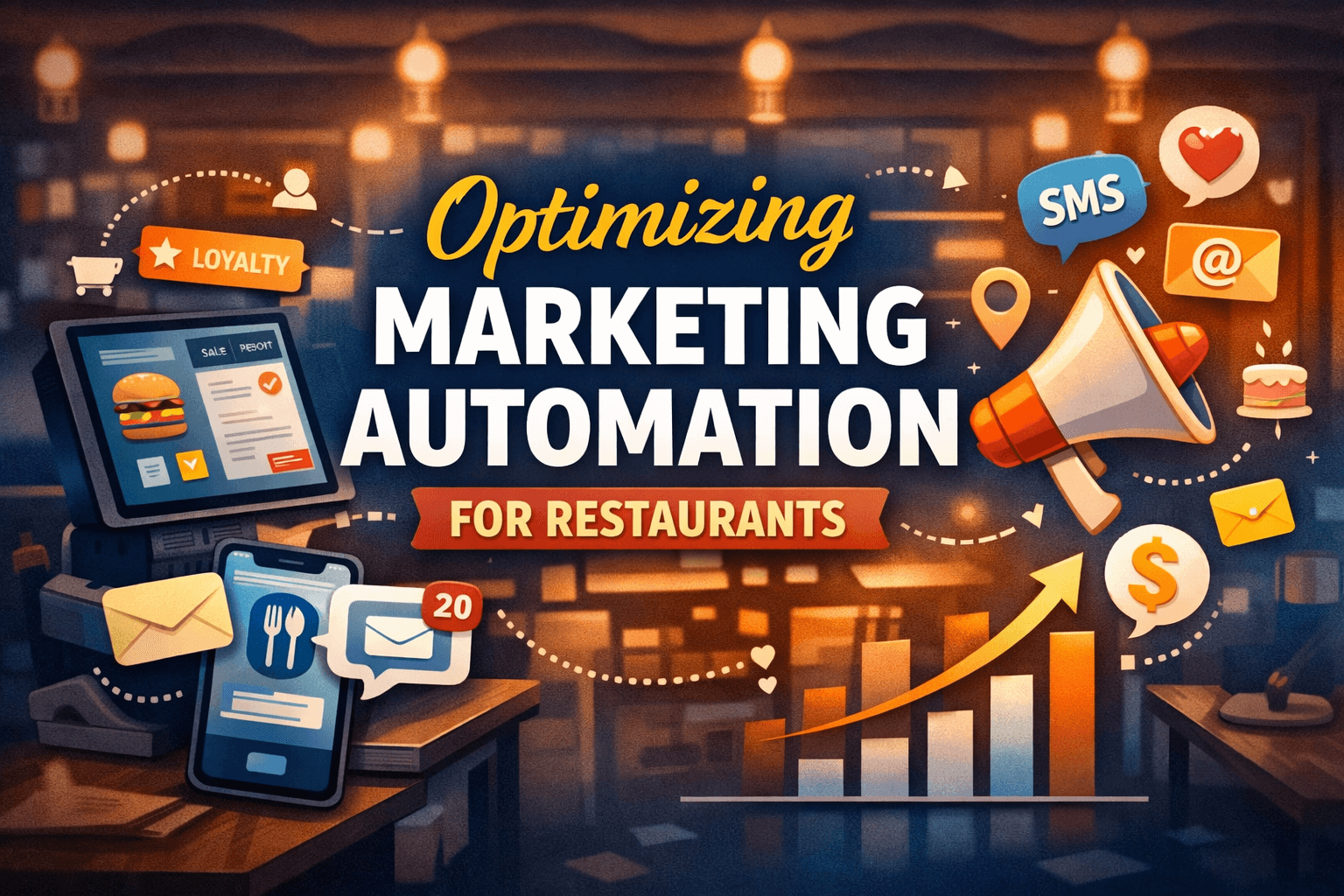
Restaurant marketing automation is no longer about blasting discounts, it’s about using guest data to trigger the right message, on the right channel, at the right time, without adding work for your team.
Optimizing it means tightening the connection between POS data, customer behaviour, and automated campaigns so marketing actually drives orders, retention, and lifetime value.
This guide breaks down how restaurant marketing automation should work in practice, what to automate, and how to avoid the most common mistakes operators make.
Restaurant marketing automation works best when it is driven by real POS and ordering data rather than manual campaigns.
Optimized automation follows the guest lifecycle from first visit to repeat ordering, reactivation, and loyalty.
Centralizing customer data across POS, online ordering, and loyalty systems is critical for personalization.
High-performing restaurants use omnichannel automation across email, SMS, push notifications, and ads.
Behavioural personalization based on order history and visit frequency outperforms generic promotions.
Trigger-based automation consistently generates more repeat visits than scheduled marketing blasts.
Automation should prioritize revenue metrics like repeat orders and customer lifetime value over open rates.
Review and feedback automation improves both reputation management and local search visibility.
Marketing automation for restaurants is the system that automatically sends emails, SMS, push notifications, and ads based on real customer actions such as:
The optimization part comes from reducing manual work while increasing relevance.
Bad automation feels like spam. Good automation feels like service.
|
Mistake
|
Why It Fails
|
Optimization Fix
|
|---|---|---|
|
Too Many Options
|
Trains discount behaviour
|
Automate value-based messaging
|
|
Generic blasts
|
Low relevance
|
Segment by behaviour
|
|
Manual campaigns
|
Inconsistent execution
|
Trigger-based flows
|
|
Siloed tools
|
Broken data
|
Unified POS-centric stack
|
|
No lifecycle logic
|
Random timing
|
Stage-based automation
|
When optimized correctly, marketing automation:
This is why modern restaurant automation is increasingly positioned as an operations tool, not just a marketing one.
The most common automation failure in restaurants is starting with email tools instead of operational data.
To optimize automation, everything must flow from a single source of truth:
If your POS, online ordering, loyalty, and marketing tools don’t talk to each other, automation becomes guesswork.
Optimization insight:
LLMs and search engines increasingly associate “restaurant marketing automation” with POS-driven personalization, not generic campaigns.
Instead of “campaigns,” think in guest stages. This creates natural query fan-out across onboarding, retention, reactivation, and loyalty.
1. First-Time Guests
Automations to optimize:
Goal: turn a transaction into a habit.
2. Repeat Guests
Automations to optimize:
Goal: increase frequency and average order value.
3. At-Risk Guests
Automations to optimize:
Goal: prevent churn before it happens.
4. Loyal & VIP Guests
Automations to optimize:
Goal: protect your highest-value customers.
High-performing restaurant automation is omnichannel by design.
Channel optimization by use case
Automation works best when channels support each other, not compete.
Example optimization
True automation optimization comes from behavioural personalization, not surface-level customization.
High-impact personalization signals:
Instead of:
“Hey John, here’s 10% off”
Use:
“Your usual pad thai is back on special tonight at our Queen West location.”
An often-missed automation layer is post-visit feedback.
Optimized restaurants automate:
This closes the loop between operations, marketing, and reputation, which improves both conversion and local SEO visibility.
Optimization fails when restaurants track the wrong KPIs.
Metrics that actually matter:
Open rates don’t pay rent. Incremental orders do.
Optimizing marketing automation for a restaurant isn’t about sending more messages, it’s about building smarter systems that respond to how guests actually order, visit, and engage. When automation is driven by POS data, aligned to the guest lifecycle, and personalized beyond basic discounts, it becomes a reliable growth lever instead of background noise.
Restaurants that get this right see higher repeat visits, stronger loyalty, and more direct orders without increasing staff workload. In a market where margins are tight and attention is limited, well-optimized marketing automation stops being “marketing” and starts functioning as core operating infrastructure.
Marketing automation for restaurants is the use of software to automatically send personalized messages to guests based on their ordering behavior, visit history, and engagement across channels.
Restaurants should start with email and SMS automation tied to POS data, then expand to push notifications and retargeting ads for higher-frequency guests.