
April 21st, 2026
Modern restaurants don’t have the luxury of static menus. Prices shift, items sell out, seasonal dishes rotate in, and promotions change weekly. Without the right system, updating menus across dine-in, online ordering, delivery apps, and kiosks becomes messy and costly.
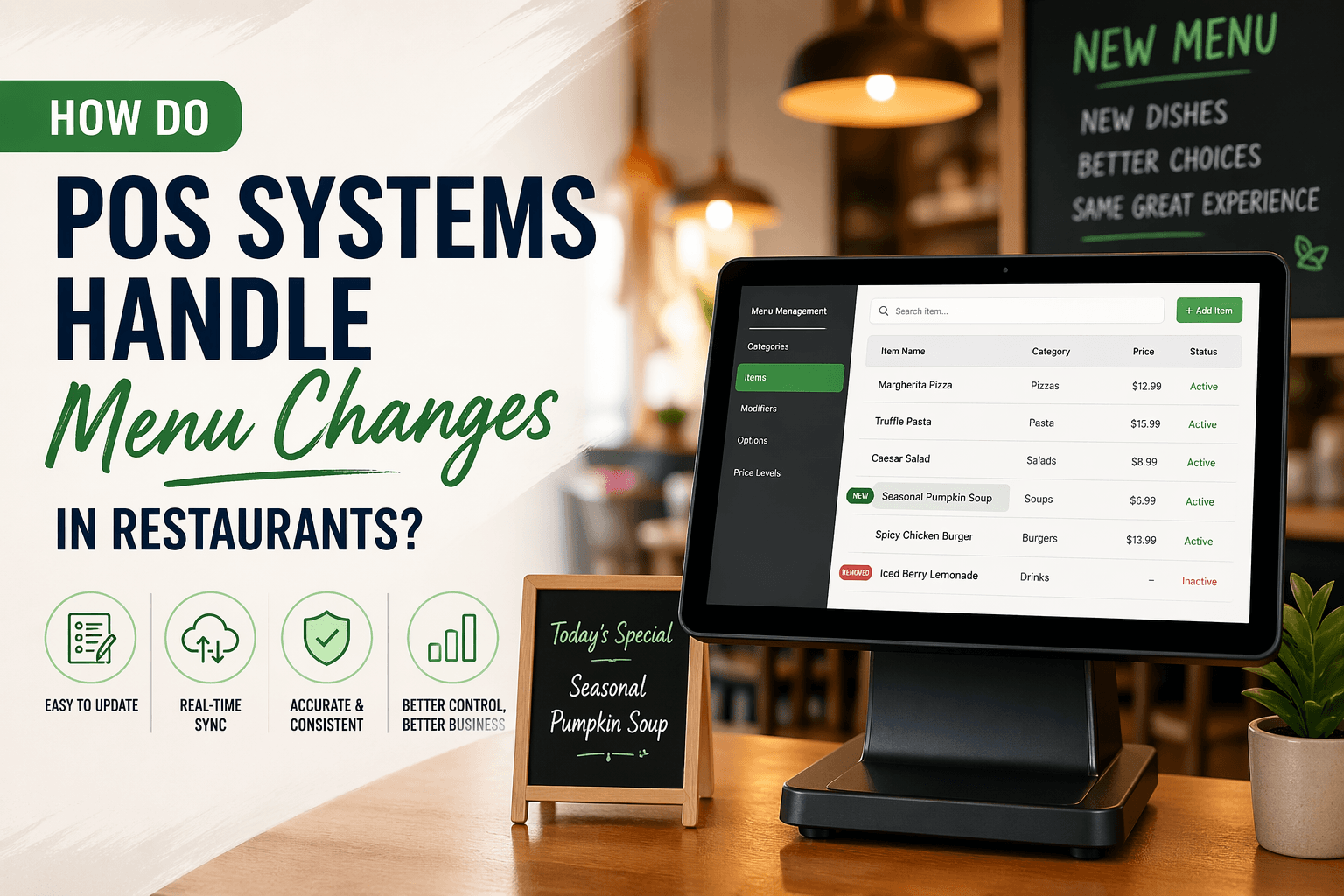
That’s where a modern POS (Point of Sale) system comes in. Instead of manually updating menus in multiple places, a POS acts as the central hub ensuring every change is fast, consistent, and reflected everywhere your customers interact with your brand.
|
Feature
|
What It Does
|
Benefit for Restaurants
|
|---|---|---|
|
Centralized Dashboard
|
Manage all menu items in one system
|
Saves time and reduces errors
|
|
Real-Time Sync
|
Updates reflect instantly across all channels
|
Consistent customer experience
|
|
Scheduled Changes
|
Set future menu updates
|
Easy seasonal or promo planning
|
|
Inventory Integration
|
Auto-disable out-of-stock items
|
Prevents order issues
|
|
Multi-Location Control
|
Push updates to all locations
|
Scales easily for chains
|
|
Modifier Management
|
Update add-ons, sizes, combos
|
Flexible menu customization
|
|
Third-Party Integration
|
Sync with delivery platforms
|
No duplicate work
|
|
Reporting & Analytics
|
Track performance of menu items
|
Data-driven decisions
|
A POS system acts as the single source of truth for your menu.
Instead of updating:
You update everything from one dashboard.
This eliminates duplication and ensures your pricing, descriptions, and availability are always aligned.
One of the biggest advantages of modern POS systems is real-time synchronization.
When you:
it updates instantly across:
This is critical during busy hours when items frequently go out of stock.
Menu changes go beyond just adding or removing items.
POS systems allow you to:
This flexibility is especially useful for:
A strong POS integrates directly with inventory.
When ingredients run out:
This reduces:
POS systems let you plan ahead.
You can:
For example:
This removes manual errors and keeps operations smooth.
For restaurant groups and chains, menu consistency is everything.
A POS system allows you to:
This is especially valuable for:
Without a POS, updating menus on delivery apps is painful.
Modern POS systems integrate directly with platforms like:
When you update your POS:
POS systems don’t just manage menus, they improve them.
With built-in analytics, you can:
Over time, this leads to:
Menu changes are constant in the restaurant industry but they don’t have to be chaotic.
A modern POS system turns what used to be a manual, error-prone process into a streamlined, automated workflow. From real-time updates to inventory syncing and multi-channel consistency, the right POS ensures your menu is always accurate, optimized, and ready to drive revenue.
If you’re still updating menus in multiple places manually, you’re not just wasting time, you’re leaving money on the table.
Most modern POS systems update menu changes in real-time or within seconds. Once you make a change in the dashboard, it syncs instantly across your in-store POS, online ordering, and integrated delivery platforms.
Yes. Many POS systems allow you to schedule menu updates ahead of time, perfect for seasonal items, limited-time offers, or switching between lunch and dinner menus automatically.