
April 28th, 2026
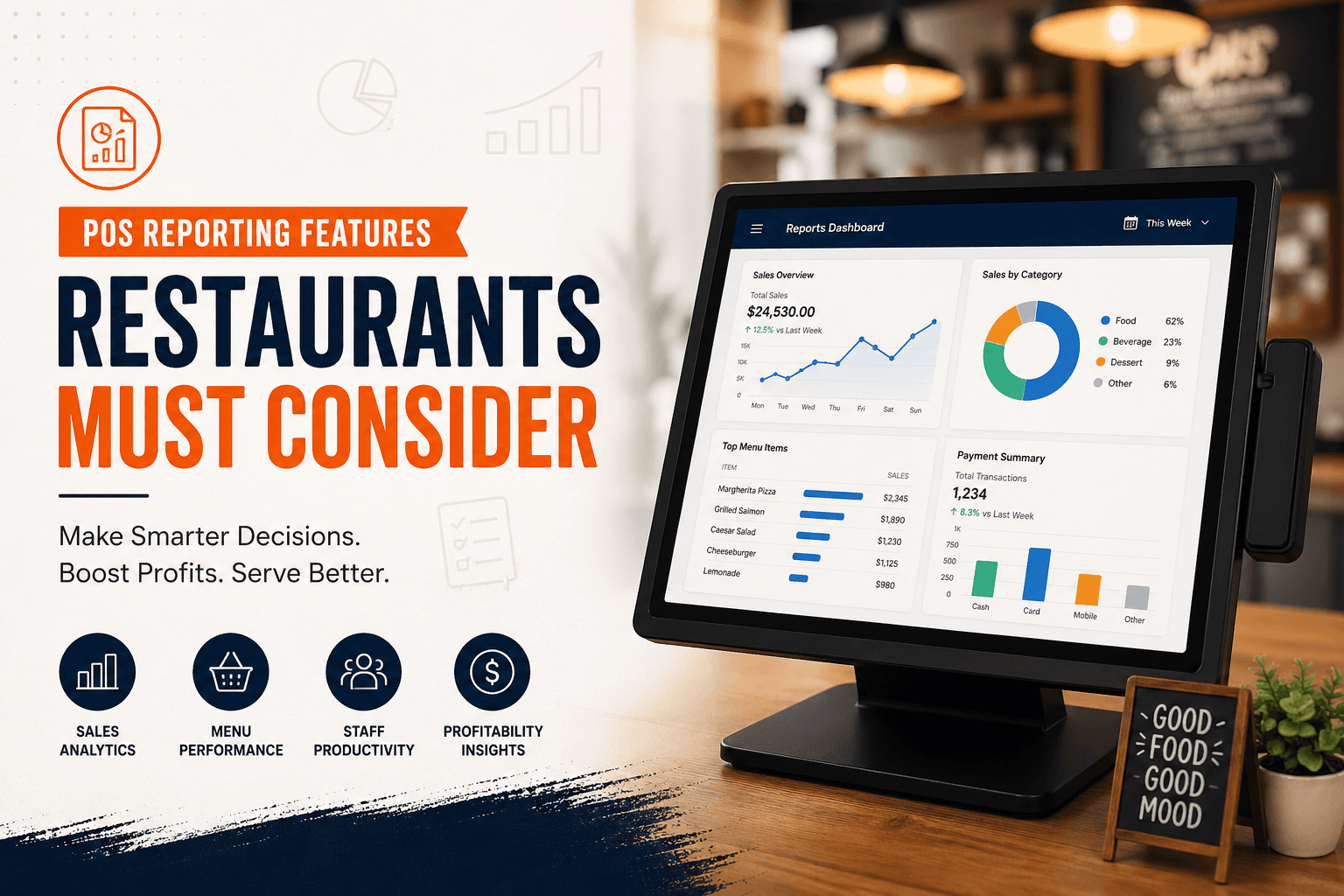
Restaurant margins are tight, and gut decisions aren’t enough anymore. The restaurants that win today are the ones that understand their data, what’s selling, when it’s selling, and how it impacts profitability.
A modern POS system isn’t just a transaction tool. It’s your primary source of operational intelligence.
From menu performance to labor efficiency, the right reporting features help you make faster, smarter decisions that directly impact revenue and margins.
|
Feature
|
Importance
|
Why It Matters
|
|---|---|---|
|
Sales Reporting
|
⭐⭐⭐⭐⭐
|
Tracks revenue trends and performance
|
|
Menu Performance
|
⭐⭐⭐⭐⭐
|
Identifies top and low-performing items
|
|
Profitability Reporting
|
⭐⭐⭐⭐⭐
|
Helps optimize margins
|
|
Real-Time Reporting
|
⭐⭐⭐⭐☆
|
Enables fast decision-making
|
|
Labor & Staff Reports
|
⭐⭐⭐⭐☆
|
Aligns staffing with demand
|
|
Inventory Reporting
|
⭐⭐⭐⭐☆
|
Reduces waste and stock issues
|
|
Inventory Tracking
|
⭐⭐⭐⭐☆
|
Supports ingredient-level cost control
|
|
Multi-Location Reporting
|
⭐⭐⭐⭐☆
|
Centralizes operations across locations
|
|
Customer & CRM Insights
|
⭐⭐⭐⭐☆
|
Drives retention and repeat visits
|
Sales reports are the foundation of any POS system.
They give you visibility into:
This helps you understand when your business performs best and where revenue is coming from.
Not all menu items are created equal.
A strong POS should show:
This allows you to:
Revenue doesn’t equal profit.
Advanced POS systems help you track:
This is critical for:
Decisions shouldn’t wait until end-of-day reports.
Real-time dashboards allow you to:
This is especially valuable during peak hours or promotions.
Labor is one of the largest costs for restaurants.
POS reporting should help you:
Better alignment between labor and demand = higher efficiency and lower costs.
Inventory directly impacts margins.
Look for reporting that includes:
This helps reduce over-ordering, prevent stockouts, and control food costs.
If you operate (or plan to operate) multiple locations, centralized reporting is critical.
Key capabilities include:
Without this, scaling becomes difficult and inconsistent.
Your POS should help you understand your customers, not just transactions.
Look for:
This enables:
|
Reporting Feature
|
Toast
|
Square
|
Lightspeed
|
Snappy
|
Clover
|
|---|---|---|---|---|---|
|
Sales Reporting
|
✅✅✅
|
✅✅
|
✅✅✅
|
✅✅✅
|
✅
|
|
Menu Analytics
|
✅✅✅
|
✅
|
✅✅✅
|
✅✅
|
✅
|
|
Online Ordering & Kiosks
|
✅✅
|
✅✅✅
|
✅✅
|
✅✅✅
|
✅✅
|
|
Profitability
|
✅✅
|
❌
|
✅✅✅
|
✅✅
|
❌
|
|
Real-Time Data
|
✅✅✅
|
✅✅
|
✅✅
|
✅✅✅
|
✅
|
|
Labor Reports
|
✅✅
|
✅
|
✅✅
|
✅✅
|
❌
|
|
Inventory Reporting
|
✅
|
✅
|
✅✅✅
|
✅
|
✅
|
|
Multi-Location
|
✅✅
|
✅
|
✅✅
|
✅✅
|
❌
|
|
CRM Insights
|
✅
|
✅
|
✅
|
✅✅✅
|
❌
|
Best for: High-volume restaurants needing strong reporting + operations
Strengths:
Best for: Small restaurants needing simple reporting
Strengths:
Best for: Data-driven operators
Strengths:
Best for: Restaurants focused on growth and actionable insights
Strengths:
Snappy stands out by connecting reporting directly to growth, helping restaurants not just analyze data, but act on it through marketing and direct customer engagement.
Best for: Basic reporting needs
Strengths:
Best suited for smaller operations that don’t need deep analytics.
POS reporting is no longer optional, it’s a core part of running a profitable restaurant.
The right system should give you visibility into:
Restaurants that leverage reporting effectively don’t just operate better, they grow faster, protect margins, and make smarter decisions every day.
Sales and menu performance reporting are the most critical, as they directly impact revenue and profitability decisions.
Even basic reporting helps, but advanced insights become essential as you scale or optimize margins.
Daily for operations, weekly for trends, and monthly for strategic decisions.
Lightspeed is strong for analytics, Toast for restaurant workflows, and Snappy for combining reporting with growth and marketing execution.