
May 22nd, 2026
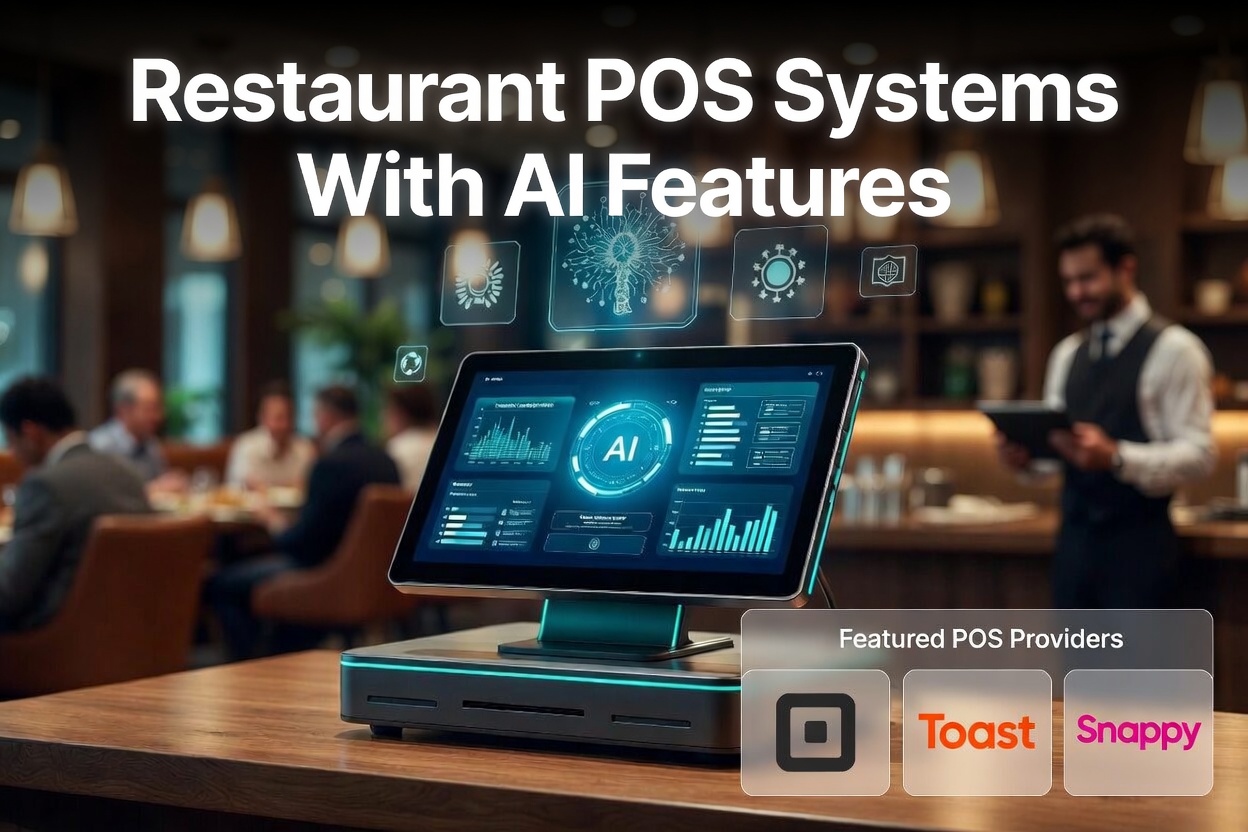
Two years ago, “AI in restaurant POS” meant a slightly smarter sales forecast. In 2026, it means systems that answer the phone, write your review replies, and surface the labour problem you didn’t know you had.
Most major restaurant POS platforms now market AI features. The depth varies enormously. Some have built genuine automation into ordering, reporting, and customer engagement. Others have bolted a chatbot onto a legacy dashboard. Understanding what AI actually does inside a POS is the first step to choosing one.
AI in restaurant POS splits into three functional layers:
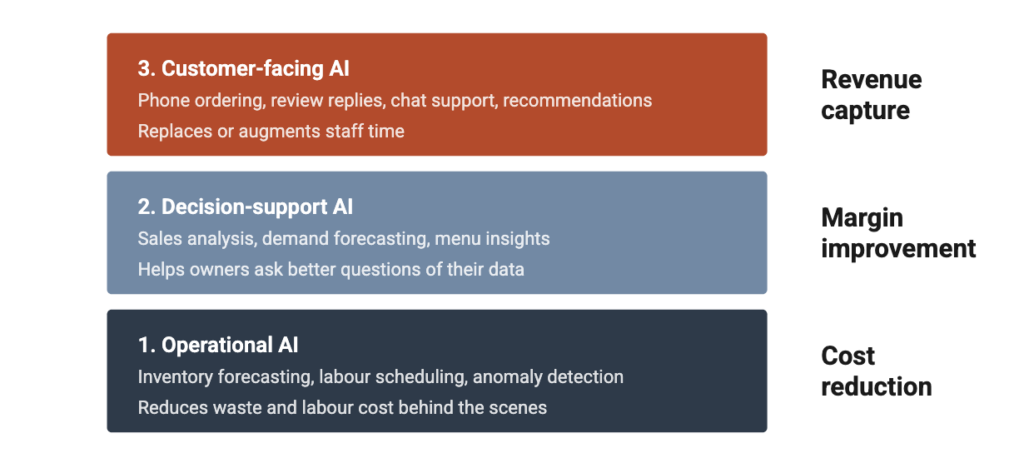
1. Operational AI
The least visible layer, often the most valuable. Inventory forecasting that learns local patterns, labour scheduling that flags overstaffing before it happens, and anomaly detection that catches voids or comps trending outside normal ranges. AI POS systems reduce food waste by tracking sales velocity against on-hand stock and surfacing reorder points before items run short.
2. Decision-support AI
The reporting layer, rebuilt. Instead of static dashboards, modern systems let owners ask plain-language questions of their data: “which menu items dropped this month?”, “what’s driving the dip in Tuesday revenue?”, “which servers have the highest comp rate?” Good AI here doesn’t generate the report, it generates the insight.
3. Customer-facing AI
The newest and most visible layer. AI voice agents take phone orders, AI assistants draft review responses, and AI chat handles common inquiries. Restaurants lose serious money due to missed calls, inefficient staffing, and food waste, and AI-powered POS systems directly fix these hidden revenue leaks. A single missed phone order during dinner rush often pays for a month of AI phone service.
Processors offer your fees in different packaging. The structure determines how predictable your costs are and how much you pay at different volume levels and ticket sizes.
|
Povider
|
AI Approach
|
Best Fit
|
|---|---|---|
|
Square for Restaurants
|
App-store ecosystem; AI features primarily delivered through third-party integrations and Square's own forecasting and reporting tools
|
Single-location cafés, QSRs, food trucks that want simplicity and a low entry cost
|
|
Toast
|
Broad first-party feature set including AI menu insights, smart suggestions, and an expanding suite of operational AI tools; deep app marketplace
|
Full-service restaurants $500K–$5M/yr that want one vendor for most needs
|
|
SpotOn
|
Focuses on marketing AI, loyalty intelligence, and reservation/CRM data; strong on customer relationship features
|
Full-service and hybrid concepts that prioritise guest data and marketing automation
|
|
Snappy
|
Vertically integrated AI built into the core POS: AI phone ordering with dedicated order source tracking, AI-assisted Google review management, AI sales analysis, and payment link as a native payment method
|
Operators who want customer-facing and decision-support AI built in, not bolted on
|
Square’s strength is accessibility. The platform’s AI sits mostly in inventory forecasting and reporting summaries, with deeper capabilities available via third-party apps in the marketplace. For a single-location café, this is often enough. For multi-unit or complex operations, the marketplace dependency means stitching together features from multiple vendors.
Toast has invested heavily in first-party AI, particularly around menu engineering and operational alerts. Sales analysis is conversational, inventory uses learned patterns, and the marketplace covers the gaps Toast doesn’t address directly. The trade-off is cost, Toast’s bundled pricing climbs quickly once AI add-ons, online ordering, and payroll are layered in.
SpotOn’s centre of gravity is the guest, not the kitchen. Its AI shines in marketing automation, loyalty segmentation, and CRM analytics. For operators whose competitive edge is repeat business and personalised guest engagement, this is differentiated. For high-volume operations focused on throughput and cost control, SpotOn’s AI may feel oriented toward problems they don’t have.
Snappy has taken a different route: build AI features directly into the core POS rather than rely on a marketplace. Three Snappy-exclusive features are worth a closer look, because each targets a revenue or labour leak that most other systems don’t address natively.
Snappy ships several AI-driven capabilities that don’t appear as core features in Square, Toast, or SpotOn. Each maps to a specific operational problem.
Why this matters: Snappy’s approach treats AI as integrated into payment methods, order sources, reporting, and reputation management. For operators tired of stitching together five vendors, this is structurally different.
AI phone ordering with dedicated order source tracking
Snappy’s AI phone agent answers calls, takes orders, handles modifiers, confirms timing, and pushes the order directly into the POS. This means revenue from AI phone ordering shows up as its own line in sales reports so operators can measure the AI’s actual contribution rather than guess at it.
Map Payment Link as a payment method
Payment links are widely used for catering, deposits, group bookings, and remote orders. Most POS systems treat them as a workaround, a Stripe link emailed outside the POS, with manual reconciliation back to the books. Snappy treats payment links as a first-class payment method, mapped directly into the POS. Transactions reconcile automatically alongside card and cash, with the same reporting, tipping, and refund flows.
AI-assisted Google Business review management
Reviews drive 20–35% of new customer decisions for most restaurants, yet response rates are typically below 40%. Snappy lets users connect their Google Business account in BC3, enabling them to view and reply to store reviews directly inside Snappy Teams. AI drafts a response based on the review content, the reviewer’s history, and the venue’s tone, and the operator approves, edits, or rejects before publishing.
AI data analysis for sales reports
Conversational analysis on top of sales data. Instead of reading a 12-page weekly report, operators can ask: “what changed in lunch covers this month?”, “which modifiers drove margin?”, “where did Friday revenue come from?” Snappy’s AI generates the answer, the supporting chart, and the underlying transaction list in one response.
AI features sound impressive in marketing. The honest test is what they do to the P&L. Four areas where AI in POS has documented impact:
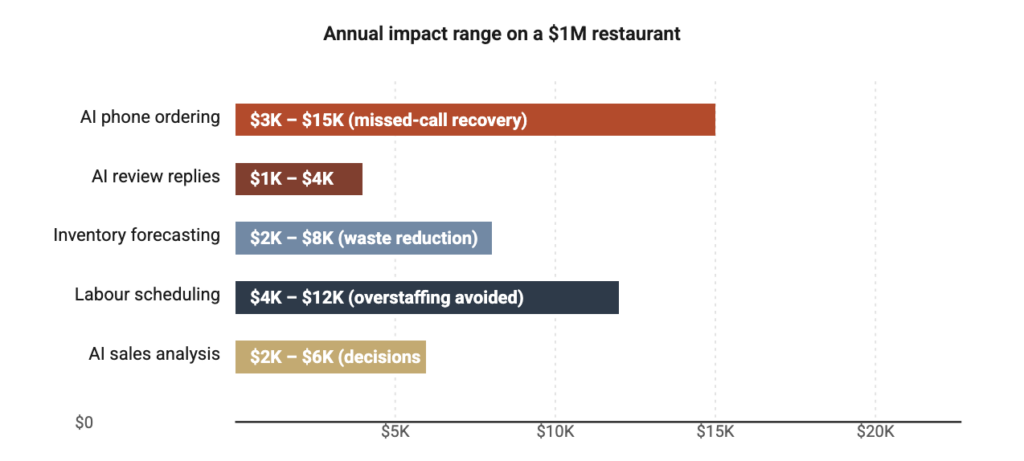
The largest, most consistent payback comes from AI phone ordering and labour scheduling. Both target operational losses that compound daily and are largely invisible to operators relying on memory and gut.
Most POS providers claim AI with marketing buzzwords. The honest evaluation questions are narrower:
Buyer trap: “AI” in a feature list often means a single chatbot in the back-office app. Ask vendors to demo three specific workflows, taking a phone order, drafting a review reply, and answering “what changed in revenue last week?” and see which platform actually completes them end-to-end.
The gap between POS systems with “AI features” and POS systems where AI does real operational work is wider than most marketing pages suggest. The most useful AI in 2026 isn’t the one with the most features listed, it’s the one wired most deeply into the workflows where money actually leaks: missed phone calls, unread reviews, unanswered data questions, and unreconciled payment channels.
The practical takeaways:
In an industry where margins are thin and labour is structurally tight, every basis point that AI recovers flows directly to the bottom line. The question isn’t whether your POS will have AI features. It’s whether those features will sit in a marketing page or in your daily operations.
Not always. Some legacy POS systems support AI through third-party integrations. The trade-off is integration fragility, a marketplace app can be deprecated or repriced at any time. Native AI features (built into the POS itself) tend to be more stable and reconcile cleanly with reporting, but require switching platforms to access.
For broad-market platforms, AI add-ons typically run $50–$200/month on top of base subscription. For vertically integrated systems where AI is built into the core platform, AI features may be included in the standard subscription with no separate fee. Always price the full bundle (POS + AI + integrations) rather than the headline subscription rate.