
May 28th, 2026
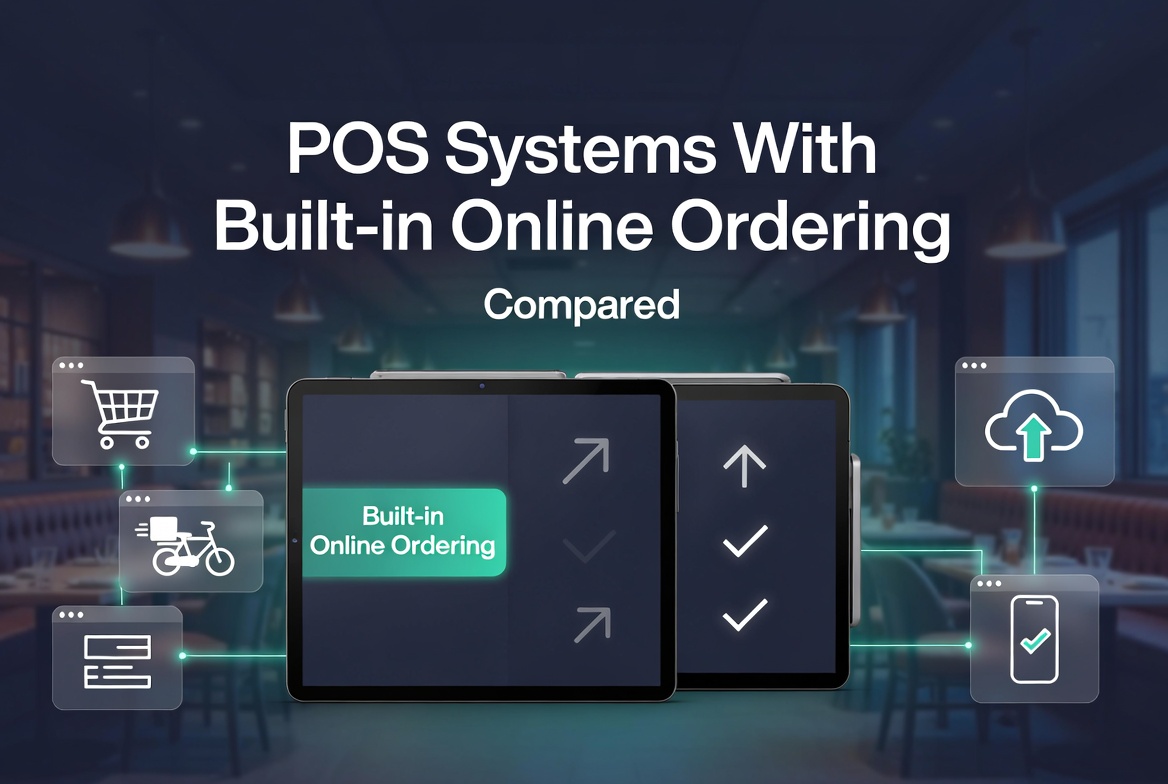
Every restaurant operator eventually arrives at the same uncomfortable realization: the online ordering stack added onto the side of the POS is costing more than the POS itself. The fix is rarely a better third-party integration. The fix is a POS where online ordering was built in from day one. Most operators underestimate how different those two architectures actually are.
A POS with built-in online ordering is not the same product as a POS with an online ordering add on. The first is one codebase, one menu, one customer database, one report. The second is two products glued together by an API that breaks every Tuesday at 11am. The economics, the failure modes, and the payback look nothing alike, but the marketing pages make them sound identical.
The headline difference between providers is how deeply online ordering is integrated into the core POS, whether it’s one product or several products glued together.
|
Provider
|
Online Ordering Approach
|
Best Fit
|
|---|---|---|
|
Square for Restaurants
|
Square Online ordering page included in core plan; marketplace and app features via Square ecosystem
|
Cafés, food trucks, single-location operators wanting fast setup and low entry cost
|
|
Toast
|
Broad first-party online ordering with native delivery dispatch, branded apps, and marketplace integrations; add-on pricing structure
|
Full-service restaurants $500K–$5M/yr that want one vendor for most needs
|
|
SpotOn
|
Native commission-free online ordering with strong loyalty and CRM integration; lower processing fees than peers
|
Mid-size full-service restaurants where processing fee savings move the needle
|
|
Snappy
|
Vertically integrated omni-channel ordering built into the core POS: native online, kiosk, QR, branded mobile app, marketplace aggregation, and Order with Google in one platform
|
Operators who want all online ordering channels built in, not bolted on
|
Square’s strength is accessibility. Square Online is bundled into the core plan with no monthly fee, and the ordering page is straightforward to set up. For a single-location café, this is often enough. For multi-unit, marketplace-heavy, or app-centric operations, the lack of a native branded mobile app and thinner marketplace depth mean stitching together additional vendors.
Toast has invested heavily in first-party online ordering, including Toast Delivery Services (dispatch through the DoorDash driver network), branded mobile apps, and marketplace integrations. Direct orders are commission-free. Toast’s bundled pricing climbs quickly once online ordering, loyalty, payroll, and delivery add-ons layer in, and the platform locks operators into Toast hardware and processing.
SpotOn’s online ordering is genuinely commission-free on direct orders, and the platform’s processing rates often come in below Toast and Square at higher volumes. The system pairs ordering with strong loyalty and CRM tools, which helps for full-service restaurants where repeat-customer value is the priority. SpotOn is less feature-dense than Toast but typically has a lower total cost of ownership.
Snappy has taken a different route: build every online ordering channel directly into the core POS rather than rely on add-on modules or a marketplace of third-party apps. Four Snappy capabilities are worth a closer look, because each consolidates a channel or workflow that most other systems leave fragmented.
Snappy ships several capabilities that don’t appear as core features in Square, Toast, or SpotOn. Each maps to a specific revenue or operational leak.
Why this matters: Snappy’s approach treats online ordering as part of one omni-channel stack (direct site, kiosk, QR, app, marketplace, and Google) running off a single menu and customer database. For operators tired of stitching together five ordering vendors, this is structurally different.
Omni-channel ordering off one menu
Snappy’s online ordering, self-serve kiosk, order-from-table QR, and custom branded app all run off the same menu and customer database as the POS. A menu update or a price change propagates to every channel in real time. Operators don’t maintain three menus; they maintain one.
Native marketplace aggregation with DoorDash and Uber Eats
DoorDash, Uber Eats, and Order with Google buttons feed orders directly into the Snappy POS as native tickets. There’s no tablet tower, no third-party middleware bill, and no manual re-entry during peaks. The kitchen sees one queue regardless of channel.
White-labelled custom mobile app
Most POS systems treat branded apps as a premium upgrade or a third-party integration. Snappy delivers a fully branded custom mobile app as part of the platform, tied directly to loyalty rewards and gift cards. Customers ordering through the app automatically receive loyalty points and rewards, and operators see app-driven revenue as its own line in reporting.
Unified customer profiles across all ordering channels
Snappy ties every order (direct site, app, kiosk, QR, marketplace, dine-in) to one customer profile in the CRM. Operators can see total customer value across channels, segment lapsed online customers for winback campaigns, and run loyalty programmes that work the same way regardless of how the customer ordered. Reporting consolidates into one dashboard rather than splitting across the POS and an ordering platform.
Online ordering features sound impressive in marketing. The honest test is what they do to the P&L. Four areas where built-in online ordering has documented impact:
|
Impact Area
|
What It Does
|
Estimated Impact
|
|---|---|---|
|
Commission savings on direct orders
|
Direct orders through a branded site pay processing fees only (~2.9%) rather than marketplace commissions of 15–30%
|
A restaurant doing $250,000/yr in digital revenue typically recovers $25,000–$35,000 annually by moving 60% of that volume to direct
|
|
Eliminating manual re-entry
|
A POS that ingests marketplace orders natively removes the need to re-type tickets, reconcile reports, and fix mis-rung orders
|
Cuts 30–60 manager minutes per day on a busy QSR
|
|
Higher repeat-order rates from branded apps
|
Loyalty integration and direct push notifications drive repeat visits that marketplace orders rarely produce
|
Customers ordering through a restaurant's own app return at meaningfully higher rates than marketplace customers
|
|
Faster table turns from QR ordering
|
Order-from-table QR systems reduce average check time and free server labour for higher-value tasks
|
Snappy customers report sales and table turnover up 10%+ after adding QR ordering on top of the POS
|
The largest, most consistent payback comes from commission savings and branded app repeat-order rates. Both target revenue that compounds daily and is largely invisible to operators relying on marketplace dashboards.
Most POS providers claim online ordering with marketing buzzwords. The honest evaluation questions are narrower:
Buyer trap: “Built-in online ordering” in a feature list often means a single Square-Online-style page bolted onto an otherwise generic POS. Ask vendors to demo three specific workflows and see which platform actually completes them end-to-end.
The gap between POS systems with “online ordering features” and POS systems where online ordering is genuinely built in is wider than most marketing pages suggest. The most useful built-in ordering in 2026 isn’t the one with the most channels listed, it’s the one wired most deeply into the workflows where money actually leaks.
Vertically integrated platforms like Snappy with omni-channel ordering, native marketplace aggregation, branded mobile apps, and unified customer profiles in one stack eliminate the integration tax that comes with stitching together third-party online ordering apps.
Square is the right answer for low-complexity single sites. Toast and SpotOn fit specific full-service profiles. Snappy is the right answer for operators who want every online ordering channel built in, not bolted on.
In an industry where margins are thin and marketplace commissions are structurally high, every percentage point of direct ordering volume flows directly to the bottom line. The question isn’t whether your POS will have online ordering features. It’s whether those features will sit in a marketing page or run the channel your customers actually order through.
Built-in means the online ordering channel uses the same menu, customer database, and reporting as the POS itself. The opposite is a bolted-on integration, where the ordering platform is a separate product connected to the POS via an API, with its own menu and dashboard. Built-in updates propagate in real time and reconcile cleanly; bolted-on integrations sync periodically and can drift.
For broad-market platforms, online ordering add-ons typically run $50–$200/month on top of base subscription. For vertically integrated systems where ordering is built into the core platform, the channel may be included in the standard subscription with no separate fee. Always price the full bundle (POS + ordering + marketplace integration + branded app) rather than the headline subscription rate.
For single-location restaurants where most digital traffic comes from search, a website ordering page is usually sufficient. For multi-unit brands, restaurants with meaningful repeat-customer revenue, or operators running loyalty programmes, a branded mobile app drives materially higher repeat-order rates and order frequency than a website alone.