
July 30th, 2026
Third-party delivery apps like DoorDash, Uber Eats, and Grubhub helped restaurants reach more customers online. But commission rates of 15%–30% per order have pushed many operators to look for a better way to take direct orders.
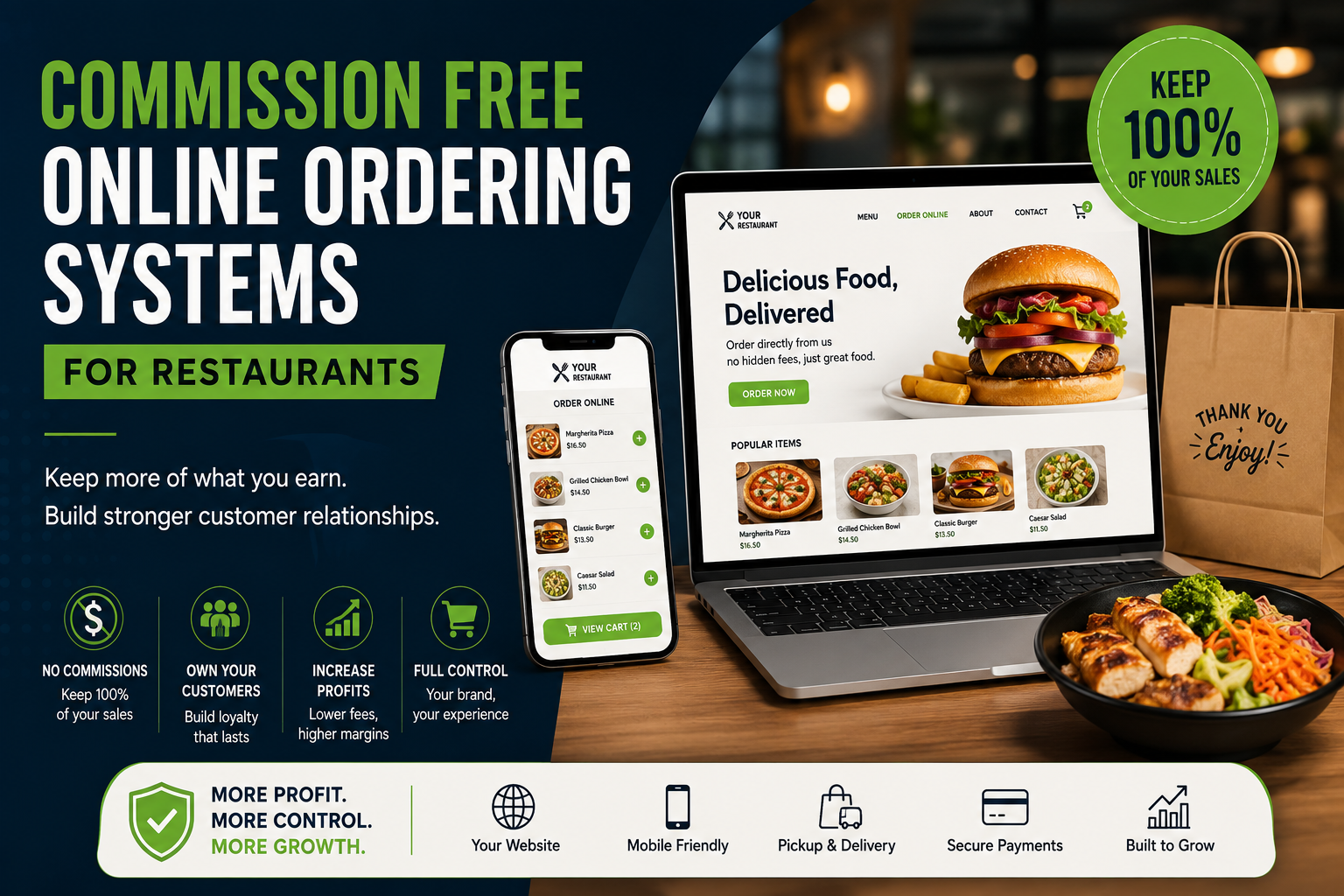
Commission-free online ordering systems let restaurants accept orders through their own website, app, or Google listing without giving up a percentage of every sale.
But not every commission-free platform works the same way, and the right one depends on what else your restaurant needs it to do.
Look past the “0% commission” headline. What actually separates these platforms is:
With that in mind, here’s how the leading commission-free ordering systems stack up:
Common reasons restaurants look for a commission-free ordering system include:
Who should still use third-party delivery apps?
Third-party delivery apps can still play a role for restaurants that want extra discovery and don’t have their own delivery drivers, especially in markets where diners default to browsing DoorDash or Uber Eats first.
Many operators use these apps as a supplemental discovery channel while directing their most loyal customers toward a commission-free ordering system for repeat business.
However, if your goal is to lower your overall cost per order, own more of your guest data, or connect ordering with the rest of your restaurant’s operations, a commission-free system should be the foundation of your ordering strategy.
The table below breaks the criteria above into specific features and shows how the leading platforms compare on each.
| Feature | Why It Matters | Snappy | ChowNow | Owner.com | Toast | Square |
|---|---|---|---|---|---|---|
| 0% Commission on Direct Orders | Keeps 100% of order revenue instead of losing a cut per sale | ✅✅✅ | ✅✅✅ | ✅✅✅ | ✅✅ | ✅✅ |
| Native POS & Kitchen Integration | Avoids manual entry and reduces order errors during rushes | ✅✅✅ | ✅✅ | ✅✅ | ✅✅✅ | ✅✅✅ |
| Third-Party Delivery Integration | Lets you accept delivery orders without hiring your own driver fleet | ✅✅✅ | ✅✅ | ✅✅ | ✅✅ | ✅✅ |
| Google Order Integration | Captures orders directly from Google Search and Maps | ✅✅✅ | ✅✅ | ✅✅ | ✅ | ✅ |
| Owned Guest Data | Enables remarketing, loyalty, and repeat-visit campaigns | ✅✅✅ | ✅✅✅ | ✅✅✅ | ✅✅ | ✅✅ |
| Built-In Loyalty & Marketing | Turns one-time orders into repeat customers automatically | ✅✅✅ | ✅✅ | ✅✅ | ✅✅ | ✅ |
| AI-Powered Analytics & Insights | Surfaces best-sellers, peak hours, and trends without manual reporting | ✅✅✅ | ✅ | ✅ | ✅✅ | ✅ |
| Multi-Location Support | Centralizes menus, pricing, and reporting as you add locations | ✅✅✅ | ✅✅ | ✅✅ | ✅✅✅ | ✅✅ |
| Room to Add POS, Kiosk & Reservations | Avoids bringing on new vendors as your restaurant scales | ✅✅✅ | ✅ | ✅ | ✅✅ | ✅✅ |
| Best For | — | Infrastructure layer for growing restaurants | Established ordering network | AI-built website + ordering | Existing Toast operators | Simple, low-cost setup |
0% Commission on Direct Orders
This is the baseline reason restaurants look at these platforms in the first place. A 20% commission on a $40 order is $8 gone before food or labor costs are even factored in. Commission-free platforms replace that variable cost with a flat monthly fee, so growth in order volume adds to your bottom line instead of eating into it.
Native POS & Kitchen Integration
If online orders don’t route directly into your POS and kitchen display, someone on staff is re-keying them by hand during your busiest hours. That’s slower, and every manual entry is a chance for an item, modifier, or address to get typed wrong. Native integration keeps online orders moving through the same workflow as dine-in and phone orders.
Third-Party Delivery Integration
Going commission-free on direct orders doesn’t mean giving up delivery. Most restaurants still need occasional access to a driver network, especially during peak hours or for orders outside their own delivery radius. Platforms that plug into Uber Eats, DoorDash, or SkipTheDishes let you use their drivers for fulfillment while keeping the order on your own system.
Google Order Integration
A large share of “where should I order from” searches now start on Google, not a delivery app. If customers can only place an order after leaving Google to open a third-party app, you lose some of them along the way. Direct ordering from Google Search and Maps captures that intent immediately.
Owned Guest Data
Third-party marketplaces rarely hand over usable customer contact information, which means every order there is essentially a one-time transaction from your perspective. Owning guest data is what makes remarketing, loyalty programs, and win-back campaigns possible at all.
Built-In Loyalty & Marketing
Getting a customer to order once is only half the goal; getting them to order again is where profitability comes from. Platforms with loyalty and marketing built directly into the ordering flow can trigger a rewards signup, a birthday offer, or a win-back email automatically, without a separate marketing tool or manual list-building.
AI-Powered Analytics & Insights
Daily sales totals tell you how much you made, not why. AI-powered analytics that flag your best-selling items, slowest-moving menu items, and peak ordering hours let you adjust staffing, prep, and promotions proactively instead of reacting after the fact. This matters more as order volume grows and manual report-reading becomes impractical.
Multi-Location Support
Updating a menu, price, or promotion across five locations one at a time is a recipe for inconsistency and errors. Centralized menu management and reporting let multi-location groups push changes everywhere at once and compare performance across locations from a single dashboard.
Room to Add POS, Kiosk & Reservations
An ordering platform that can’t grow with you eventually forces a choice: stay on a tool that’s outgrown, or migrate to a new vendor and lose historical data and integrations in the process. Platforms built as a broader technology stack let you add POS, self-serve kiosks, or reservations later without starting over.
Who it’s for: Restaurants that have outgrown a standalone ordering tool and need commission-free ordering to run on the same infrastructure as their POS, kitchen display, reservations, loyalty, and marketing with the reporting to back up decisions as order volume grows.
Most commission-free ordering tools solve one problem: getting rid of per-order fees. Snappy is built to solve the next problem too and what happens once a restaurant is taking hundreds of direct orders a week across a website, an app, Google, and delivery partners, and needs that volume to actually inform decisions rather than just get processed.
That’s why Snappy positions itself less as an ordering app and more as an infrastructure layer: the ordering, delivery, POS, kitchen display, loyalty, and reporting all sit on the same system, so growth in one area doesn’t require bolting on another vendor.
What it does well:
What other platforms may do better:
Best for:
Growing restaurants and multi-location groups that need commission-free ordering to sit on the same infrastructure as POS, kitchen operations, loyalty, and AI-driven analytics rather than running ordering as a disconnected tool that gets harder to scale as volume increases.
Who it’s for: Restaurants that want an AI-built website paired with commission-free ordering, SEO pages, and a branded app in one flat-rate package.
Owner.com positions itself around building and optimizing a restaurant’s website first, then layering commission-free ordering, a branded mobile app, and automated SEO pages on top of it.
What it does well:
What platforms like Snappy may do better:
Best for:
Restaurants whose website badly needs a rebuild and want commission-free ordering, SEO, and an app bundled together with it.
Who it’s for: Restaurants already running Toast as their POS that want native commission-free ordering without adding a separate vendor.
Toast Online Ordering is a natural fit for restaurants already inside the Toast ecosystem, since ordering, POS, and kitchen display share the same backend.
What it does well:
What platforms like Snappy may do better:
Best for:
Restaurants already using Toast POS that want to add commission-free ordering without introducing another system to manage.
Who it’s for: Small restaurants, cafes, or food trucks that want a free or low-cost way to start taking commission-free orders quickly.
Square Online is a practical entry point for smaller operators who already use Square for payments and want ordering added with minimal setup.
What it does well:
What platforms like Snappy may do better:
Best for:
Very small or new restaurants that want the simplest, lowest-cost way to start taking commission-free orders.
Go with Snappy if…
Go with ChowNow if…
Go with Owner.com if…
Go with Toast if…
Go with Square if…
The best commission-free online ordering system depends on what your restaurant needs most.
If you mainly want a standalone tool to stop paying delivery app commissions, ChowNow or Square may cover the basics. But if your goal is to connect ordering with your POS, kitchen operations, loyalty, and marketing under one roof, a broader platform is worth considering.
Restaurants should compare commission-free ordering systems based on POS integration, delivery app coverage, Google ordering support, loyalty and marketing tools, multi-location support, and total monthly cost.
For restaurants that want commission-free ordering to work as part of a larger, connected growth system, Snappy Online Ordering & Delivery is one of the strongest options to consider. It helps operators eliminate commission fees while keeping ordering, delivery, loyalty, and marketing tied to the same platform.
The best system depends on your needs. Snappy is a strong choice for restaurants that want ordering connected to POS, kitchen operations, and marketing. ChowNow is strong for an established standalone network, Toast is strong for restaurants already on Toast POS, and Square is strong for very small operators.
Most commission-free platforms charge a flat monthly subscription fee plus standard payment processing on each transaction, rather than taking a percentage of the order total the way third-party delivery apps do.
Snappy and Toast Online Ordering are both strong options for multi-location groups, offering centralized menu management and reporting across locations.
Small restaurants may consider Square Online for its low cost of entry, Slice if the concept is pizza-focused, or Snappy if they want room to add loyalty, marketing, and POS tools as they grow.