
August 10th, 2026
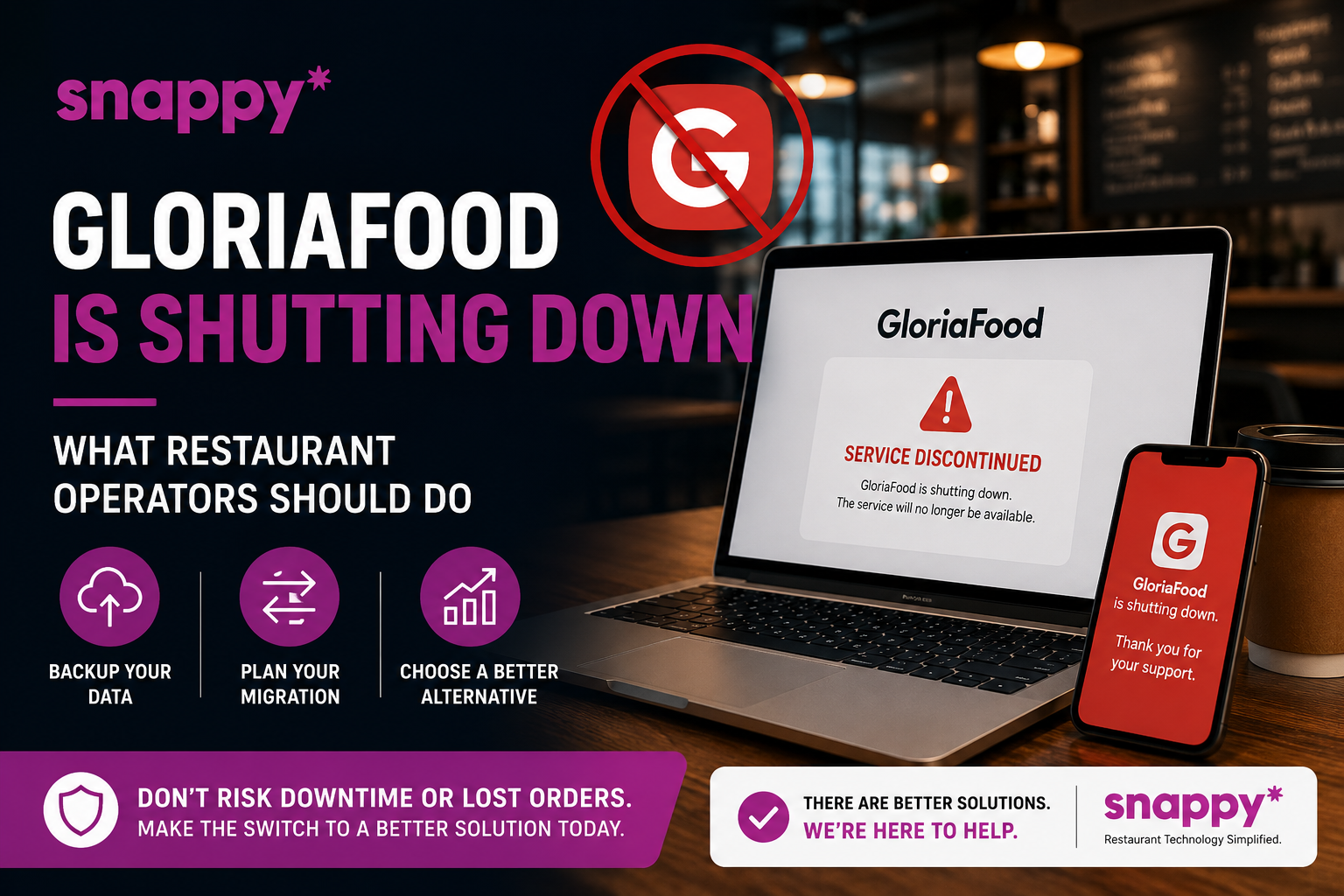
If your restaurant takes online orders through GloriaFood, you are on a clock. Oracle is permanently shutting the platform down on March 31, 2027 and when it goes dark, it takes your menus, customer records, order history, and delivery settings with it. There is no archive and no data-retention safety net after that date.
The instinct is to wait. New signups are already closed and the product is feature-frozen, but your existing account still works so it’s tempting to deal with it “closer to the deadline.” That is exactly why it’s a trap. A rushed migration in early 2027, alongside thousands of other restaurants scrambling for the same alternatives, is how you lose orders, break your online presence during a busy season, and leave money on the table.
This guide covers what’s actually happening, what you stand to lose, the timeline you should work backwards from, and how to choose a replacement including why a 0% commission, direct-ordering platform is the switch most operators should be making anyway.
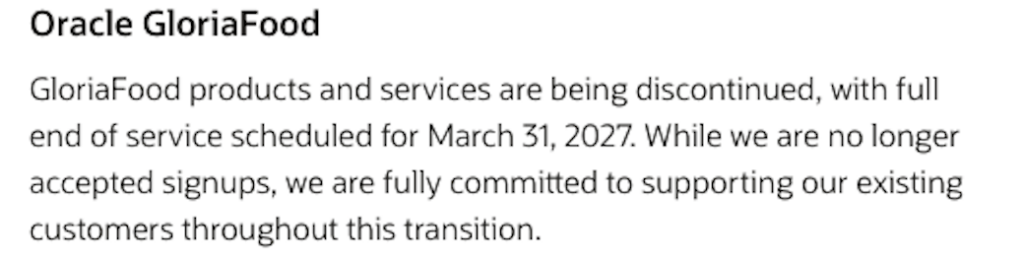
The essentials, stripped of the noise:
In short: the platform still works right now, but it is a dead end with a hard expiration date. Every day you stay is a day closer to a forced move.
Oracle has confirmed there is no data retention beyond the shutdown date. Unless you export it first, everything tied to your GloriaFood account becomes permanently inaccessible:
|
Migration Type
|
What It Involves
|
|---|---|
|
Menus, items & photos
|
Rebuilding a full menu from scratch on a new platform is hours of work per location
|
|
Customer records
|
Names, emails, and phone numbers are your marketing list, lose them and you lose your direct line to guests
|
|
Order history
|
Your data on what sells, when, and to whom gone
|
|
Delivery configurations
|
Zones, fees, prep times, and rules all reset to zero
|
|
Marketing campaigns & promos
|
Any automation or promo logic built inside GloriaFood does not travel with you
|
The customer list is the one to obsess over. Hardware and menus can be rebuilt; a relationship with thousands of past guests cannot be re-bought at any reasonable price. Export your customer data before anything else.
The deadline feels far away in 2026. Here’s why moving now beats moving later:
Rule of thumb: work backwards from March 31, 2027, and give yourself a full quarter of overlap. Migrating by late 2026 or early 2027 while GloriaFood is still live as a fallback is the low-risk path.
Not all “GloriaFood alternatives” are equal. Many are the same model with a different logo. As you evaluate options, weigh these factors:
If you’re going to switch, switch to something that fixes the margin problem too. Snappy Online Ordering lets you take orders directly through your own channels instead of renting them from third-party apps and it does it commission-free.
Must have features:
The results Snappy reports from operators back it up: one client saw a 28% increase in online orders after joining; another has online orders make up 32% of total revenue with a 50%+ improvement in order accuracy; a third reported 12% gross sales growth and a 27% increase in online/delivery orders.
The takeaway: GloriaFood’s shutdown is a forced decision, but it’s also a chance to stop paying commission and start owning your orders and your guest data. That’s the upgrade, not just the replacement.
After losing a free tool, the tempting move is to reach for the next free one.
Resist it. “Free” ordering tools are never actually free, they recoup the cost somewhere you can’t see: per-order fees baked into checkout, ads and upsells for competitors on your own storefront, your customer data monetized, or a stripped-down feature set with no real support.
And because you’re not a paying customer, you’re not a priority which is precisely how a free platform gets quietly sunset with a hard deadline and no data safety net. You just lived through that. A paid platform aligns the provider’s incentives with yours: they keep your restaurant running because you’re the customer, not the product. The right way to read the difference:
|
What Matters
|
"Free" Platform
|
Paid Platform (ie: Snappy)
|
|---|---|---|
|
True cost
|
"Free" upfront recouped via per-order fees, ads, upsells, or data
|
Transparent subscription, 0% commission on orders
|
|
Longevity & support
|
Can be sunset with little notice; minimal or no support (see: GloriaFood)
|
Actively developed with dedicated onboarding & support
|
|
Your customer data
|
Often limited export; sometimes monetized or shared
|
You own it outright and can export any time
|
|
Storefront branding
|
Provider branding, ads, or competitor upsells on your page
|
Your brand, your storefront, your customer relationship
|
|
Feature Depth
|
Basic order form
|
Loyalty, memberships, QR ordering, multi-location, unified payments
|
|
Migration Help
|
Self-serve, you're on your own
|
Guided setup in a few days
|
Work through these in order, ideally by early 2027 while GloriaFood is still live as a backup:
GloriaFood shutting down on March 31, 2027 isn’t a maybe, it’s a fixed deadline with no data safety net behind it. The operators who lose the least are the ones who treat 2026 as the year to move, not 2027.
Export your data now, choose a platform that lets you own your orders and your guest relationships, and use the forced switch to your advantage. Moving to a 0% commission, direct-first platform like Snappy Online Ordering turns a disruption into a margin upgrade, you stop handing 15–30% to third parties and start keeping the orders, the data, and the revenue that were always supposed to be yours.
March 31, 2027. After that date, customer accounts and the partner program close permanently, and Oracle has confirmed there is no data retention beyond the deadline.
Yes, existing accounts still work as the platform winds down. But it’s feature-frozen and in maintenance mode, so don’t expect fixes or new capabilities. Treat it as a fallback while you migrate, not a long-term home.
It varies, but a modern platform like Snappy can be deployed in a few days. Give yourself a buffer of at least a quarter before the deadline so you can rebuild your menu, test, retrain staff, and run in parallel before cutting over.
Only if you choose one that charges it. GloriaFood was commission-free, so don’t downgrade, Snappy Online Ordering charges 0% commission on every online order, saving you the 15–30% that third-party apps typically take.