
September 15th, 2026
Restaurants handle a constant stream of phone calls, from reservations and orders to questions about hours, menus, delivery, and special requests. During busy periods, answering every call can be difficult without pulling staff away from guests.
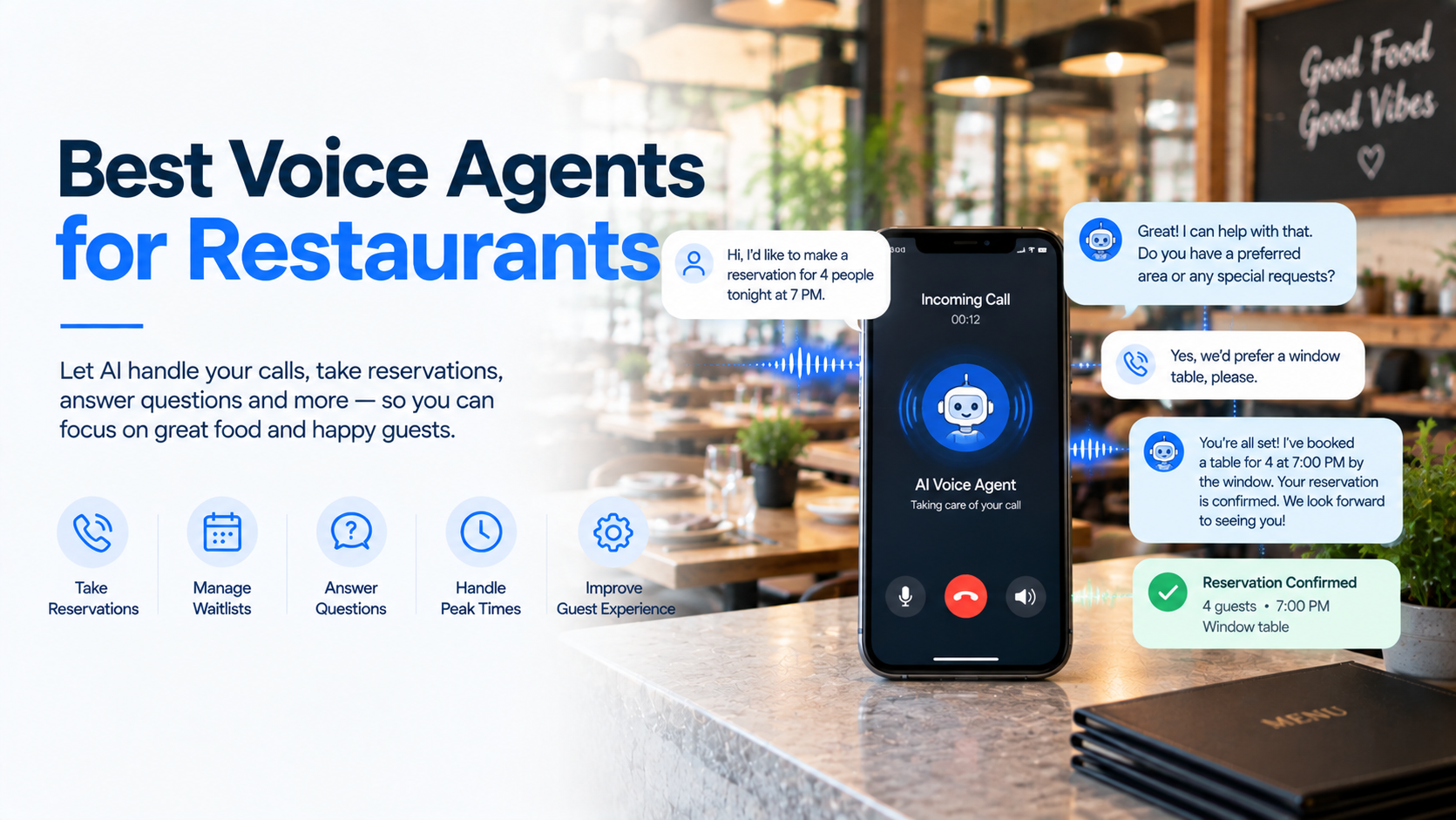
Voice agents for restaurants are designed to handle those conversations automatically, helping restaurants answer calls, capture orders and reservations, and route calls to staff when human assistance is needed.
A restaurant voice agent is an AI phone assistant that can have conversations with guests using natural voice. Instead of sending every call directly to restaurant staff, the agent can understand what the caller needs and guide them through the appropriate process.
Depending on the system, a voice agent can answer questions, take orders, manage reservations, provide restaurant information, and transfer calls to staff when necessary. Restaurant-specific systems can also be configured around a restaurant’s menu, hours, policies, and workflows.
The most useful restaurant voice agents go beyond simply answering FAQs. They connect the phone conversation to an action, such as placing an order or making a reservation.
Reduce Missed Calls
Restaurant staff often have to prioritize guests in the dining room, kitchen operations, and counter service. Calls can therefore go unanswered, particularly during rush periods.
A voice agent can answer calls immediately instead of leaving guests waiting or sending them to voicemail. Snappy, for example, can answer inbound calls and route callers to staff when a human is needed.
Handle Orders and Reservations
A voice agent can guide callers toward placing an online order or making a reservation, reducing the amount of manual work required from restaurant employees.
Snappy Voice Agent can handle orders and reservations through its assistant flow, while its reservation system supports phone-based booking.
Keep Staff Focused on Guests
Instead of having employees repeatedly stop what they are doing to answer routine calls, voice agents can handle common requests automatically and escalate calls when staff involvement is necessary.
Provide Coverage Outside Regular Hours
Voice agents can continue handling calls during peak periods, after hours, weekends, and holidays. This gives restaurants another way to capture orders and reservations when employees are unavailable.
Most restaurant voice agents follow a similar process:
1. A Guest Calls
The customer calls the restaurant’s existing phone number.
2. The Voice Agent Answers
Instead of waiting for an employee, the voice agent answers and begins a conversation with the guest.
3. It Identifies the Guest’s Intent
The system determines whether the caller wants to place an order, make a reservation, ask a question, or speak with staff.
4. It Guides the Caller
The agent follows the appropriate restaurant-specific workflow.
For example:
Order → Menu → Options → Payment → Confirmation
or
Reservation → Date → Time → Party size → Confirmation
| Feature | Snappy Voice Agent | Restaurant-Specific Voice Agent | Reservation-Focused Agent | Generic AI Receptionist |
|---|---|---|---|---|
| Restaurant-Specific Workflows | ✓✓✓ | ✓✓✓ | ✓✓ | ✓ |
| AI Voice Answering | ✓✓✓ | ✓✓✓ | ✓✓✓ | ✓✓✓ |
| Phone Ordering | ✓✓✓ | ✓✓✓ | Varies | Varies |
| Reservations | ✓✓✓ | ✓✓ | ✓✓✓ | ✓ |
| Menu & Guest Questions | ✓✓✓ | ✓✓✓ | ✓✓✓ | ✓✓ |
| Call Routing | ✓✓✓ | ✓✓✓ | ✓✓✓ | ✓✓✓ |
| Custom Voice Flows | ✓✓✓ | ✓✓✓ | ✓✓✓ | ✓✓ |
| Missed-Call SMS | ✓✓✓ | Varies | Varies | ✓✓ |
| Peak-Hour Coverage | ✓✓✓ | ✓✓✓ | ✓✓✓ | ✓✓✓ |
| After-Hours Coverage | ✓✓✓ | ✓✓✓ | ✓✓✓ | ✓✓✓ |
| Multi-Location Support | ✓✓✓ | ✓✓ | ✓✓✓ | ✓✓ |
| Restaurant Integrations | ✓✓✓ | ✓✓✓ | ✓✓✓ | Varies |
| Caller Reporting | ✓✓✓ | ✓✓ | ✓✓ | ✓✓ |
| Broader Restaurant Platform | ✓✓✓ | Varies | Varies | — |
Best for: Restaurants that want voice answering connected to ordering, reservations, and restaurant operations.
Snappy Voice Agent is designed specifically around restaurant phone interactions. It can answer incoming calls, understand guest intent, guide callers through the appropriate flow, and route calls to staff when necessary.
One of its biggest advantages is that voice is part of a broader restaurant technology platform. Snappy offers POS, online ordering, reservations, waitlist, delivery, loyalty, analytics, and other restaurant products, allowing the phone experience to work alongside other restaurant systems.
Key features
Snappy can also use an automated SMS fallback when a call is missed, directing guests toward online ordering or reservations.
Best for: Restaurants that need detailed phone ordering, menu handling, or restaurant-specific call flows.
Restaurant-specific voice agents are built around the unique requirements of hospitality. Instead of treating a restaurant like a generic business, these systems can be configured around menus, modifiers, hours, reservation policies, and other restaurant information.
For example, restaurant-focused platforms can support phone ordering, reservations, guest questions, and staff escalation.
Some systems focus heavily on phone ordering. VoxAI, for example, is positioned around restaurant phone orders and describes workflows for handling menu options, confirming orders and totals, and sending confirmed order information to the kitchen.
Best for: Restaurants where reservations, confirmations, and guest inquiries are the primary phone use cases.
Reservation-focused voice agents are designed to answer calls and help guests book, modify, or manage reservations.
Some platforms integrate with established reservation systems, while others provide their own reservation management. Sadie, for example, supports reservation booking, modification, cancellation, confirmation, and integrations with several reservation platforms.
Best for: Restaurants primarily looking to automate basic questions and call routing.
Generic AI receptionists can answer common questions, provide business information, and route callers to the appropriate person.
They can be useful for basic call handling, but restaurants should pay close attention to whether the system understands restaurant-specific workflows. Taking an order, handling modifiers, checking reservation availability, or directing a guest to the correct ordering channel requires more than simply answering frequently asked questions.
| Area to Evaluate | What to Look For |
|---|---|
| Restaurant Knowledge | The agent should understand your menu, hours, policies, locations, and common guest questions. |
| Phone Ordering | Look for the ability to guide customers through orders, options, modifiers, pickup, and delivery. |
| Reservations | The system should be able to create, modify, or manage reservations where supported. |
| Call Routing | Calls should be transferred to staff when a situation requires human assistance. |
| Missed Calls | Look for automated follow-up options such as SMS responses that help convert missed calls into orders or reservations. |
| Customization | Voice flows should be customizable around your menu, hours, policies, and restaurant workflows. |
| Peak-Hour Coverage | The agent should continue handling calls when staff are busy serving guests. |
| After-Hours Coverage | Look for support outside regular operating hours, including evenings, holidays, and other periods when staff may be unavailable. |
| Multi-Location Support | For restaurant groups, the system should support multiple locations and location-specific information. |
| Reporting | Look for caller data and reporting that helps you understand call volume, missed opportunities, and customer activity. |
| Restaurant Integrations | The voice agent should connect with relevant restaurant systems such as ordering, reservations, POS, and other operational tools. |
The best voice agent for a restaurant depends on what you want to automate.
Restaurant-specific voice agents can be a better fit when detailed phone ordering and menu workflows are the priority. Reservation-focused agents make sense for restaurants where booking and guest communication dominate phone traffic, while generic AI receptionists can work for simpler FAQ and call-routing requirements.
The key is to choose a voice agent that does more than answer the phone, it should help your restaurant capture revenue, reduce staff interruptions, and move callers toward the right next action.
A voice agent is an automated phone assistant that can answer restaurant calls, understand guest requests, answer questions, take orders or reservations, and route calls to staff depending on its capabilities.
Yes. Some restaurant-specific voice agents can guide customers through menus and ordering workflows. The exact ordering capabilities and integrations vary by provider.
Yes. Call routing is an important feature for situations where a caller needs human assistance. Snappy Voice Agent allows callers to request staff and be routed accordingly.