
October 30th, 2026
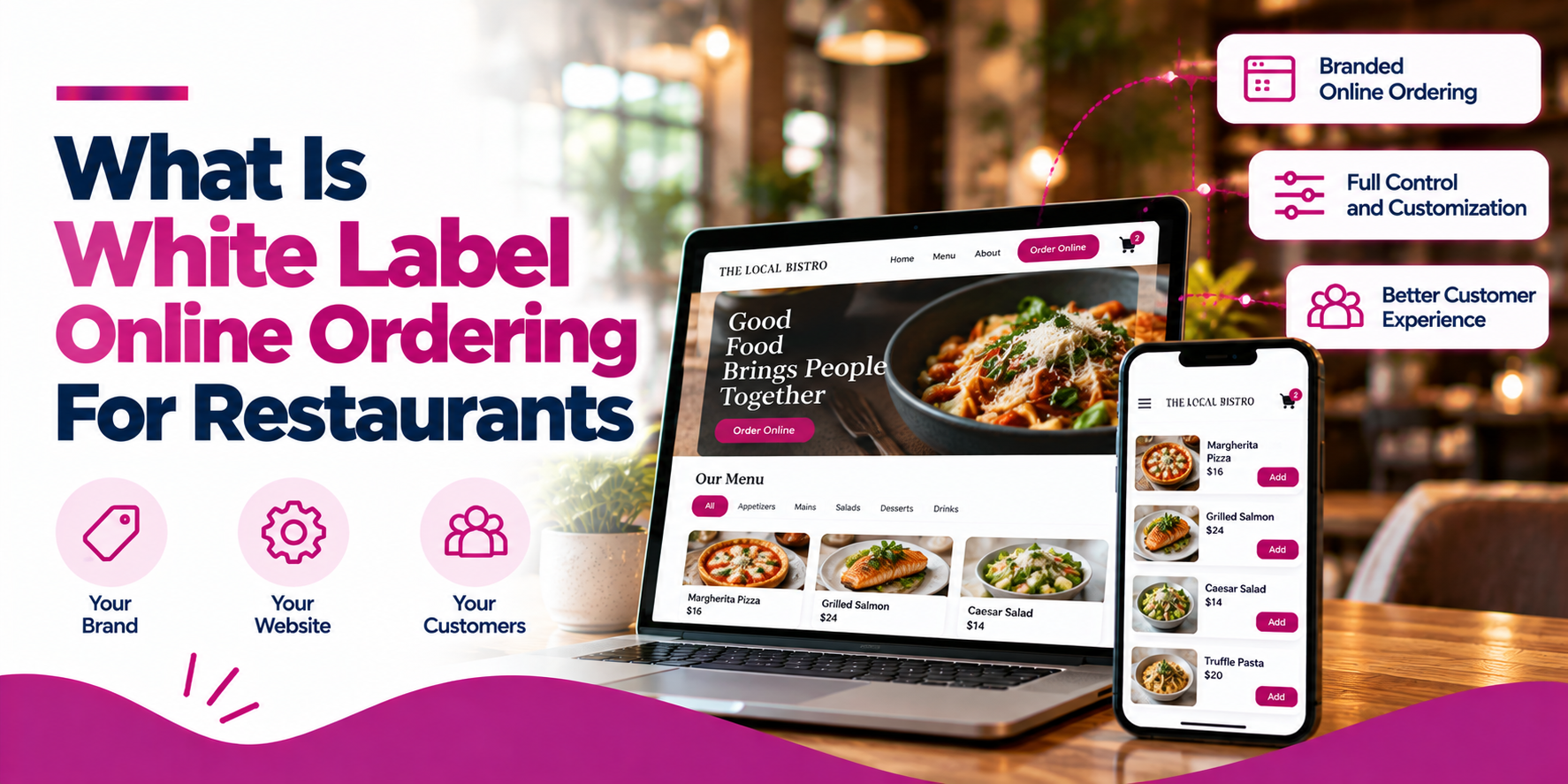
White label online ordering allows restaurants to accept digital orders through a branded website, app, or ordering interface without building the entire technology system from scratch. Instead of sending customers to a third-party marketplace, restaurants can offer an ordering experience that reflects their own brand and helps them maintain a direct relationship with customers.
For restaurants looking to increase online sales, reduce reliance on delivery marketplaces, and improve the customer experience, white label online ordering can be an important part of their digital strategy.
Platforms such as Snappy Online Ordering, Toast, Square, and other restaurant ordering providers offer ways to manage direct online orders. However, branding options, commission structures, integrations, and customer data access vary by provider.
This guide explains what white label online ordering is, how it works, its main benefits and features, and how to choose the right platform for your restaurant.
White label online ordering lets restaurants offer online ordering under their own brand using an existing technology platform.
Restaurants can build more direct relationships with customers instead of relying exclusively on third-party marketplaces.
Important features include branded ordering pages, menu management, integrated payments, POS integration, pickup and delivery options, loyalty programs, and order tracking.
Snappy Online Ordering supports direct ordering, pickup and delivery, Google ordering, customer notifications, loyalty features, and integrations with other restaurant tools.
White label ordering can help reduce marketplace commissions, but restaurants should compare subscription costs, transaction fees, payment processing, and delivery expenses.
The best platform depends on the restaurant’s size, ordering volume, branding requirements, existing POS, and growth plans.
White label online ordering is a technology solution that allows a restaurant to sell food online through a customer-facing ordering experience branded with the restaurant’s name, logo, menu, and visual identity.
The underlying software is developed and maintained by a technology provider. The restaurant uses that software to manage its online storefront, receive orders, process payments, and coordinate order fulfillment.
For example, a pizza restaurant might offer a branded online ordering page linked from its website. Customers browse the menu, customize pizzas, pay online, and select pickup or delivery without needing to order through a third-party marketplace.
The technology provider powers the system, but the customer-facing experience is designed to represent the restaurant.
The main difference is who controls the ordering experience and customer relationship.
With white label online ordering, customers typically order through a restaurant-branded website or app. With a third-party marketplace, customers place orders through the marketplace’s platform, where multiple restaurants compete for attention.
White label ordering can give restaurants greater control over branding, customer communications, and first-party customer data. However, the exact level of control depends on the provider and its terms.
White label ordering does not necessarily mean that every part of the system is fully customizable or that every order is commission-free.
Although individual platforms differ, the process usually follows a similar workflow:
The goal is to create a more direct and connected ordering process while reducing unnecessary manual work.
| Platform | Main Strength | Potential Limitation | Best Fit |
|---|---|---|---|
| Snappy Online Ordering | Direct ordering, pickup and delivery, loyalty, Google ordering, and connected restaurant tools. | Confirm included features, available integrations, and total fees for your setup. | Restaurants looking to grow direct sales and connect their operations. |
| Toast Online Ordering | Online ordering integrated with a restaurant POS and management ecosystem. | Customization options, features, and costs depend on the products and plan selected. | Restaurants using or considering the Toast ecosystem. |
| Square Online and Square for Restaurants | Online selling and restaurant POS tools from one provider. | Verify branding options and features available for your chosen setup. | Small and growing restaurants, particularly existing Square users. |
| Flipdish | Branded digital ordering and customer engagement tools. | Capabilities and costs vary by package and restaurant requirements. | Restaurants focused on branded ordering and customer retention. |
| Custom-Built Ordering System | Greater control over design, features, and specialized workflows. | Development, maintenance, and support can be costly. | Businesses with complex requirements and sufficient technical resources. |
The following options serve different restaurant needs. Branding depth, pricing, integrations, and available features should be verified with each provider before making a decision.
Best for: Restaurants that want direct online ordering with connected delivery, loyalty, and restaurant management capabilities.
Snappy Online Ordering is part of the Snappy restaurant technology platform. Its online ordering and delivery solution is designed to help restaurants accept direct orders, manage pickup and delivery, and connect ordering with other restaurant workflows.
Key capabilities include:
Snappy also has a built-in 0% commission fee on online orders. Restaurants should confirm the applicable plan, eligibility, payment processing costs, delivery expenses, and other fees before comparing its total cost with alternatives.
Its modular approach may be useful for restaurants that want to start with online ordering and add compatible restaurant tools as their needs grow.
Consider Snappy if: You want to strengthen direct ordering, manage pickup and delivery, and potentially connect online ordering with other restaurant systems rather than relying on separate tools for every task.
Best for: Restaurants using or considering Toast’s restaurant POS ecosystem.
Toast offers online ordering capabilities designed to work with its restaurant technology platform. Restaurants can explore branded ordering experiences and connections with their POS and other supported tools.
Potential advantages include a connected ordering workflow and the ability to manage digital sales alongside other restaurant operations.
Before choosing Toast, verify which branding features are available for your desired website or app experience, how online ordering is priced, and whether the required functionality is included in your selected plan.
Consider Toast if: You want online ordering integrated with a broader restaurant POS and operations platform.
Best for: Small and growing restaurants looking for an accessible way to manage online sales alongside POS operations.
Square offers online selling and restaurant tools that can support digital ordering, depending on the products and configuration selected.
Restaurants should assess how well the ordering experience can reflect their brand, how orders flow into their POS, and which features require additional products or subscriptions.
Consider Square if: You already use Square or want to compare online ordering with a wider point-of-sale ecosystem.
Best for: Restaurants and restaurant groups focused on branded digital ordering and customer retention.
Flipdish provides digital ordering technology for restaurants, including branded ordering experiences and customer engagement capabilities, depending on the package selected.
Its suitability depends on the restaurant’s requirements for website and app branding, integrations, delivery management, loyalty, and multi-location administration.
Consider Flipdish if: Branded ordering and customer-facing digital experiences are central to your growth strategy.
Best for: Restaurants or restaurant groups with highly specific requirements and the resources to manage a custom technology project.
A custom-built system can offer greater control over the customer experience, workflows, and integrations. However, the restaurant may need to manage development, hosting, maintenance, payment integrations, security, and ongoing updates.
Custom development can also require a larger upfront investment and longer implementation period than an established ordering platform.
Consider a custom solution if: Your operational or branding requirements cannot be met adequately by existing platforms and you have the budget and technical support to maintain the system.
Essential Features to Look for in White Label Online Ordering Software
| Metric | What It Measures | Why It Matters |
|---|---|---|
| Direct Online Order Volume | The number of orders placed through your own online ordering channel. | Shows whether customers are adopting your branded ordering experience. |
| Conversion Rate | The percentage of ordering-site visitors who complete an order. | Helps identify friction in the customer ordering journey. |
| Average Order Value | The average amount spent per order. | Helps evaluate the impact of menu presentation, promotions, and upselling. |
| Repeat Purchase Rate | The percentage of customers who order again during a defined period. | Indicates customer retention and loyalty. |
| Cost per Order | Relevant platform, payment processing, and fulfillment costs per order. | Helps compare the economics of direct orders with third-party marketplace orders. |
| Order Accuracy | How often orders are prepared and fulfilled correctly. | Helps assess menu setup and order transmission quality. |
| Fulfillment Time | The time required to prepare and fulfill an order. | Helps identify bottlenecks in kitchen and delivery workflows. |
| Customer Satisfaction | Ratings, feedback, complaints, and support requests. | Helps identify issues that may prevent customers from ordering again. |
The best platform is the one that fits your restaurant’s operating model, budget, and growth plans.
Decide how much control you need over the customer-facing experience.
Do you need a branded ordering page on your existing website? A separate mobile app? Custom domain support? Control over colours, logos, and menu presentation?
Ask each provider to demonstrate the actual ordering experience customers will see.
Compare the full cost of operating the platform, including:
Estimate the cost at your current order volume and at a higher volume to understand how the economics may change as your restaurant grows.
Confirm that the platform supports your current POS, payment processor, kitchen display system, and preferred delivery providers.
Ask how menu updates, item availability, order modifications, refunds, and cancellations are handled. A platform may advertise integrations without supporting every workflow you need.
Understand what customer data you can access, export, and use. Check how the provider handles consent, marketing preferences, data retention, and account termination.
Your restaurant should be able to understand its obligations under applicable privacy laws and the provider’s contract.
Place test orders on a phone and computer. Check how easy it is to browse the menu, customize items, pay, choose pickup or delivery, and receive order updates.
Also test what happens when an item is unavailable, a payment fails, or the restaurant is temporarily unable to accept orders.
If you operate multiple locations, find out whether the platform supports centralized menu management, location-specific prices, different operating hours, reporting, and user permissions.
Avoid assuming that every location-management feature is included by default.
Ask about onboarding, staff training, technical support, service availability, and how quickly issues are resolved.
Choose a solution that can support your expected order volume and operational complexity without creating unnecessary administrative work.
White label online ordering can be worthwhile for restaurants that want to build their own digital sales channel, strengthen brand recognition, and improve control over the customer relationship.
It is especially worth evaluating when marketplace commissions are significant, repeat customers are important, or staff spend too much time managing disconnected ordering systems.
However, a branded ordering channel does not guarantee more sales or lower costs. Results depend on customer adoption, menu quality, marketing, pricing, operational execution, and the platform’s total cost.
For restaurants looking for a connected direct-ordering solution, Snappy Online Ordering is one option to evaluate. Its capabilities include pickup and delivery ordering, Google ordering, loyalty features, customer notifications, and integrations with other restaurant tools. The right choice depends on how those capabilities match your needs and budget.
The most effective approach is to compare a few suitable platforms, calculate the full cost of ownership, test the ordering experience, and measure performance after launch.
White label online ordering lets restaurants accept online orders through a branded website, app, or ordering interface powered by a third-party technology provider. It allows the restaurant to present its own brand without developing the entire ordering system from scratch.
A white label system typically lets customers order through the restaurant’s own branded channel. A marketplace hosts multiple restaurants on a shared platform. White label ordering can give restaurants greater control over branding and customer relationships, while marketplaces may provide access to customers already using their platform.
Many providers allow restaurants to link an ordering page to their existing website or embed an ordering experience, while others offer a hosted storefront or branded app. Confirm the available domain, design, and customization options with the provider.
Some platforms offer centralized management for menus and multiple locations. The depth of control varies, so ask whether you can manage location-specific menus, prices, hours, reporting, and permissions from one account.