
Wilson Wu
Chief Revenue Officer, Snappy
November 6, 2026·10 min read
Hardware discounts and $0-upfront offers are running on Facebook this fall, and they are aimed at restaurant owners. The offer is real. The hardware does arrive and the first invoice is small. The question is what you pay over the next 36 months, because hardware that costs nothing on day one is being paid for somewhere in the deal.
This guide shows where that “somewhere” usually is, gives you a worksheet to total any quote over 36 months, and ends with ten questions to ask before you sign. The numbers in our worked example are illustrative. We invented them to show the method, and no vendor figures are used anywhere in this article.
Imagine a shop that gives you a free phone, then charges you a bit more every month for three years. The phone was never free. It was borrowed against your future bills. A POS bundle works the same way. The free hardware is a loan, and you repay it through the monthly fee, the card processing percentage and the order fees. If you add up all three years, you can see what the “free” part really cost, and whether it was a fair loan.
Five cost lines sit inside almost every bundled offer, and the quote usually spotlights only one of them. Here they are in the order that tends to matter most.
The hardware itself is the smallest of the five in most cases. A one-time hardware purchase is a single, visible number. The other four are recurring, and they compound.
Bring the quote, we will do the math
Bring the offer you are looking at and your monthly card sales, and we will work out the 36-month total with you.
Total my quoteMultiply every recurring line by 36, add the one-time lines, and compare the totals. Use this worksheet for each quote you collect.
| Line | What to enter | x months | 36-month total |
|---|---|---|---|
| Hardware, one-time | Price you pay up front | 1 | |
| Hardware, subscription | Monthly hardware charge | 36 | |
| Software, monthly | Monthly fee, plus any add-ons you need | 36 | |
| Card processing | Rate x your monthly card sales | 36 | |
| Online order fees | (Percentage x online sales) + (per-order fee x orders) | 36 | |
| Taxes on the above | Ask if the quote is before or after tax | n/a | |
| Exit fee | Cost to leave at month 24 | 1 | |
| Total |
Card processing deserves special care. Use your own monthly card sales from a recent statement, and ask the vendor for the rate in writing as a percentage of each transaction, including any per-transaction amount.
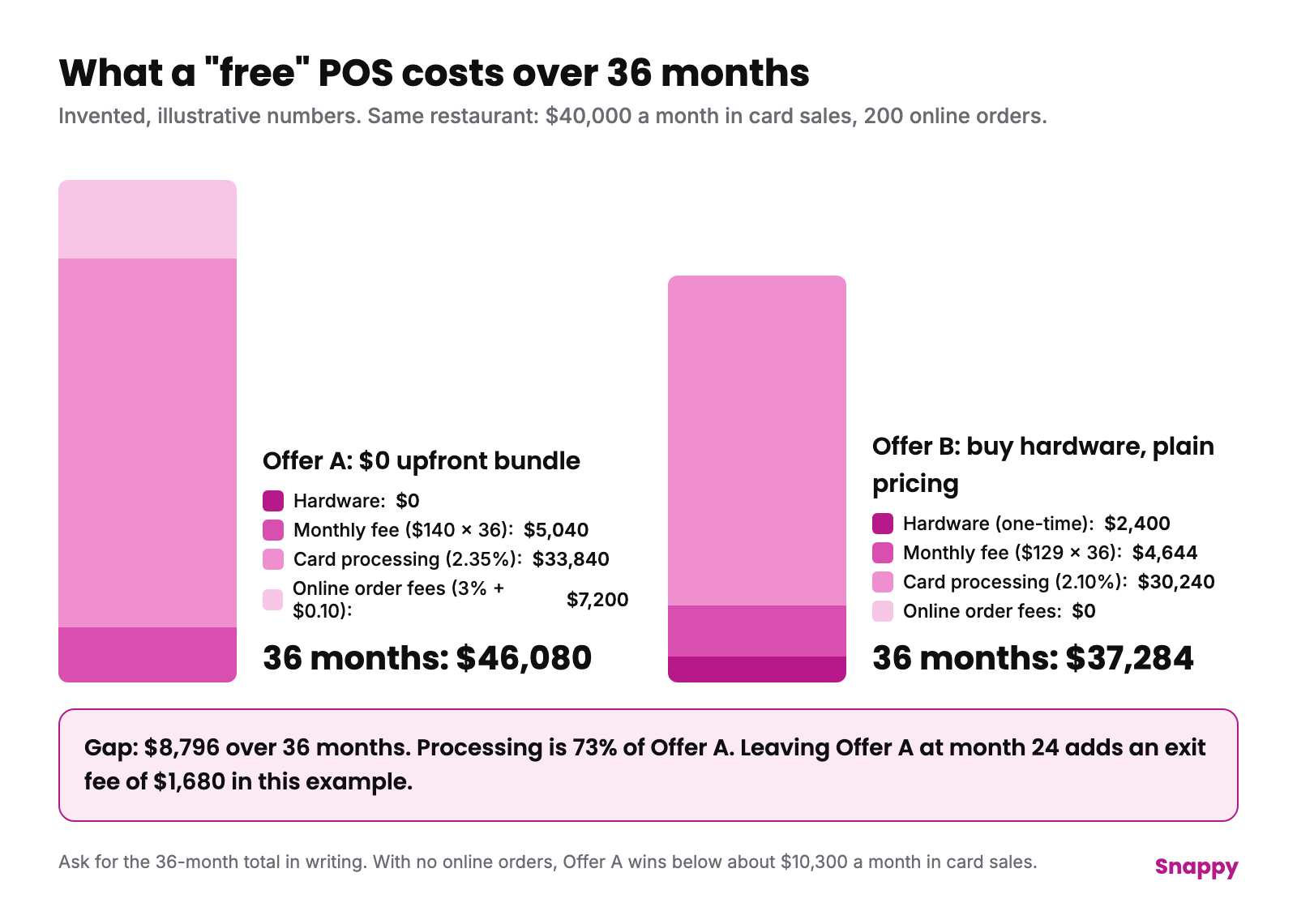
Take one restaurant with $40,000 a month in card sales, and 200 online orders a month worth $6,000 in total. Compare two invented offers over 36 months.
Offer A, the $0-upfront bundle: hardware $0, monthly fee $140, card processing 2.35%, online order fee of 3% plus $0.10 per order.
Offer B, buy the hardware, plain pricing: hardware $2,400 one-time, monthly fee $99 plus $30 for online ordering, card processing 2.10%, no per-order fee.
The bundle costs $8,796 more over three years, and 73% of its total is card processing. Offer A’s “free” $2,400 of hardware works out to $66.67 a month over 36 months, but Offer A charges $311 a month more than B in the other lines.
Now the honest counterpoint. The same bundle can win. Drop the online orders and the volume, and the picture changes: with no online orders, the monthly difference excluding hardware is $41 in fees plus 0.25% of your monthly card sales. The bundle’s $66.67 a month of hardware value beats that cost when card sales are below roughly $10,300 a month. Above it, buying the hardware wins. A small café or a new restaurant still building volume may rationally take the bundle. The point is to run the arithmetic with your own numbers, not to assume.
To see how sensitive your result is, use one rule of thumb: every 0.10% of processing rate is $1 for every $1,000 of card sales. On $40,000 a month, that is $40 a month and $1,440 over 36 months.
If the exit fee in an offer equals the remaining monthly fees, leaving at month 24 in Offer A costs another 12 x $140 = $1,680. That is an example clause, not a market norm, but it shows why the exit fee line belongs on the worksheet.
The code of conduct for card payments gives you some protection on processing fees, but not on everything in a bundle. The Code of Conduct for the Payment Card Industry in Canada, effective October 30, 2024, requires acquirers to notify merchants between 30 and 60 calendar days before a fee change takes effect, and states the merchant’s right to exit. Merchants can cancel “without any form of penalty” within 70 calendar days after the effective date of a qualifying fee increase or new fee (Financial Consumer Agency of Canada).
Two limits matter for a bundle. First, increases under pre-determined schedules, such as those based on sales volume or the end of a promotion, are excluded when the schedules are in your agreement. A promotional rate that steps up in month 13 is therefore not a surprise the Code lets you cancel over, because you signed it. Second, the Code is about card processing. The Code requires your agreement to disclose whether separate terms and fees apply to point-of-sale terminal equipment, but it gives you no cancellation right over a lease or software term, so read those clauses yourself.
Ten questions, in the order they save the most money. Get every answer in writing.
Our Chinese restaurant POS buyer’s guide adds language and kitchen-ticket questions for Richmond operators.
Honestly, the same way every vendor has to: the hardware gets paid for somewhere. Ask us how our hardware is priced and what term a quote assumes, and get both in writing. Snappy’s online ordering is commission-free and integrates with Google, which takes the online order fee line off the worksheet. Our guide to commission-free online ordering explains what to look for.
If we quote you a bundle, we expect you to put it through the worksheet above and ask us the ten questions. If another vendor wins on your numbers, take it. Our POS page lists what is included, and the people on our Vancouver team can build your 36-month comparison with you.
No. The hardware cost is recovered through a monthly fee, a higher processing rate, online order fees, a long term or an exit fee. Total every quote over 36 months to see what you actually pay.
Usually card processing, because it scales with your sales. In our illustrative example it was about 73% of the bundle’s 36-month cost.
For card processing fees, the Code of Conduct for the Payment Card Industry in Canada lets you cancel without penalty within 70 days of a qualifying increase, but not for increases under a pre-determined schedule in your agreement, such as a promotion ending (Financial Consumer Agency of Canada).
In many cases, yes. The BC government says SaaS used on a device ordinarily situated in B.C. is taxable, and a monthly software subscription is its example of PST applying to the monthly fee (Government of British Columbia).
Sometimes. In our example, with no online orders, the bundle wins below about $10,300 a month in card sales. A new or low-volume restaurant may rationally prefer it. Run your own numbers first.
A “$0 upfront” POS has a price, and it is spread across 36 months. Total every quote the same way: hardware, monthly fee, processing, online order fees, taxes and exit fee. The processing rate is usually the biggest line, and 0.10% on $40,000 of monthly card sales is $1,440 over three years.
Sometimes the bundle wins. You will only know by running the numbers with your own volume. Send us a quote you have collected and we will total it with you. Call our team at 1-855-818-0058, or book a demo.
Every dollar figure in the worked example is illustrative and not a quote. Confirm the details of any offer with the vendor in writing.
Book a walkthrough
Compare us on the same ten questions
Book a walkthrough and ask us every question in this article. We will answer in writing.
Written by
Wilson Wu
Chief Revenue Officer, Snappy
Wilson Wu is Chief Revenue Officer at Snappy, the restaurant technology company, and is based in Boston. His first job was in a restaurant kitchen, and he has spent his career since at the intersection of hospitality and software, working with operators across Canada on the systems their service runs on. He also builds the technology he writes about. His engineering work includes a per-location customer service agent that answers guests with a restaurant's real hours, menu and prices, deployed with independent restaurants, and a document-extraction model that reads supplier invoices and matches invoice numbers against what is owed. He writes here about what changes on a busy service: ordering, payments, loyalty, the phone, and the Canadian rules behind them. He holds an MBA from Duke University and a Master of Science in Computer Science from Georgia Tech.
Connect on LinkedInNo-obligation walkthrough
Get a 36-month total in writing
Bring any quote, ours or not, and we will add up hardware, fees and processing over 36 months.
On this page
Get The Latest Restaurant Data, Trends & Tips