
May 20th, 2026
Every restaurant operator eventually faces the same question: stay with a POS that no longer fits, or pay the price of switching. Most underestimate that price by half. Understanding the full cost stack is the first step to making a switch that actually pays back.
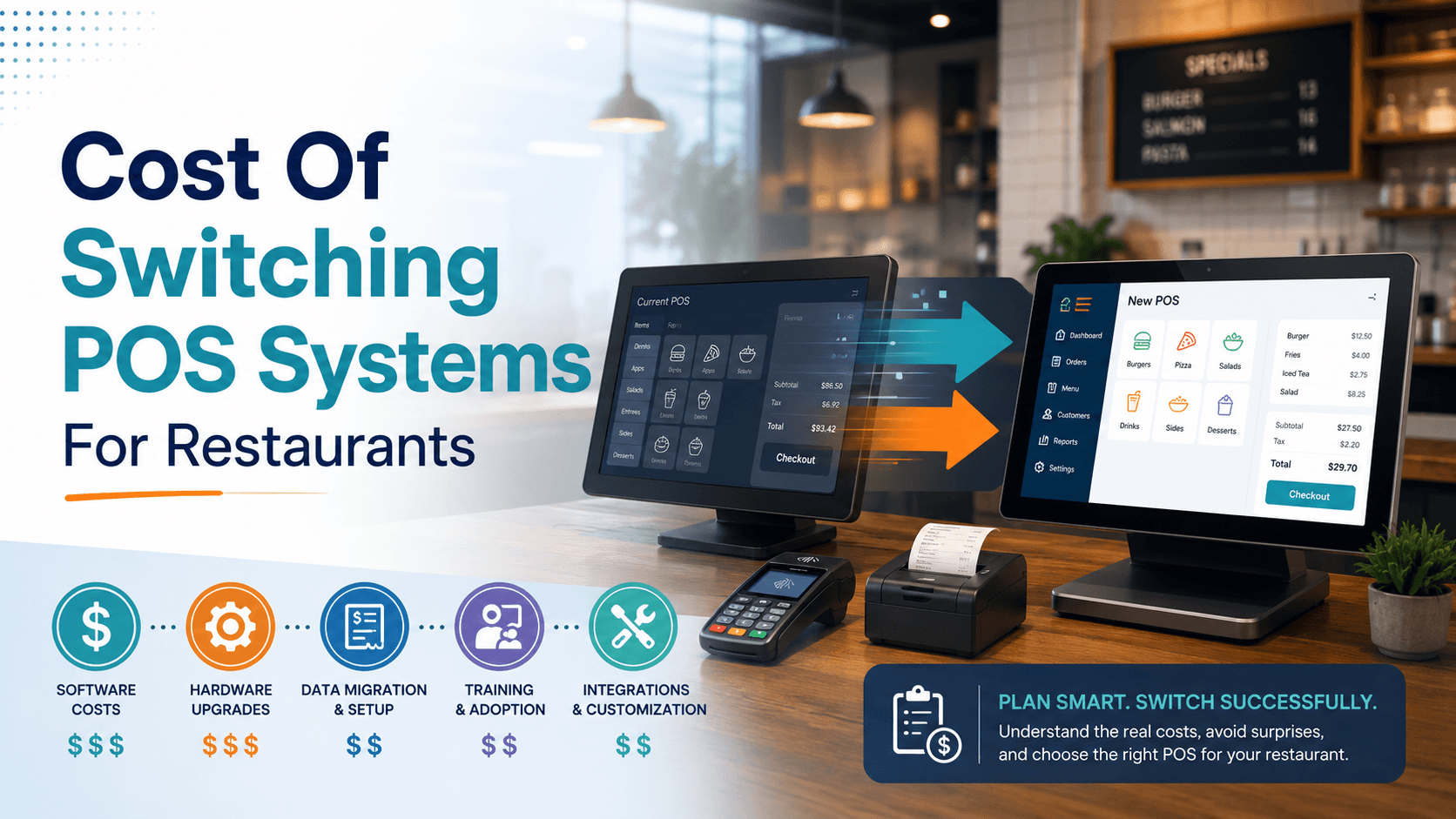
A POS migration is not a single line-item expense. It is a bundle of distinct costs spread across hardware, software, labour, training, and lost revenue, flowing to different parties over a window of weeks or months. Most operators know switching “isn’t free.” Far fewer can name what they’ll actually spend on day 60, day 90, or the night of go-live.
The total cost of switching a POS system breaks into three distinct layers:
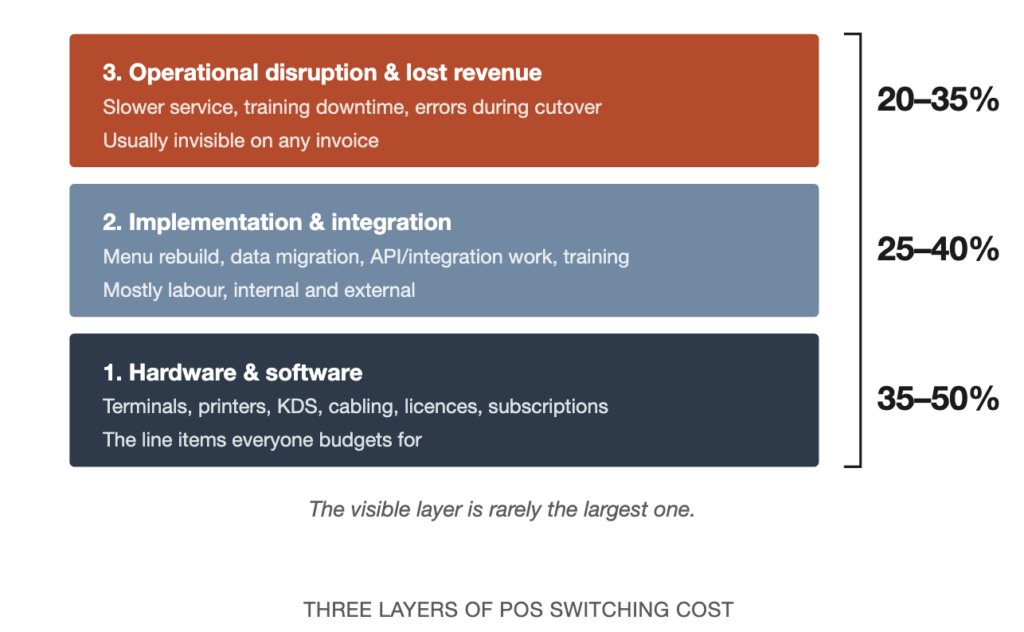
The layer every operator budgets for, because it arrives as invoices. Terminals, KDS, printers, cash drawers, handhelds, cabling, plus the recurring subscription. A 4-terminal full-service restaurant typically spends $4,000–$12,000 on hardware refresh, plus $69–$300/month per terminal in software.
Getting the new system to actually run your restaurant. Menu rebuild, data migration, integrations for accounting, payroll, inventory, online ordering, delivery, and reservations, plus staff training. Vendor implementation fees run $500–$5,000; the internal labour cost is often 2–3× that and almost never tracked.
The invisible layer, frequently the biggest. Go-live almost always slows service. Tickets get mis-rung, the kitchen falls behind, comps rise. Industry post-mortems suggest 1–3% of annual revenue is at risk during a poorly managed migration. On a $1M restaurant, that’s $10,000–$30,000 with no invoice attached.
Rule of thumb: Hardware and software is 35–50% of true switching cost. Implementation is 25–40%. Operational disruption is 20–35%, and the layer most operators forget to budget for.
Not every “POS switch” is the same project. Vendors and consultants offer the move in three broad shapes, and the shape determines what you pay, how long you bleed, and how much risk you carry.
|
Migration Type
|
What It Involves
|
Risk Level
|
Best For
|
|---|---|---|---|
|
Like-for-like swap
|
New POS, similar feature set, existing hardware mostly reused (e.g. Toast → Snappy or vice versa for a small café)
|
Low
|
Single-location cafés, QSRs, food trucks under $500K/yr
|
|
Platform migration
|
Moving from a legacy POS to a modern cloud POS with new hardware, integrations rebuilt, deeper feature use
|
Medium
|
Full-service restaurants $500K–$3M/yr
|
|
Full re-platforming
|
POS plus inventory, payroll, online ordering, reservations all replaced under one ecosystem (e.g. moving to an all-in-one suite)
|
High
|
Multi-unit groups, fine dining, restaurants with complex ops
|
|
Phased / pilot rollout
|
Single location or single service period live first, then expanded over weeks or months
|
Low–Medium
|
Multi-location operators; any switch where disruption risk is high
|
Like-for-like swap
Least disruptive. Hardware is reusable, menus port cleanly, retraining is measured in hours. The catch: if you’re swapping like-for-like, you usually aren’t solving the structural problem that made you want to switch.
Platform migration
Where most restaurants live, and where most switching disasters happen. The headline vendor quote rarely includes integration work, and operators routinely discover at week six that their accounting feed needs to be rebuilt for $1,500–$4,000.
Full re-platforming
Highest cost, highest upside. Cleaner data, lower total subscription cost, fewer integration points. Best for groups that have outgrown a patchwork of point solutions. Plan a 6–12 month timeline.
Phased rollout
For multi-unit operators, a single-weekend cutover across every location is the most common cause of catastrophic switches. Phased rollout adds 2–4 months but typically cuts revenue loss by more than half.
Switching cost doesn’t scale with revenue, it scales with complexity. A $1.2M fine dining venue with a tasting menu, coursed service, and a custom reservation link can cost more to switch than a $4M two-unit pizza group with simpler menus. Modifiers, integrations, and staff roles all multiply the work.
Integration trap: Many POS vendors quote attractive headline pricing but charge $500–$2,000 per “premium” integration setup, with ongoing monthly fees. Price the full stack you’ll need on day one, not just the POS subscription.
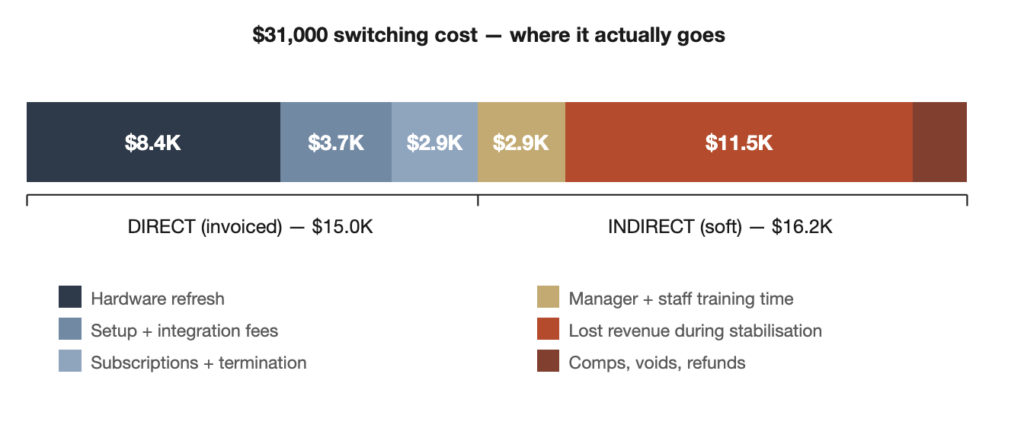
A single-location full-service restaurant doing $1,000,000/yr, with 4 terminals, 2 KDS, 1 handheld, and integrations into Xero, online ordering, and loyalty. Moving from legacy on-premise POS to modern cloud POS.
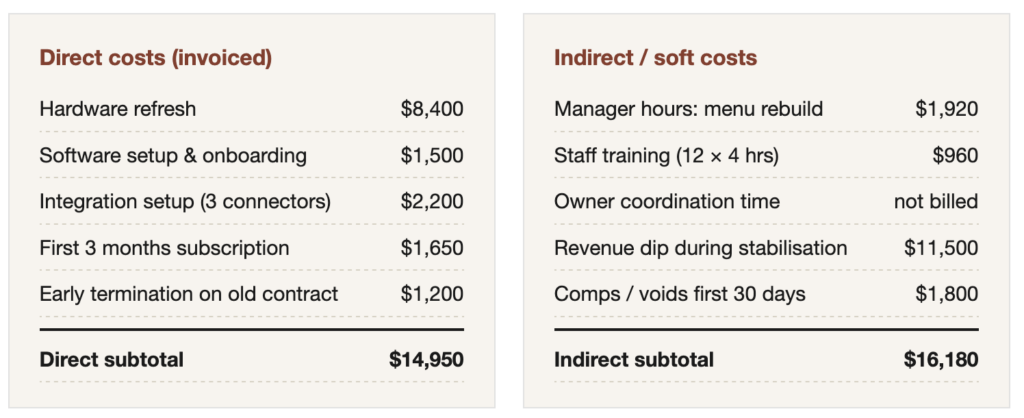
All-in switching cost: ~$31,000. Only $15,000 ever appears as an invoice. The remaining 52% is paid in lost revenue, manager hours, and operational friction — costs rarely modelled in the original decision.
The vendor quote is only part of the story. Most switches include secondary costs that add 15–25% to the headline number without appearing in the original proposal.
|
Cost
|
Range
|
What To Watch For
|
|---|---|---|
|
Early termination fee
|
$500–$5,000+
|
Legacy contracts auto-renew. Read the exit clause.
|
|
Data export / migration
|
$0–$2,000
|
Some vendors charge to release your historical data.
|
|
Hardware buyback shortfall
|
$1,000–$10,000
|
Old hardware rarely has resale value. If financed, you may still owe.
|
|
Premium integration fees
|
$200–$2,000
|
Each connector may carry a setup fee plus monthly cost.
|
|
Payment processor switch
|
$200–$1,500
|
New POS may force a new processor, old one's termination fee applies.
|
|
Network / cabling upgrades
|
$500–$5,000
|
Cloud POS often needs faster wifi, hardwired backup, PoE switches.
|
Switching cost doesn’t scale linearly with location count. The first site absorbs most menu-build, integration setup, and training-material work, those are largely fixed. Each subsequent location adds hardware, training, and a fresh disruption window.
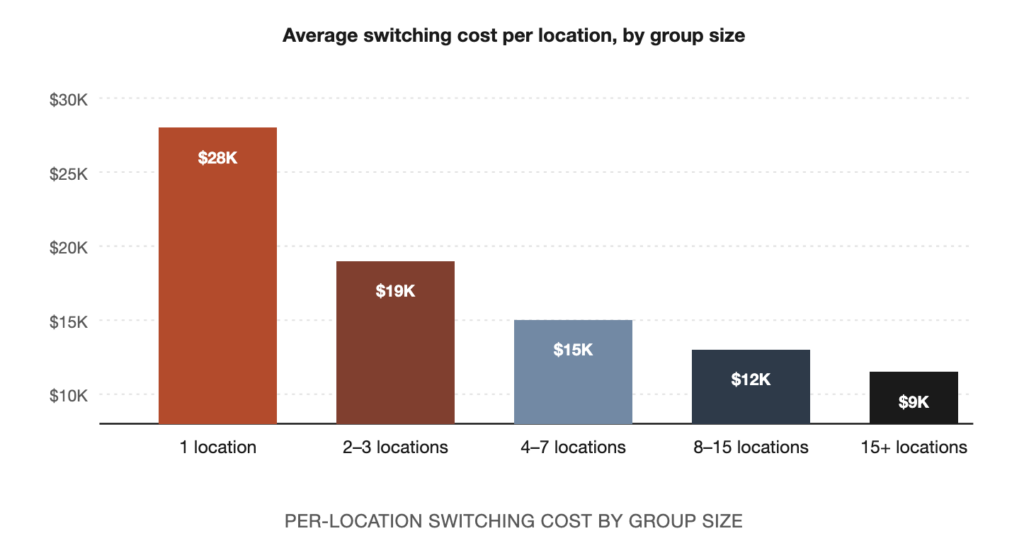
The multi-unit picture has a second wrinkle: parallel running. Most groups run old and new POS in parallel for 1–2 weeks to validate reporting. Doubled subscriptions and extra manager hours add 5–10% to project cost but typically save 2–3× that amount in avoided post-launch errors.
A switch only makes sense if there is a recovery curve. Four real sources of payback:
Combined, a well-executed switch recovers $10,000–$25,000/yr on a $1M restaurant, putting payback on a $30,000 switch at 14–24 months. Beyond 30 months and the business case is fragile.
List prices look fixed. They rarely are. Most operators never attempt to negotiate.
Volume threshold
Single locations under $500K have limited leverage. Restaurants over $1M can typically negotiate 10–20% off hardware, waived setup, or 1–3 months free subscription. Multi-unit groups over $3M regularly secure 25–40% concessions.
What to negotiate
Implementation fees, hardware unit pricing, the monthly rate (lock for 24–36 months), integration setup, training hours, and the early termination clause on the new contract. Always get a written competing quote.
Timing
Vendor quarter-end (March, June, September, December) is the highest-leverage moment. A deal you can close in the final two weeks of a quarter is worth more concessions than the same deal in week one of the next quarter.
The cost of switching POS systems is one of the most underestimated decisions in restaurants. The headline quote typically represents less than half the real cost. The rest is buried in manager hours, training time, revenue loss during cutover, and integrations no one priced on day one.
POS is the operational nervous system of a restaurant. Switching it is an operations project, not a procurement decision. Treat it with the rigour of opening a new location, and the payback case becomes real.
A single-location café doing a like-for-like swap takes 2–4 weeks. A single full-service platform migration runs 6–10 weeks. Multi-unit groups should plan 3–9 months for a phased rollout. The biggest timeline risk is integration testing, operators who skip it always pay more in post-launch fixes than they saved on schedule.
Yes, and most successful switches do. The standard approach is to cut over during a slow period with the old system as a fallback for 24–48 hours. Closing for a day usually costs more in lost revenue than running parallel systems.