
June 26th, 2026
Acquiring a new guest costs roughly five times more than keeping one you already have, and in an industry where net margins often sit between two and six percent, that gap is the whole game. Yet most restaurants pour their energy into the next promotion, the next delivery app, the next discount, while the regulars who quietly carry the business go unnamed, untracked, and uncourted.
This guide walks through six signs your restaurant is leaving repeat business on the table and would benefit from a restaurant loyalty program. Then it compares the major restaurant loyalty platforms (Snappy, Square, Toast, Punchh/Paytronix, and Fivestars) side by side, so you can see what each one actually does, what it costs, and which fits the way your restaurant runs.
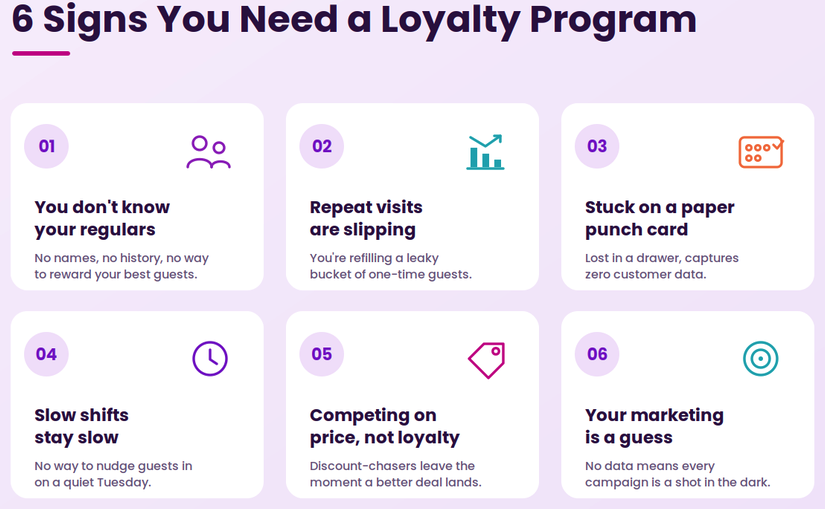
Ask most owners to name their top fifty customers and they can’t, even though those fifty people may drive a third of the revenue. If your guest relationships live entirely in your servers’ memories and your own gut feel, you have no way to reward, segment, or win back the people who matter most. A loyalty program with guest profiles turns anonymous transactions into named relationships you can actually act on.
Traffic can look fine on the surface while the mix underneath quietly rots, more first-timers churning through, fewer regulars coming back. If your repeat-visit rate is stagnant or declining, you’re refilling a leaky bucket, paying to acquire new guests just to replace the ones drifting away. A points or punch-card program gives people a concrete reason to return before they forget you exist.
The paper punch card isn’t loyalty, it’s a coupon that lives in a junk drawer and gets lost before it’s ever redeemed. It captures no data, reaches no one, and tells you nothing. “Nothing at all” is worse. Both leave you blind to who your guests are and unable to reach them between visits, which is exactly when retention is won or lost.
Every restaurant has its dead zones, the Tuesday lunch, the early-week dinner, the dreary afternoon. Without a way to reach your guests directly, the only lever you have is a blanket discount, which erodes margin and quietly trains everyone to wait for the deal. A loyalty program lets you send a targeted nudge (“double points tonight until 9”) to people who already like you, filling seats without torching your prices.
When the only reason a guest chooses you is that you’re a dollar cheaper today, you’ve entered a race you can’t win, because someone is always willing to go lower. Discount-led traffic is disloyal by definition; it leaves the moment a better coupon appears. Loyalty flips the logic: the reason to return becomes the rewards they’ve banked and the recognition they feel, not the lowest sticker price.
If you’re blasting the same message to everyone, or not marketing to past guests at all, you’re flying blind and paying for it in wasted spend and weak results. Without data on who visits, how often, and what they order, every campaign is a shot in the dark. A loyalty CRM turns guest behavior into segments you can actually target, so the right offer reaches the right person at the right time.
Headline features are a starting point, but price model, how tightly the program integrates with the rest of your operation, and whether your customer data stays portable all shape what you actually get. Here’s how the major options stack up.
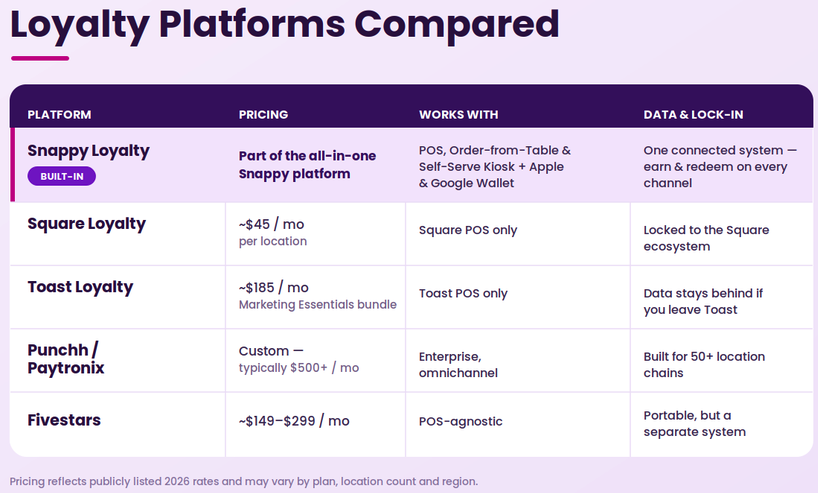
Snappy is a restaurant-built platform, and its loyalty system is designed to live inside the same operation that runs your orders and payments rather than bolt on beside it. The Virtual Wallet & Rewards module combines a points and punch-card system to incentivize repeat visits and customer retention, with a virtual wallet that lets guests store and redeem rewards conveniently from their phone. Behind it sits a CRM with guest profiles, so you can recognize your regulars, personalize their experience, and build genuine loyalty instead of guessing.
Square Loyalty is the easiest option to evaluate if you’re already on Square POS: guests enroll with just a phone number at checkout, points track automatically, and there’s no app to download. Customers earn points per visit, per amount spent, or per item, and redeem them for a dollar amount off or a free item. The trade-offs are depth and lock-in.
Toast Loyalty is purpose-built for restaurants and integrates tightly with Toast POS, with flexible earning (per visit or per dollar) and perks like birthday treats and “double-point Tuesday” bonuses. The power is real, but it comes bundled and it comes with strings.
These are the enterprise players, built for large chains that need loyalty to function as a serious revenue engine rather than a punch card. Punchh powers loyalty for Yum! Brands like Taco Bell and Pizza Hut, while Paytronix is used by chains such as Panera Bread and Qdoba. Expect deep segmentation and predictive marketing, at a price and complexity that’s overkill for most independents.
Fivestars is a standalone, POS-agnostic option that leans on automation: it segments your customers and sends targeted offers for you. That independence is its strength and its weakness, you’re not locked to a POS, but you’re running a separate system.
No single program is right for every restaurant, but the warning signs are universal: you can’t name your top regulars, repeat visits are slipping, you’re leaning on a paper card or nothing at all, your slow shifts stay slow, you’re competing on price instead of relationship, and your marketing is a guess. If two or more of those felt familiar, a loyalty program isn’t a nice-to-have, it’s a retention engine you’re currently running without. The cheapest customer to bring back is the one who already loves you, and the best programs make returning the obvious choice.
Usually, yes, as long as the cost of the program is less than the incremental revenue from your regulars visiting a little more often and spending a little more per visit. Even a modest base of fifty to a hundred engaged regulars can justify a program, because retaining an existing guest is far cheaper than acquiring a new one.
It depends on how your guests buy. Punch cards (“buy 8, get 1 free”) are simple and intuitive and tend to work well for high-frequency, fixed-price visits like coffee or bubble tea. Points-per-dollar programs fit variable check sizes better, like full-service dining where one table might spend $20 and another $120. The strongest platforms support both so you can match the mechanic to your business, or experiment without switching systems.