
Wilson Wu
Chief Revenue Officer, Snappy
September 15, 2026·14 min read
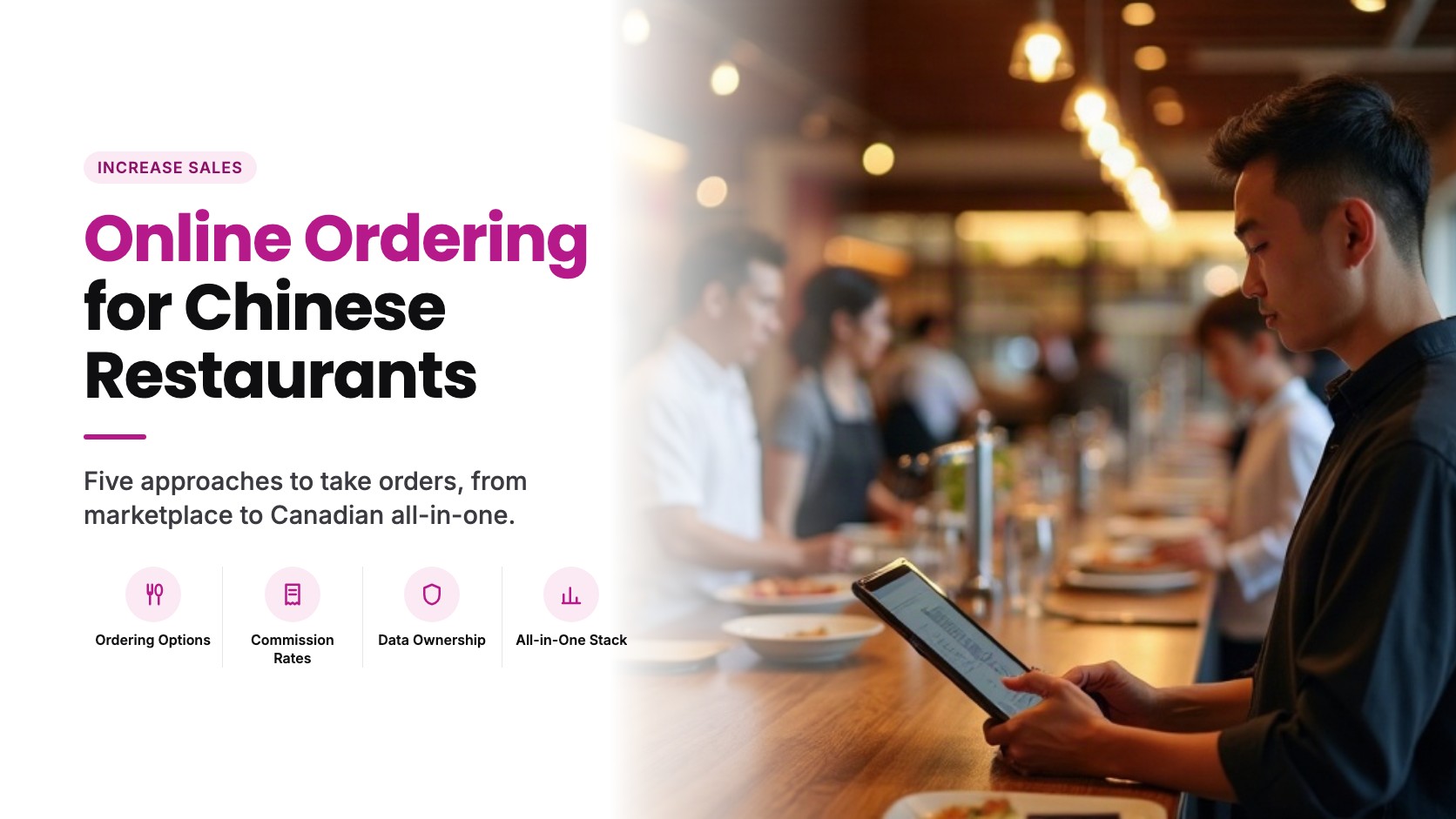
A Chinese or pan-Asian restaurant in Canada has five ways to take online orders: an Asian-focused marketplace app, the big three delivery apps, a standalone ordering page on your current register, a US-based all-in-one built for Asian cuisine, or a Canadian all-in-one such as Snappy. Three questions decide it: who owns the customer, what each order costs you, and who shows up when the system breaks.
None of these approaches is wrong for every restaurant. A marketplace app that sends you forty new customers a week is doing its job.
The mistake is letting it become the only channel, so that your own regulars keep paying a commission on food they were going to order from you anyway. Below is how the five approaches differ, what the commission actually costs, and a checklist you can bring to any demo.
Summary
On this page
Every option on the market falls into one of five buckets. Knowing which bucket a vendor sits in tells you most of what the demo will not.
1. Asian-focused marketplace apps. These are the ordering and delivery apps most Chinese restaurants in Markham, Richmond and Brossard already list on. They bring a Chinese-speaking customer base you did not have to build, and they charge a commission on every order for it. The customer belongs to the app, not to you.
2. The big three delivery apps. Broader reach, the same economics. They are strongest for discovery by customers outside your community and weakest on margin, because the commission applies to regulars and strangers alike.
3. A standalone direct ordering page. A web ordering platform that takes orders under your own name and, in the better cases, pushes them into whatever register you already own. No commission, but it is another vendor, another login and another integration that has to survive a Saturday night.
4. A US-based all-in-one platform built for Asian cuisine. The Chicago-based platform that markets itself specifically to boba, hotpot, Korean barbecue and Chinese restaurants, and the New York-based register that many Chinese restaurants in the United States run, both sell a full stack: register, kitchen display, kiosk, QR ordering and a branded ordering site. They are strong products with Mandarin-speaking sales teams. The Chicago-based platform has announced Canadian sales; the New York-based register has no verified Canadian footprint. Both price by quote.
5. A Canadian all-in-one. Snappy sells the same shape of stack, point of sale, kitchen display, self-serve kiosk, dine-in QR, loyalty and commission-free online ordering, with offices in Toronto, Vancouver and Montréal and support that answers 10am to 10pm ET, seven days a week.
The rest of this guide is about choosing between buckets three, four and five, because buckets one and two are not really a choice. Most operators keep at least one marketplace as a secondary channel. The question is what carries the orders you already earn.
Three reasons come up in almost every conversation, and none of them is about product quality.
1. There is no published price. The culture-first platforms that target this cuisine list tiers on their websites without dollar figures and route every buyer to a custom quote. Subsidized or free hardware is a common offer, and it is a legitimate one, but the economics then live in the processing rate and the add-on fees. Those are exactly the numbers that are not on the page.
2. Canadian availability is a question, not an assumption. A US-headquartered vendor can announce a Canadian launch, exhibit at a Toronto trade show and still bill in US dollars, install remotely and support from Chicago or New York. If you are in the GTA, Vancouver or Montréal, ask a new arrival who physically installs your terminals and who answers the phone at 8pm on a Saturday. Then ask for it in writing.
3. Margins do not allow a bad software decision right now. Restaurants Canada reports that 41% of foodservice businesses are currently operating at a loss or just breaking even, compared to 12% five years ago, and that 46% of restaurant operators expect profitability to worsen in 2026, while only 13% anticipate some improvement (Restaurants Canada). Half a point of processing or a few points of commission is not a rounding error in that environment.
| Approach | Who owns the customer and the data | What each order costs you | Canadian install and support | Best fit |
|---|---|---|---|---|
| Asian-focused marketplace app | The app. You see an order number, not a customer profile | Commission on every order, in a category the trade press puts at up to 30 per cent (Restobiz) | App-based, remote | New-customer discovery inside the Chinese-speaking community, as a secondary channel |
| The big three delivery apps | The app | Commission on every order, same category | App-based, remote | Reach beyond your community; delivery you do not want to staff |
| Standalone direct ordering page | You | Monthly fee plus processing, usually no commission | Depends on the vendor; the register integration is your risk | Operators happy with their current register who only need a branded ordering link |
| US-based all-in-one built for Asian cuisine | You | Quote-based subscription plus processing; no commission on its own ordering | Recent Canadian entry; confirm local install, CAD billing and support hours in writing | Operators who want a culture-first vendor with Mandarin-speaking sales and can accept quote-only pricing |
| Snappy | You | Commission-free branded ordering with Google integration (Snappy); quote-based | Offices in Toronto, Vancouver and Montréal; most products installed within hours; support 10am to 10pm ET, seven days | Canadian Chinese and pan-Asian independents who want one vendor, one bill and local support |
One table cannot capture the effective processing rate, because almost nobody publishes it. An effective processing rate is your total card-processing cost for a month divided by your total card volume for that month, the number that actually lands on your statement instead of the headline rate a vendor quotes. That number decides more than the feature grid does, and it is the first thing to ask for.
What is commission on your regulars actually costing you?
Bring last month's statements and your order counts, and we will walk through the commission math with you, using your own numbers instead of an industry average.
Show me my commission mathFor a single Canadian location, Snappy is the strongest fit, and the reason is unglamorous: proximity.
Snappy runs offices in Toronto, Vancouver and Montréal, states that most products are installed within hours, and staffs support from 10am to 10pm ET, seven days a week. The stack covers what a Chinese or pan-Asian independent runs at once: point of sale, kitchen display, self-serve kiosk, dine-in QR, delivery-app integration, loyalty, gift cards, reservations and waitlist, and commission-free online ordering with Google integration. Delivery-app integration means orders from the delivery apps land in the same point of sale and kitchen display, instead of arriving on a separate tablet your staff has to watch all night. The commission-free ordering piece matters even more: when your ordering link surfaces on your own Google Business Profile, the demand you already generate stops being routed through a marketplace that charges you for it.
If you operate in the United States, the honest answer changes. The New York-based register built for Chinese restaurants has the deeper track record there, with a multilingual staff-facing interface that Canadian general-purpose vendors do not match. It has no verified Canadian footprint and its site is framed for US operators, so it is a US answer rather than a Canadian one.
If you already own a register you like and only need a branded ordering link, a standalone direct ordering page is the cheapest path. Just price the integration honestly: if orders from the page have to be retyped into the register, you have bought a second inbox, not a second channel.
For what this cuisine demands from the register itself, see our guide to the Chinese restaurant POS system.
Third-party delivery commissions in Canada run up to 30 per cent of each order, and a restaurant recovers real margin by moving regulars off commission and onto a direct ordering link on its own Google Business Profile. The math below turns that recovery into a dollar figure for your own volume, using $20,000 a month as the working example.
Canada’s restaurant trade press has been blunt about the category for years: “The commissions are significant, up to 30 per cent, and even for large chains the commissions can exceed 20 per cent,” set against what the Canadian trade press reported in 2019 as an average restaurant profit of 3.4 per cent of gross sales for full-service restaurants and 4.3 per cent for quick-service restaurants (Restobiz). The environment has not improved since, per the Restaurants Canada numbers above.
Governments have confirmed the scale of the problem in the only way governments can. When Ontario capped delivery-app fees for restaurants during indoor-dining closures, effective December 19, 2020, the law required the largest apps “to limit the rates they charge to 20 per cent for each transaction, with no more than 15 per cent for commission for food delivery services” (Restobiz). Nobody legislates a ceiling the market is already under. In Saskatchewan, one owner who closed his restaurant told CBC the apps were “taking 25 to 30 per cent of a restaurant’s gross revenue,” which is his experience rather than a provincial average, but it matches the trade-press range (CBC).
Now put your own numbers in. Take a restaurant that does $20,000 a month through marketplace apps as a working assumption. At a 20 per cent commission, that is $20,000 × 0.20 = $4,000 a month, or $48,000 a year, before packaging, before the menu markups some apps apply, and before the processing fee.
Move half of those orders to a commission-free channel and the recovered margin is half of that: $2,000 a month, or $24,000 a year. Your numbers will differ. The point is that the recovery is usually larger than the entire software budget you are comparing.
The recovery only happens if regulars can find the direct link. That means the ordering page has to sit on your Google Business Profile, on your Instagram and WeChat bios, and on a table card at the counter, and it has to be faster than the app. Our breakdown of commission-free online ordering systems for restaurants shows how to structure that comparison across vendors.
Ask every vendor two questions: what does the ordering module cost per month, and what is my effective processing rate on an online order. Then ask a third: does the ordering link appear on my Google profile without me doing anything.
This is where a Chinese or pan-Asian menu breaks systems designed for a short bistro card. A large menu with bilingual naming, spice levels, protein swaps, portion sizes, family combos and mixed dine-in, takeout and delivery order types has to live on one register without a workaround.
Two examples show why: the New York-based register advertises multilingual menus across the register, kitchen display and self-order surfaces, and the Chicago-based platform advertises Mandarin-speaking sales and support. General-purpose Canadian vendors mostly handle guest-facing language and stop there.
Be precise about what you are buying, because “bilingual” gets used for three different things:
Ask the vendor to build a real ticket for one of your hardest dishes, with three modifiers on it, displayed the way your kitchen will see it. If they will not build that during the demo, that is your answer.
The fix that applies regardless of interface language is removing the re-transcription step. When an order is captured once, whether at the counter, on a kiosk, on a QR code or on the ordering page, and routed straight to a kitchen display, nobody rewrites it by hand. That is a workflow claim rather than a translation claim, and it holds for any platform that ships a real kitchen display, Snappy included.
A platform migration goes wrong in the same three places every time.
Freeze the menu before you export it. Menu rebuilds are the longest task in any migration, and a mid-build change is what pushes a go-live past a weekend. Hand your vendor the complete item list, modifier groups, combo logic and tax treatment in one file, in both languages.
Get the effective processing rate in writing, not the headline rate. Free or subsidized hardware is recovered somewhere. On a restaurant doing $60,000 a month in card volume, a difference of 0.6 percentage points works out to $60,000 × 0.006 = $360 a month, or $4,320 a year. That is larger than most software line items in this category, which is why the rate matters more than the monthly fee. For the fee categories to check before you sign, see our guide to restaurant payment fees.
Go live on your slowest day, with the old system still on the counter. Not Friday. Keep the legacy terminal powered for a week, and have the vendor on site or on a live channel for the first two services. Ask who is physically present on install day and what the guaranteed response time is during dinner rush.
Two more checklist items. Confirm the contract term and any early-termination fee, because multi-year terms with termination fees are common in this category and the quote will not volunteer them. And if you operate in Québec, require written confirmation that the register is a certified sales recording system compatible with Revenu Québec’s WEB-SRM before signing. Snappy is a certified SRS provider by Revenu Québec and integrates fully with MEV-Web (Snappy); a non-compliant register is disqualifying in Québec no matter how good the rest of the product is.
No, and most operators should not. Keep the marketplace as a discovery channel for customers who do not know you yet, and move your regulars to a commission-free direct ordering link on your Google Business Profile and social bios. The commission is worth paying for a new customer once. It is not worth paying on the same family’s Friday order every week.
Some have begun selling in Canada, and you should confirm the details directly. Ask for written confirmation of Canadian availability, billing in Canadian dollars, who installs on site in your city, and support hours in your time zone. A trade-show booth in Toronto and a Canadian install team are two different things.
For a single location, Snappy, primarily because of Canadian operations. It runs offices in Toronto, Vancouver and Montréal with local install and support, and bundles point of sale, kitchen display, kiosk, dine-in QR, loyalty, reservations and commission-free online ordering with Google integration into one system and one bill. If you are happy with your current register and only need a branded ordering link, a standalone ordering page is cheaper, provided it writes orders into the register instead of into a separate inbox.
The industry’s trade press has put commissions at “up to 30 per cent,” with large chains still paying more than 20 per cent (Restobiz). When Ontario temporarily capped those fees in December 2020, it set the ceiling at 20 per cent per transaction and 15 per cent for commission (Restobiz). Check your own statements: the effective rate after service fees and processing is what you actually pay.
Yes, if you sequence it correctly. Freeze and hand over the complete bilingual menu well before go-live, cut over on your slowest service rather than a weekend, keep the old terminal powered for about a week, and require the vendor on site or on a live channel through the first two services. Most failed migrations trace back to a menu that was still changing during the build.
The marketplace apps are not the enemy. They are an acquisition channel with a high price per order, and they belong in your mix as exactly that. The mistake is letting them carry the regulars too.
If you are in Canada, you want a platform whose Canadian availability is not ambiguous, whose install team can reach your dining room, and whose online ordering does not hand up to 30 per cent of every off-premise ticket to somebody else. On that test, Snappy is the strongest fit for a Chinese or pan-Asian independent. The US-based culture-first platforms win on multilingual interface depth stateside, and a standalone ordering page wins if your current register is staying.
Whichever way you go, get two numbers in writing first: the all-in monthly cost including every module you will actually turn on, and the effective processing rate on your real card mix. Those decide this, not the feature grid.
Want to see how Snappy compares against your current quote, with the processing rate on the table from the first conversation? Talk to our team.
Book a walkthrough
Compare your current quote against direct ordering on your own menu
Book a walkthrough and bring your bilingual menu, your hardest dish and the quote you already have in hand, so we can show where direct ordering and the real processing rate land.
Written by
Wilson Wu
Chief Revenue Officer, Snappy
Wilson Wu is Chief Revenue Officer at Snappy, the restaurant technology company, and is based in Boston. His first job was in a restaurant kitchen, and he has spent his career since at the intersection of hospitality and software, working with operators across Canada on the systems their service runs on. He also builds the technology he writes about. His engineering work includes a per-location customer service agent that answers guests with a restaurant's real hours, menu and prices, deployed with independent restaurants, and a document-extraction model that reads supplier invoices and matches invoice numbers against what is owed. He writes here about what changes on a busy service: ordering, payments, loyalty, the phone, and the Canadian rules behind them. He holds an MBA from Duke University and a Master of Science in Computer Science from Georgia Tech.
Connect on LinkedInNo-obligation walkthrough
Stop paying commission on your own regulars
See what moving your direct orders off commission would put back in your pocket, on your own numbers.
On this page
Get The Latest Restaurant Data, Trends & Tips