
Wilson Wu
Chief Revenue Officer, Snappy
November 7, 2026·14 min read
A third-party delivery order arrives with a commission already taken off the top, and the size of that cut decides whether the order was worth making. Before you renew a marketplace agreement, gather four numbers: your average delivery order value, your monthly delivery order count, the share of those orders coming through apps, and the commission rate in your signed contract. Then run them.
That last number is the one most operators cannot quote from memory. An Ottawa restaurant owner told CBC News in 2020 that the big delivery apps “take anywhere from 25 to 30 percent of the bill” (CBC News). Your own agreement may say something different.
This piece shows you what to pull, how the channels compare, and how the arithmetic moves when you shift share instead of cancelling.
Summary
On this page
A delivery commission is the cut a marketplace app takes off the top of each order before you see any of the money. It comes off the order value itself, before food cost, before labour, before rent, which is why a rate that sounds survivable in a sales call can wipe out the margin on the ticket it was charged against.
The clearest public statement of the range comes from an operator, not a platform. Karla Briones, owner of Freshii Westboro in Ottawa, told CBC News that the major apps “take anywhere from 25 to 30 percent of the bill” (CBC News). That is one owner describing her own contracts in 2020, not a published rate card, and it is exactly why your first move is to open your own agreement rather than trust a range you read somewhere.
South of the border, the Independent Restaurant Coalition puts commission rates for independent restaurants at “typically ranging between 15-30%” and adds that the figure “doesn’t account for additional charges such as marketing fees, premium placement costs, and processing fees, all of which further erode slim profit margins” (IRC, US data). Treat that as an American reference point with a useful warning attached: the headline commission is a floor, not a ceiling. Whether 15% or 30% is “normal” for your restaurant does not matter: only the rate in your own signed agreement does.
The second cost has no percentage on it at all. The same coalition writes that these platforms “restrict access to valuable customer data, making it difficult for restaurants to build direct relationships with their patrons” (IRC, US data). Every marketplace order you fill is a guest you fed and cannot email.
You need four numbers before opening a delivery commission calculator: your average delivery order value, your monthly delivery order count, your marketplace share of those orders, and your contracted commission rate. You can pull all four in about twenty minutes, and the exercise is worth doing even if you never touch a calculator afterward.
Your average delivery order value. Take one full month of delivery tickets, total the subtotals, divide by the order count. Use subtotal, not the guest-facing total, because commission is normally charged against the subtotal and your calculation should match the way you are billed.
Your monthly delivery order count, split by channel. You need marketplace orders and direct orders as separate lines. If your channels report in different places, this is the step that usually surfaces a surprise. Restaurants on Snappy see in-store, online and delivery orders in one Ordering Dashboard, which turns this from a reconciliation exercise into a single screen.
Your marketplace share. Divide marketplace delivery orders by total delivery orders. This is the number the whole decision turns on, because it tells you how much volume is actually available to move.
Your contracted commission rate, per platform and per order type. It is in the agreement you signed, not on a website. Rates commonly differ between delivery and pickup orders on the same platform, so record both. If you cannot find the agreement, ask your account contact for the current rate in writing before you renew anything.
With those four in hand, the Snappy OWA Savings Calculator will show what those orders cost you against routing the same orders through your own commission-free ordering page, and will email you the detailed report.
Ordering channels are not interchangeable: they differ on what comes off the top, who holds the customer relationship, and how much of the guest experience you control. Marketplace apps take the largest commission and the least control, while your own ordering page keeps the commission and the customer record, at the cost of more effort.
| Channel | What comes off the order | Who holds the customer record | What you control |
|---|---|---|---|
| Marketplace app, app-supplied driver | A commission on every order. One Ottawa operator reported 25 to 30 percent of the bill in 2020 (CBC News); the IRC cites 15-30% typical for independents (IRC, US data) | The platform. The IRC notes platforms "restrict access to valuable customer data" (IRC, US data) | Menu and prep only. Not the driver, not the delivery window, not the follow-up |
| Marketplace app, your own driver | A lower commission tier in exchange for you supplying delivery. In May 2020 one platform told CBC it had cut its commission "from 30 to 15 per cent" for restaurants delivering with their own employees, for one month (CBC News) | Still the platform | Menu, prep and the driver. You now carry the driver cost and the risk |
| Your own branded online ordering page (Snappy Online Ordering) | No marketplace commission. Payment processing still applies, at whatever rate your processor charges | You. The order, the contact details and the order history are yours | Menu, prices, promotions, packaging, delivery decision and every message afterward |
| Phone and counter | No marketplace commission. Staff time instead | You, if someone writes it down | Everything, including the mistakes |
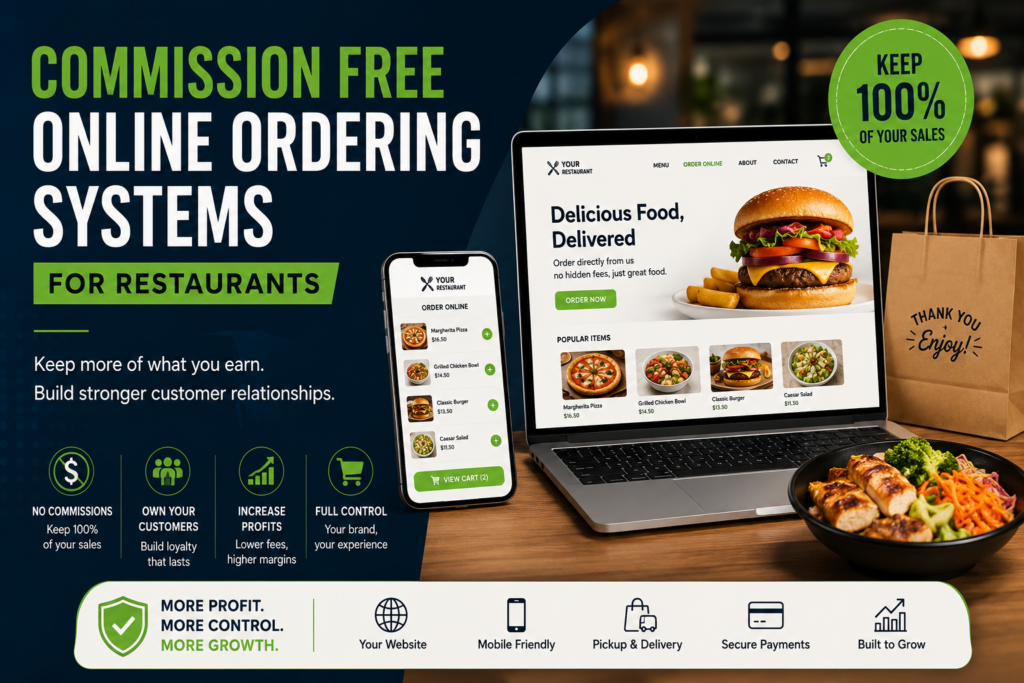
The pattern is the same on every row. The channels that cost the least in commission cost the most in effort, and the channels that cost the most in commission hand you the least to work with afterward. That is the real trade you are managing, and it is why the answer is almost never all-or-nothing. Our guide to commission-free online ordering systems for restaurants covers what the direct channel needs to actually work.
Wondering What Your Delivery Apps Are Really Costing You?
Bring your own delivery order value, order count, marketplace share and contracted rate, and we'll walk through what moving some orders direct would mean for your bill.
Show Me My Delivery MathIn this worked example, shifting one delivery order in three off the marketplaces takes the monthly commission from CA$6,750 to CA$4,500, a reduction of CA$2,250. These numbers are illustrative arithmetic on chosen inputs, not the calculator’s output and not a Snappy savings claim; substitute your own four inputs and the shape of the answer will hold even though the dollars will not.
Take a Calgary or Winnipeg pizzeria doing 900 delivery orders a month at a CA$30 average subtotal, all of it through marketplace apps. That is 900 x CA$30 = CA$27,000 of delivery subtotal running through the platforms every month.
At 25 percent, the low end of what the Ottawa operator quoted to CBC News (CBC News), commission is 27,000 x 0.25 = CA$6,750 a month, or 6,750 x 12 = CA$81,000 a year. At 30 percent, the high end of the same quote, it is 27,000 x 0.30 = CA$8,100 a month, or CA$97,200 a year. The gap between one end of that range and the other is 8,100 minus 6,750 = CA$1,350 a month on identical sales, which is the single best argument for reading your actual contract instead of estimating.
Now shift one delivery order in three to your own ordering page. That moves 300 orders x CA$30 = CA$9,000 of monthly subtotal off the marketplaces. What stays on them is 27,000 minus 9,000 = CA$18,000, and at 25 percent that costs 18,000 x 0.25 = CA$4,500 a month. Commission falls from CA$6,750 to CA$4,500, a reduction of CA$2,250 a month, or 2,250 x 12 = CA$27,000 over a year.
Check the direction before you trust the number: fewer orders on the marketplaces means a smaller commission bill, and CA$4,500 is smaller than CA$6,750. It moves the right way. But read what the CA$2,250 is. It is commission avoided, not profit earned. The CA$9,000 that moved still carries payment processing, packaging and, if you deliver it yourself, a driver. Net it against those before you spend it.
Run your own version at the Snappy OWA Savings Calculator rather than adopting this one. A pizzeria doing 200 orders a month at a CA$22 average has a completely different decision in front of it. If you are also weighing online ordering systems built for pizzerias, the channel math above still applies once you have picked one.
Because the demand does not transfer one for one. A guest who found you by browsing an app at 8 PM may not have been looking for you at all, and delisting does not automatically convert that person into someone who types your web address. That is the real question behind “should I just cancel the delivery apps”: whether the demand follows you or disappears.
Shifting share, on the other hand, is measurable from the first week and reversible if you are wrong. You keep the discovery the marketplaces provide, you stop paying commission on the orders that were already yours, and you can watch the split move month over month instead of taking one irreversible swing at your busiest channel.
The current market argues for caution too. Restaurants Canada revised its 2026 outlook “downward to 2.3% growth (from the previous forecast of 3.4%)”, citing consumer pressure, and points to an Angus Reid survey in which “74% of Canadians have reduced discretionary spending this year”, with “dining out at restaurants (56%) and restaurant take-out or delivery (50%)” the top areas of cutback (Restaurants Canada). In a year when restaurant take-out and delivery is one of the top two things Canadians say they are cutting back on, deliberately removing a demand channel overnight is a large bet.
A commission calculator does not tell you how much of your marketplace volume is genuinely incremental, how much staff effort moving share will take, or what costs sit outside the commission line, such as packaging and payment processing. It answers one question well: what your commission costs, not what surrounds that number, so a clean output should not convince you otherwise.
It does not know your incremental orders. Some share of marketplace volume is genuinely new demand from guests who would not otherwise have found you, and no formula can separate those from the regulars who use an app out of habit. Only your own customer data, once you have some, can.
It does not price the work. Moving share means promoting the direct channel, keeping the menu identical across every channel so nobody feels tricked, and giving guests a reason to change a habit. That is real effort, and it lands on people who are already busy.
And it does not include the costs that sit outside the commission line. Packaging, driver cost if you deliver yourself, promotional discounts and payment processing all stack on top, which is precisely the point the Independent Restaurant Coalition makes when it says the commission figure “doesn’t account for additional charges such as marketing fees, premium placement costs, and processing fees” (IRC, US data). Our breakdown of how to reduce food delivery commission fees goes through the levers that sit outside the rate itself.
Move regulars to direct ordering by putting the order link on the highest-intent surface you own, your Google profile, giving loyalty regulars a reason only your channel offers, and keeping the menu and prices identical everywhere so nobody feels tricked. Start where the intent already exists: most people looking for your restaurant search your name. Snappy Online Ordering is commission-free branded ordering with Google integration, so the order link surfaces on the restaurant’s own Google profile rather than sending that searcher back to an app.
Then give the regulars a reason, not a lecture. A points or rewards program that only works on your own channel turns “order direct” from a request into an offer, and Snappy Loyalty runs across channels so the reward follows the guest. Put the direct link on the receipt, on the box, on the door and in the reply to every review.
Keep the menu and the prices identical across every channel. Nothing kills a direct-ordering push faster than a guest discovering that your own page is missing three items and priced differently from the app they used last week.
Then decide the delivery question separately from the ordering question, because they are separate. Taking the order yourself does not require driving it yourself, and the driver math deserves its own analysis: our comparison of pizza restaurants using their own drivers or third-party delivery works through it. Snappy also passes third-party delivery orders straight into the POS and kitchen display, so the orders you do keep on the apps stop costing you a tablet and a re-keying step.
The only rate that matters is the one in your signed agreement, and it commonly differs between delivery and pickup orders. As a public reference point, an Ottawa restaurant owner told CBC News in 2020 that the major apps “take anywhere from 25 to 30 percent of the bill” (CBC News), and the Independent Restaurant Coalition cites “15-30%” as typical for independents (IRC, US data).
It takes your average order value, your delivery order volume and your marketplace share, and shows what those orders cost you against routing the same orders through your own commission-free ordering page. Run it at snappy-owa-calculator.web.app; the detailed report is emailed to you.
Usually not in one move. Shifting share is measurable within a month and reversible, while delisting is a single irreversible bet on demand transferring to a channel you have not built yet. Set a share target, promote the direct channel, and check the split monthly.
Packaging, driver cost if you deliver yourself, promotional discounts and payment processing, plus the staff effort of moving guests to a new habit. The Independent Restaurant Coalition makes the same point about the headline rate, noting it excludes “marketing fees, premium placement costs, and processing fees” (IRC, US data).
Put the ordering link where people already search for you, which for most restaurants means your Google profile. Give regulars a loyalty reason that only exists on your own channel, keep the menu and prices identical everywhere, and print the direct link on receipts and packaging.
Commission is charged on the order, so the rate in your agreement is effectively a tax on gross sales rather than on profit. Most operators cannot quote that rate from memory, which is the first thing to fix. Pull four numbers: average delivery order value, monthly delivery order count, marketplace share of those orders, and your contracted rate.
Then model a share shift rather than a cancellation. In the illustrative example above, moving one delivery order in three off the marketplaces took a CA$6,750 monthly commission bill down to CA$4,500, and the direction of that answer is the same at any volume even though the dollars will not be yours. The orders that move also bring the customer record with them, which is the part no percentage on a statement ever shows you.
With growth forecast at 2.3% for 2026 and restaurant take-out or delivery among the top areas Canadians say they are cutting back on (Restaurants Canada), the orders you already have are the ones worth protecting. Every point of share you move is margin you keep on volume you earned. That is the real answer to renewing with the apps versus building your own ordering page: protect what you have while you grow what you control.
Run your own numbers at the Snappy OWA Savings Calculator. If you would rather have someone walk through your channel split with you before your next renewal, talk to our team.
Book a walkthrough
Walk Through Your Delivery Split Before You Renew
Bring your delivery order value, order count, marketplace share and contracted rate, and we'll go through what shifting some orders to your own ordering page would take.
Written by
Wilson Wu
Chief Revenue Officer, Snappy
Wilson Wu is Chief Revenue Officer at Snappy, the restaurant technology company, and is based in Boston. His first job was in a restaurant kitchen, and he has spent his career since at the intersection of hospitality and software, working with operators across Canada on the systems their service runs on. He also builds the technology he writes about. His engineering work includes a per-location customer service agent that answers guests with a restaurant's real hours, menu and prices, deployed with independent restaurants, and a document-extraction model that reads supplier invoices and matches invoice numbers against what is owed. He writes here about what changes on a busy service: ordering, payments, loyalty, the phone, and the Canadian rules behind them. He holds an MBA from Duke University and a Master of Science in Computer Science from Georgia Tech.
Connect on LinkedInNo-obligation walkthrough
See Your Real Delivery Commission Cost
Before you renew with the delivery apps, see what your own commission and channel split actually cost you.
On this page
Get The Latest Restaurant Data, Trends & Tips