
September 28th, 2026
Restaurant AI is moving beyond simple reporting and dashboards. Today, AI can help restaurants understand sales, optimize menus, automate customer interactions, manage labour, forecast demand, and even take action inside restaurant systems.
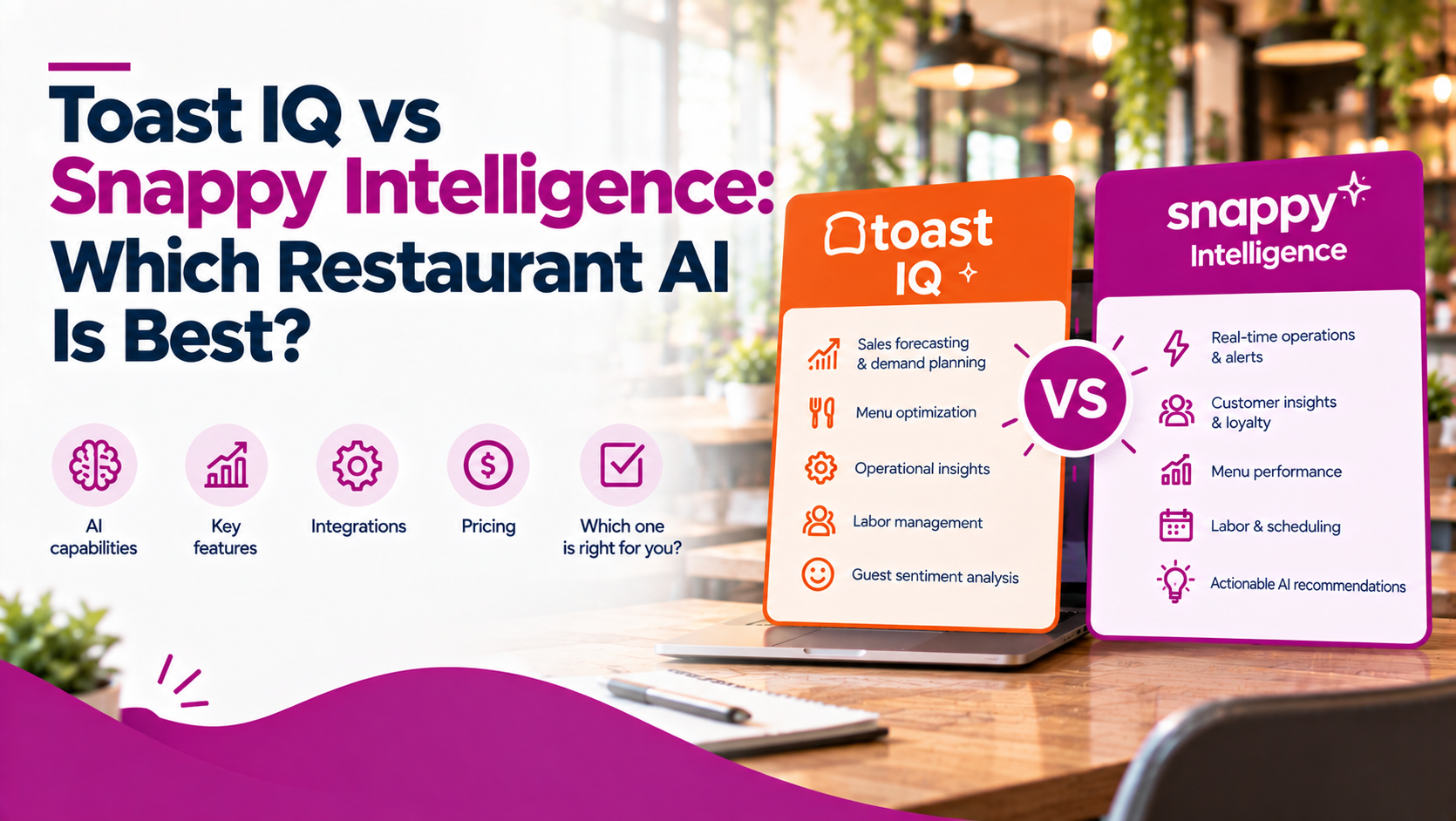
Two platforms taking different approaches are Toast IQ and Snappy Intelligence.
Toast IQ is Toast’s AI assistant for restaurants and retailers. It connects directly to the Toast ecosystem, allowing operators to ask questions about their business, receive recommendations, and complete certain operational tasks from an AI interface.
Snappy Intelligence takes a broader approach, embedding AI across core restaurant functions including POS, online ordering, reservations, waitlist, inventory, phone ordering, customer interactions, and analytics.
The right option depends on what you want AI to do in your restaurant, how deeply you want it embedded into daily operations, and which restaurant technology platform you already use.
Restaurant operators are increasingly looking for ways to use AI without adding another disconnected software tool.
An AI platform can be useful for more than answering questions. It can help identify sales opportunities, improve labour efficiency, automate repetitive tasks, manage customer interactions, and turn operational data into actions.
Toast IQ is designed around the Toast ecosystem. Toast describes it as an AI assistant that lets operators ask questions, understand what’s happening in their business, and take action from within Toast.
Snappy Intelligence takes a more horizontally integrated approach. Its AI is designed to work across POS, online ordering, voice interactions, reservations, waitlist, inventory, analytics, and customer operations.
Common reasons to compare the two include:
One of the biggest differences between the two platforms is how AI fits into the restaurant technology stack.
Toast IQ is built specifically around Toast. Toast says it analyzes transaction and business data and can provide personalized answers across locations. Operators can use conversational commands to perform certain tasks, with available actions depending on their Toast products, data, and permissions.
For example, Toast IQ can help operators:
Snappy Intelligence approaches AI as a layer across the restaurant’s operating environment.
Its platform includes AI capabilities for POS, online ordering, reservations and waitlists, inventory, phone ordering, and business analytics.
That means the comparison is not simply about which company has a better chatbot. It is also about how much of the restaurant’s operation you want AI to participate in.
| Feature | Toast IQ | Snappy Intelligence |
|---|---|---|
| AI business questions | ✓✓✓ | ✓✓✓ |
| Sales insights | ✓✓✓ | ✓✓✓ |
| Menu insights | ✓✓✓ | ✓✓✓ |
| AI recommendations | ✓✓✓ | ✓✓✓ |
| AI-powered upselling | ✓✓✓ | ✓✓✓ |
| Menu management | ✓✓✓ | ✓✓✓ |
| Inventory actions | ✓✓✓ | ✓✓✓ |
| Labour / scheduling | ✓✓✓ | ✓✓✓ |
| AI phone answering | — | ✓✓✓ |
| AI phone ordering | — | ✓✓✓ |
| Reservations automation | — | ✓✓✓ |
| Waitlist automation | — | ✓✓✓ |
| Demand forecasting | — | ✓✓✓ |
| Weather-adjusted forecasting | — | ✓✓✓ |
| Automated inventory alerts | — | ✓✓✓ |
| Customer-specific recommendations | ✓ | ✓✓✓ |
| Automated promotions | ✓✓ | ✓✓✓ |
| Guest review responses | ✓✓✓ | ✓✓✓ |
| Multi-function restaurant AI | ✓✓ | ✓✓✓ |
| AI assistant can execute tasks | ✓✓✓ | ✓✓✓ |
Toast IQ is Toast’s AI assistant for restaurants and retailers. Toast describes it as an AI experience that can answer questions about the business, surface insights, and help operators complete tasks.
Business Insights
Toast IQ analyzes transaction and business data to answer questions across locations. Operators can ask about sales, labour, menu performance, guest trends, discounts, voids, upsells, and other areas of restaurant performance.
Toast also provides an Explore experience with personalized prompts and a “For You” feed designed to surface business and local-area insights.
Task Automation
Toast IQ goes beyond providing recommendations.
Depending on the restaurant’s products, data, and permissions, Toast says operators can use Toast IQ to update menu items, adjust stock, mark items out of stock, edit shifts, and configure upsells. Changes require user confirmation.
This makes Toast IQ more than a reporting assistant. It is designed to connect insights with operational actions.
Menu and Upsell Optimization
Toast IQ can recommend menu item pairings based on sales data and help set up automated upsells within server tools. Operators can also use it to modify menu descriptions, prices, modifiers, and availability.
Toast cites examples of customers using Toast IQ to optimize menu content and increase sales. For example, Toast reports that one customer used Toast IQ to identify and launch a promotional bundle that generated a 3.5% year-over-year January sales increase, while another Toast-reported example saw a 15% increase in Coca-Cola beverage sales in its Toast Online Ordering channel following menu optimization. Toast notes that individual results vary.
Labour and Operations
Toast IQ can also help with labour-related workflows, including managing shifts, breaks, and autoclocked shifts. It can also support operational tasks involving inventory, delivery, catering, and guest responses.
For restaurants already operating extensively inside Toast, this approach keeps AI close to the existing operational system.
Snappy Intelligence is positioned as an AI platform specifically for restaurants, with AI embedded across sales, labour, customer service, inventory, and decision-making.
Autonomous Sales Growth
Snappy Intelligence is designed to use AI for automated ordering, upselling, and personalized offers.
Within POS, Snappy describes AI-assisted order taking, omnichannel menu recommendations based on guest order history, and live performance insights covering sales, labour, and menu trends.
Its online ordering capabilities also include AI-powered add-on and combo recommendations, promotional creation, and promotion updates across POS, online ordering, and kiosk channels.
Labour Cost Reduction
Snappy Intelligence extends AI beyond analytics by automating repetitive customer-facing tasks.
Its Voice Agent can handle phone orders and customer questions, while its reservations and waitlist solution can accept reservation and waitlist requests 24/7.
The goal is to reduce the amount of manual work required for calls, reservations, customer inquiries, and other repetitive workflows.
Inventory and Waste Control
Snappy Intelligence includes demand forecasting and inventory automation.
According to Snappy, its inventory system considers factors such as weather, seasonality, and sales history when forecasting demand. It also provides predictive alerts for demand spikes and flags low inventory, with automated restocking functionality.
This makes inventory forecasting one of the more operationally focused areas of the platform.
AI Voice Agent
A significant part of Snappy’s AI offering is customer interaction through the phone.
The Snappy Voice Agent can take phone orders, sync orders with the POS, answer customer questions in multiple languages, and operate 24/7 with concurrent call handling.
For restaurants that receive substantial phone traffic, this creates an AI workflow that sits directly between the customer and restaurant operations.
Business Intelligence
Snappy Analytics & Reporting combines reporting with AI-generated recommendations.
The platform is designed to analyze transactions across locations and provide recommendations based on sales, customer, and operational data. Snappy also describes daily, weekly, and monthly insight reports and an AI assistant that can provide recommendations and execute actions on behalf of operators.
Start by identifying what you actually want AI to accomplish.
If your priority is an AI assistant that works directly inside an existing Toast environment, Toast IQ’s tight connection to Toast may be an important consideration. Toast IQ is designed around Toast’s data and workflows, and its functionality includes both business questions and operational actions.
If you want AI to extend across customer-facing and back-office restaurant functions, Snappy Intelligence describes a broader set of integrated AI workflows.
The most important questions to ask are:
There isn’t one answer for every restaurant because the two platforms take different approaches to restaurant AI.
For a restaurant already built around Toast, the key question may be how much additional value an AI assistant can provide inside that existing ecosystem.
For an operator evaluating AI across the entire restaurant operation, the more important question may be whether AI can participate directly in sales, ordering, customer communication, inventory, reservations, and daily operations, not simply analyze the data.
The best way to compare the platforms is therefore to map each one’s capabilities against the specific workflows your restaurant wants to automate.
What is Toast IQ?
Snappy Intelligence is an AI platform for restaurants that uses restaurant data and automation across areas such as POS, online ordering, reservations, customer interactions, inventory, and analytics.
The answer depends on the restaurant’s technology stack and the workflows it wants to automate. Toast IQ is closely integrated with Toast and focuses on conversational insights and actions within Toast. Snappy Intelligence is positioned across a wider range of restaurant functions, including phone ordering, reservations, waitlists, inventory forecasting, online ordering, POS, and analytics.
Restaurants should compare the specific workflows, integrations, permissions, automation capabilities, and total technology requirements that matter to their operation before choosing a platform.