
September 9th, 2026
Restaurant phone calls can be difficult to manage during busy service periods. Staff may be taking orders, serving tables, preparing food, or helping customers in the restaurant while incoming calls continue to arrive.
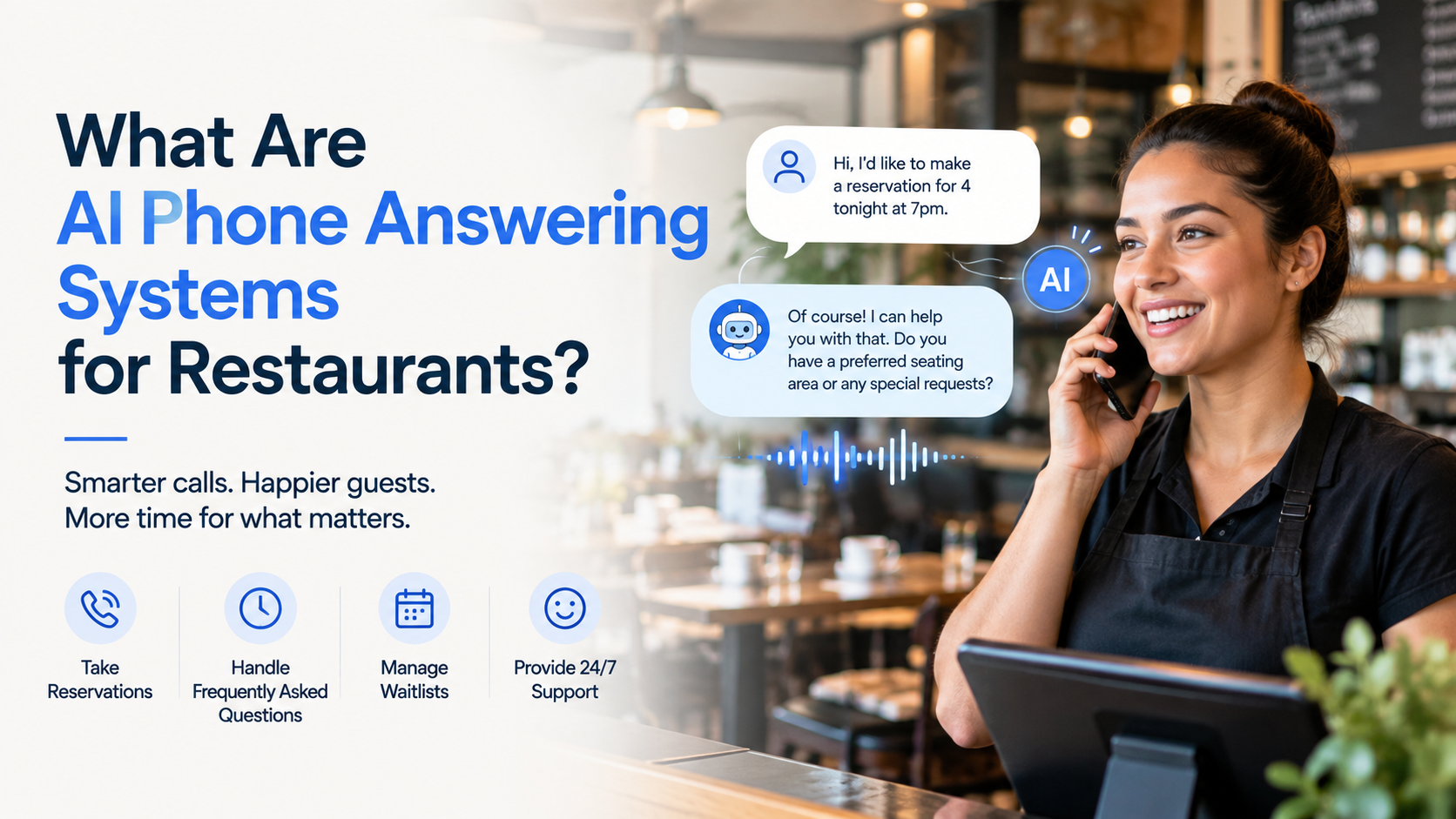
AI phone answering systems for restaurants are designed to help handle these calls automatically. Depending on the system, an AI voice assistant can answer guest questions, help with reservations, guide customers toward online ordering, or route calls to restaurant staff when human assistance is needed.
These systems can be particularly useful for restaurants that receive a high volume of calls but don’t want employees constantly interrupted by the phone.
An AI phone answering system uses artificial intelligence to answer incoming restaurant calls instead of requiring an employee to answer every call manually.
Rather than simply playing a recorded message, a conversational AI system can understand what the caller is trying to accomplish and guide them toward the appropriate action.
For example, a caller might want to:
Restaurant-focused systems can be configured around the business’s specific information and workflows.
The goal isn’t necessarily to replace restaurant employees. Instead, AI phone systems can handle routine calls and interruptions while giving staff the ability to step in when a caller needs human assistance.
A typical AI phone workflow can look something like this:
1. Guest Calls the Restaurant
The customer calls the restaurant’s existing phone number.
2. AI Answers the Call
Instead of waiting for an employee to answer, the AI voice assistant responds immediately.
3. AI Identifies the Guest’s Intent
The system determines what the caller wants, such as an order, reservation, question, or staff member.
4. AI Guides the Guest
The assistant directs the caller toward the appropriate action.
For example, Snappy Phone can guide guests toward online ordering or reservations and can use custom voice flows based on the restaurant’s menu and hours.
5. Staff Gets Involved When Necessary
If the caller needs human assistance, the call can be routed to restaurant staff.
This creates a hybrid approach where AI handles routine interactions while employees remain available for situations that require a human.
1. Fewer Missed Calls
One of the biggest challenges with restaurant phone calls is simply answering them.
During a busy dinner service, employees may not be able to pick up every incoming call. An unanswered call can mean a missed reservation, order, or potential customer.
AI phone systems can answer calls immediately, helping restaurants respond even when employees are occupied.
Snappy Phone, for example, can answer inbound calls with an AI voice assistant and can also provide an automated SMS response when a call is missed.
2. Reduced Staff Interruptions
Constant phone calls can interrupt employees throughout a shift.
A restaurant employee may need to stop what they’re doing to answer a question that could otherwise be handled automatically.
AI phone answering systems can take care of routine interactions while allowing employees to focus on:
Snappy Phone is specifically designed to reduce staff interruptions during peak periods.
3. 24/7 Call Handling
Restaurants don’t only receive calls during regular service.
Customers may call before opening, after closing, or during holidays.
An AI phone system can continue responding during these periods, allowing restaurants to provide information and direct customers toward online ordering or reservations.
Snappy Phone supports peak hours, after-hours, and holidays.
4. More Direct Orders and Reservations
A restaurant phone call doesn’t always need to end with a staff member answering the phone.
Some AI systems can guide customers toward completing an online order or making a reservation.
For example, Snappy Phone Agent can guide guests through ordering and reservation flows, while missed calls can trigger an SMS containing links to those actions.
| Feature | Snappy Phone Agent | Generic AI Receptionist | Restaurant-Specific AI Agent |
|---|---|---|---|
| AI Voice Answering | ✓✓✓ | ✓✓✓ | ✓✓✓ |
| Restaurant-Specific Workflows | ✓✓✓ | ✓ | ✓✓✓ |
| Online Ordering | ✓✓✓ | ✓ | ✓✓ |
| Reservations | ✓✓✓ | ✓✓ | ✓✓✓ |
| Missed-Call SMS | ✓✓✓ | ✓✓ | ✓✓ |
| Call Routing | ✓✓✓ | ✓✓✓ | ✓✓✓ |
| Custom Voice Flows | ✓✓✓ | ✓✓ | ✓✓✓ |
| Peak-Hour Coverage | ✓✓✓ | ✓✓✓ | ✓✓✓ |
| After-Hours Coverage | ✓✓✓ | ✓✓✓ | ✓✓✓ |
| Multi-Location Support | ✓✓✓ | ✓✓ | ✓✓ |
| Restaurant Order Integration | ✓✓✓ | — | ✓✓ |
| Caller Reporting | ✓✓✓ | ✓✓ | ✓✓ |
Best for: Restaurants that want AI phone answering combined with online ordering, reservations, missed-call recovery, and restaurant-specific call routing.
Snappy Phone (AI) is built specifically around restaurant call behaviour rather than functioning as a generic business receptionist.
Key strengths:
Snappy Phone Agent can answer a call immediately, understand what the guest needs, guide them through the appropriate flow, and route the call to staff when human assistance is requested.
Missed Call Recovery
One of the more useful features is that Snappy doesn’t only focus on calls that are answered.
When a call goes unanswered, the system can automatically send an SMS with a link to online ordering or reservations. The guest can then complete the action without requiring restaurant staff to call them back.
AI Voice Assistant
For restaurants using AI voice, the assistant can answer calls immediately and guide guests through the appropriate next step.
It can handle ordering and reservation flows, while callers who need a person can request to be routed to restaurant staff.
Why Choose Snappy Phone Agent?
The main advantage is that the phone system connects with the restaurant’s broader digital workflow.
Instead of simply answering questions, Snappy Phone Agent can help turn incoming calls into orders and reservations while reducing the amount of time staff spend answering routine calls.
Best for: Restaurants that primarily need automated answers to common questions.
General AI receptionist platforms can answer calls, provide business information, collect caller details, and route calls.
Key strengths:
However, restaurants should verify whether a general AI receptionist can actually understand restaurant-specific workflows such as menu modifiers, online orders, reservations, and delivery questions.
Best for: Restaurants that want an AI system trained around their menu, hours, reservation rules, and guest questions.
Restaurant-specific AI phone systems can be configured around hospitality scenarios.
Depending on the provider, they may support:
The advantage is that the AI can be designed around restaurant-specific information instead of using a generic business receptionist workflow.
Not every AI phone system is designed for restaurants. Before choosing one, restaurant operators should evaluate how well the system fits their actual phone workflow.
| Area to Evaluate | What to Look For |
|---|---|
| Restaurant Knowledge | Look for an AI system that can understand your menu, hours, locations, services, and other restaurant-specific information. |
| Online Ordering | Check whether the AI can guide callers toward placing an online order instead of simply answering questions. |
| Reservations | Look for reservation capabilities that can help guests book a table without requiring restaurant staff to answer every call. |
| Call Routing | Make sure callers can be transferred to restaurant staff when they need assistance that the AI cannot handle. |
| Missed Calls | Consider systems that can automatically follow up with callers who were unable to reach the restaurant. |
| Customization | Look for customizable voice flows that can be adapted to your restaurant's specific operations and guest needs. |
| Peak-Hour Coverage | The system should be able to handle incoming calls when employees are busy with customers and restaurant operations. |
| After-Hours Coverage | Check whether the AI can continue answering calls and providing useful information outside regular operating hours. |
| Multi-Location Support | Restaurant groups should look for centralized support for multiple locations, including location-specific information and workflows. |
| Reporting | Look for reporting that provides insight into calls, callers, missed opportunities, and system activity. |
| Restaurant Integrations | Check whether the AI phone system can connect with your POS, online ordering, reservation, and other restaurant technology. |
AI phone answering systems are becoming an increasingly useful tool for restaurants that want to manage high call volumes without adding more work for their staff.
The best solution depends on how much automation a restaurant needs. Generic AI receptionists can work for basic call answering, while restaurant-specific systems can provide more specialized handling of menus, reservations, orders, and guest questions.
Snappy Phone Agent stands out as a restaurant-focused option because it combines AI voice answering, missed-call SMS, online ordering, reservations, custom voice flows, call routing, and reporting in one system.
For restaurants, the key is to choose an AI phone system that doesn’t simply answer calls, but actually helps turn calls into orders and reservations while allowing staff to focus on the guests in front of them.
An AI phone answering system uses a conversational voice assistant to answer incoming restaurant calls, respond to common questions, assist with orders or reservations, and route calls to staff when needed.
Some restaurant-focused AI phone systems can help customers place orders or direct them to the restaurant’s online ordering system. The capabilities vary by provider, so restaurants should check whether the system integrates with their ordering and POS technology.
Yes. AI phone systems can provide coverage outside regular business hours, allowing restaurants to answer common questions and direct customers toward online ordering or reservations even when employees aren’t available.
Yes. One of the main benefits is reducing staff interruptions during peak periods. An AI phone agent can handle routine calls while employees focus on customers, food preparation, and other restaurant operations.