
June 24th, 2026
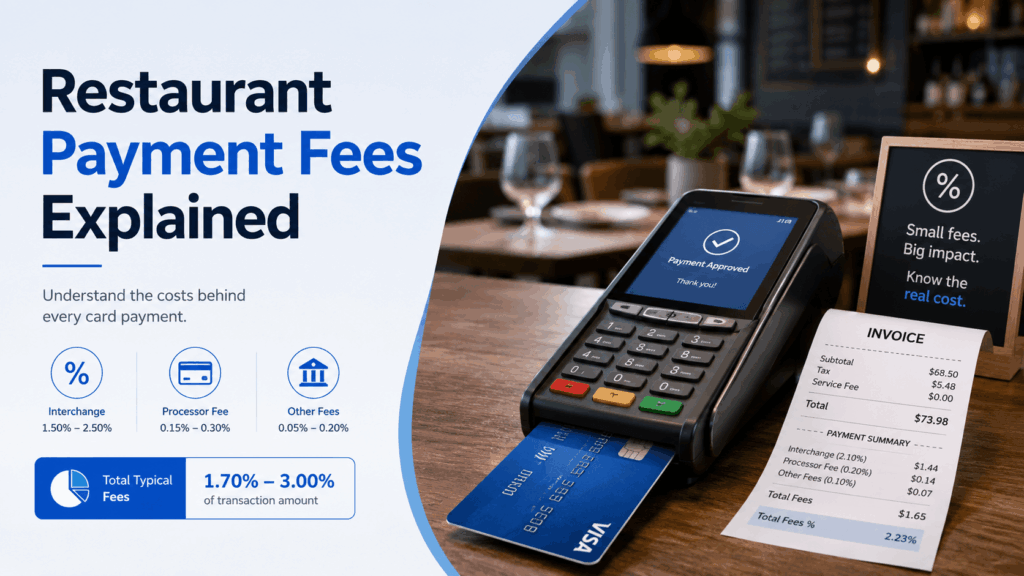
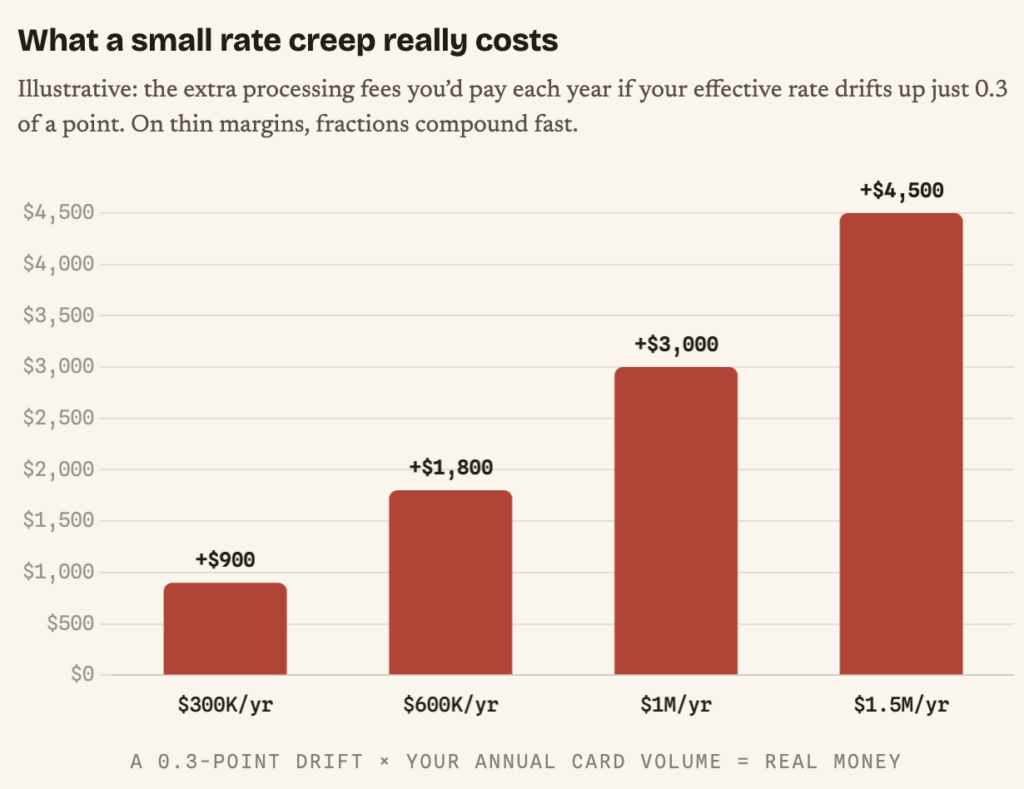
Payment processing is the one cost that shows up on every single transaction, and in an industry where net margins often sit between two and six percent, even a fraction of a percentage point compounds into real money. Yet most owners choose a processor once during the chaos of opening and never look at it again, right up until the statements start creeping, the terminal freezes during a Friday rush, or a held payout throws off payroll.
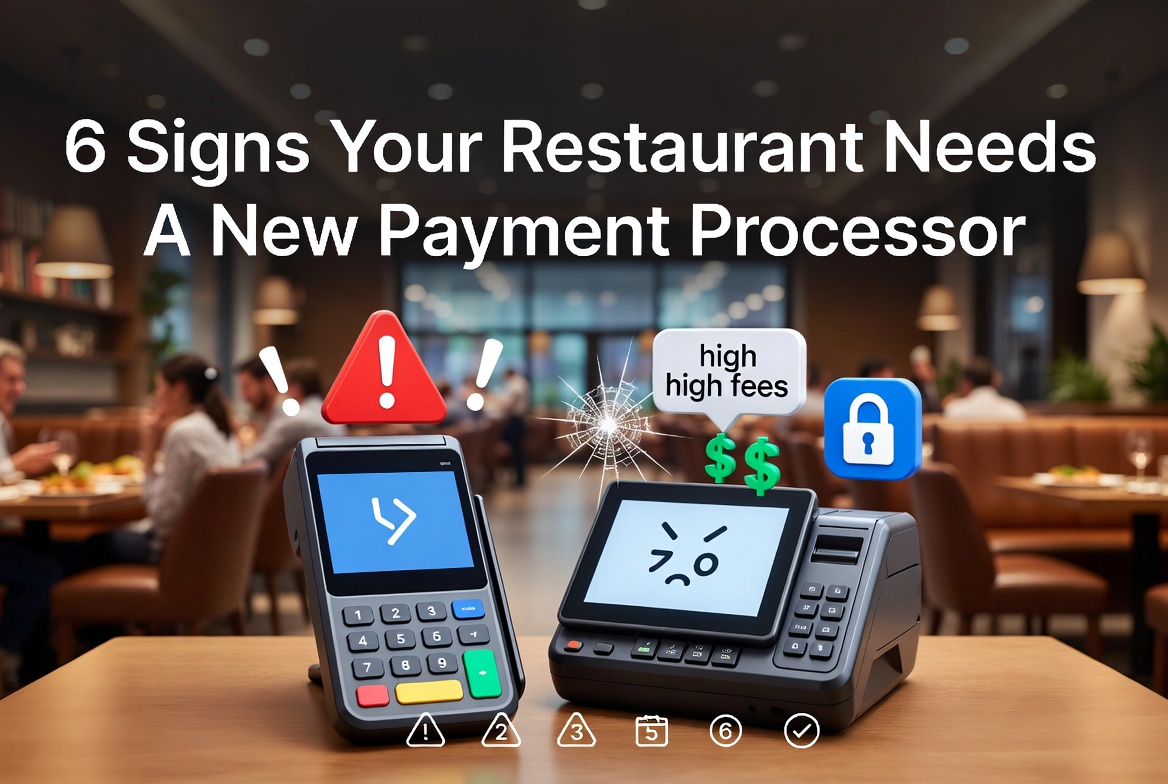
This guide walks through six concrete signs your current setup is costing you more than it should. Then it compares the major restaurant payment platforms (Snappy, Square, Toast, Clover, and TouchBistro) side by side, so you can see exactly where your money is going and what a better fit might look like.
The number that matters isn’t the rate a salesperson quoted you, it’s your effective rate (total fees divided by total card sales). If that figure drifts upward month over month while your volume stays flat, something in the fine print is working against you. Tiered pricing that quietly downgrades certain cards, padded interchange, or a “30 days’ notice” rate hike you never registered are all common culprits. Some restaurant processors are contractually allowed to raise your rates mid-contract.
A processor that times out at 7:45 on a Friday isn’t a minor annoyance, it’s revenue walking out the door and a line of irritated guests at the same time. “Failed to connect” at the terminal, laggy authorizations, or a platform-wide outage during peak hours all point to infrastructure that can’t comfortably carry your volume. The sales you lose during a rush are the hardest ones to ever win back.
Many restaurant processors bundle you into multi-year agreements with early-termination fees equal to your remaining balance. Proprietary hardware deepens the trap: when the terminals only run one company’s software, switching means buying everything new, and your old gear becomes a paperweight the day you leave.
Cash flow is oxygen for a restaurant. If payouts take days, or you’re paying a percentage just to access your own sales the same day, the model is working against you. Worse are sudden account holds: some aggregator-style processors freeze funds for weeks or even months when a risk algorithm flags ordinary activity, which can stall payroll, rent, and supplier orders overnight.
When a terminal dies mid-service you need a human who understands restaurants, not a forty-minute hold or a script that doesn’t fit the problem. If your provider’s support is hard to reach, can’t resolve anything complex, or offered no real onboarding in the first place, that gap surfaces at the worst possible moment.
If your card processing doesn’t talk to your POS, online ordering, loyalty, and reporting, you’re paying for a stack of disconnected tools and stitching them together by hand every night. A modern setup unifies in-person, online, QR, and delivery sales into one view, so the numbers reconcile themselves and you can actually see which channels and items are carrying the business.
Rates and headline plans are a starting point, contracts, hardware, payout terms, and how tightly payments integrate with the rest of your stack all shape what you actually pay. Here’s how the major options stack up.
Snappy is a restaurant-built platform that combines POS, integrated payments, commission-free online ordering, QR and kiosk ordering, loyalty, branded apps, and reporting into a single system. Its payment terminal, Snappy Pay, accepts every payment type, processes payments and refunds in one place, and is cloud-based. Because payments live inside the same platform as everything else, there’s no separate processor to reconcile against: in-person, online, QR, and delivery all roll up into one view.
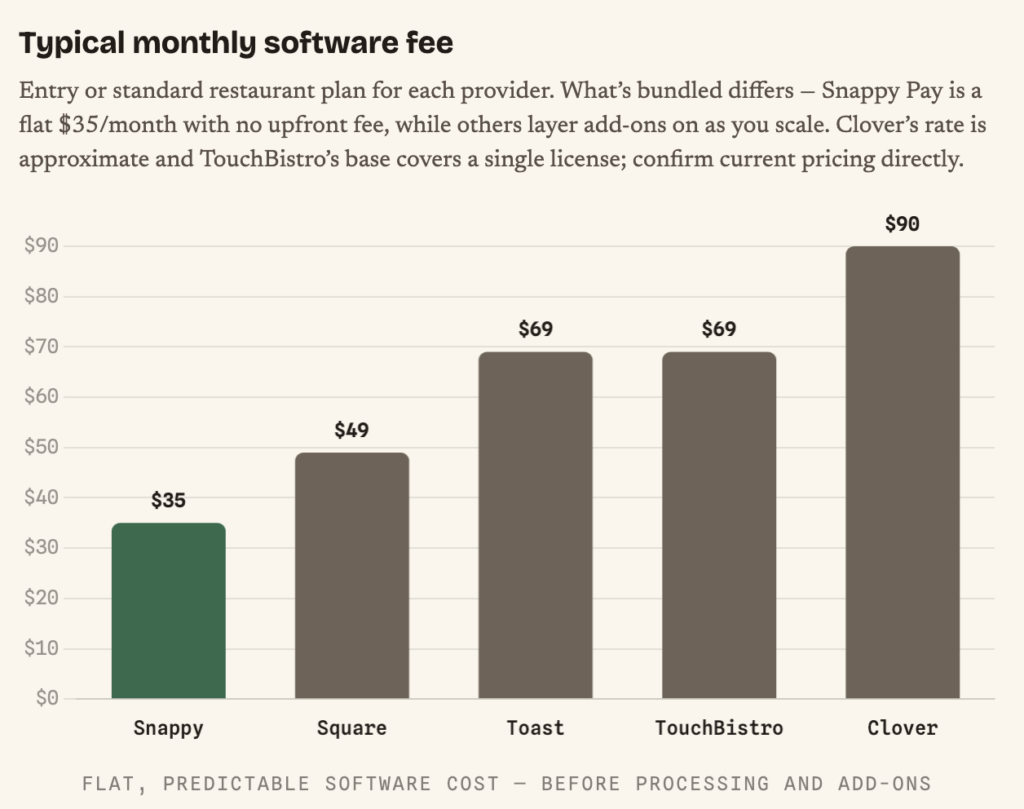
Pricing is a flat $35/month with no one-time upfront fee and no hidden charges. Rather than a fixed card percentage, Snappy passes through interchange, so the rate varies with each cardholder’s card type. The Snappy Pay terminal carries a lifetime warranty with free replacement for any malfunction.
Square is the easiest option to evaluate because everything is published: rates, software tiers, hardware costs, no contracts. It’s a strong fit for cafes, food trucks, and independents that want to keep fixed costs low and walk away anytime. The trade-offs are an aggregator model that can occasionally hold funds, and rate increases rolled out across 2025–2026.
Toast is purpose-built for restaurants, with a deept feature set (kitchen display, coursing, tableside, direct online ordering) and hardware engineered to survive heat, grease, and spills. That power comes at a premium and with strings: you must use Toast’s own processing, hardware is proprietary, and contracts run multiple years.
Clover pairs sleek Fiserv hardware with a broad app marketplace and the lowest headline restaurant rate here, starting around 2.3% + 10¢. The catch is the channel: Clover is sold largely through resellers, so rates, fees, and contract terms vary widely depending on who you buy from. Read the agreement closely.
TouchBistro is a restaurant-only POS built around the iPad, with strong table management, tableside ordering, and floor-plan tools aimed at full-service venues. It offers its own integrated processor, TouchBistro Payments, but also lets you connect a wide range of third-party acquirers. The catch is commercial: plans start at $69/month, there’s no free trial, and it requires a contract that auto-renews and is costly to leave early.
No single processor is right for every restaurant, but the warning signs are universal: a creeping effective rate, outages during the rush, contracts and hardware that punish you for leaving, slow or frozen payouts, support that disappears when you need it, and payments stranded apart from the rest of your operation. If two or more of those felt familiar, it’s worth pulling your last three statements, running your actual effective rate, and gathering fresh quotes. The savings usually pay for the switch many times over.
Add up every processing-related fee on one monthly statement, then divide by your total card sales for that month. Repeat for three months. That single percentage is the only honest way to compare providers, because it captures the padding a quoted “headline” rate hides.
A good provider plans the cutover around your slowest window, pre-configures the hardware, and runs test transactions before go-live, so most switches are close to seamless. The biggest source of friction is proprietary hardware. Ask any prospective processor about migration help, and check your current contract for an early-termination fee before you give notice.