
July 15th, 2026
Most operators think of a loyalty program as a coupon with extra steps. It is closer to an operating system for repeat business, a way to identify your regulars, learn what they buy, and give them a reason to come back one more time each month.
The economics are hard to ignore. Industry research consistently finds that roughly 65–80% of restaurant revenue comes from returning guests, yet around 70% of first-time diners never come back. Winning a new customer costs somewhere between five and seven times more than keeping one you already have. A loyalty program is the cheapest lever most restaurants have to close that gap and in 2026 it is close to table stakes, with roughly two-thirds of restaurants already running one.
But “start a loyalty program” is not a single decision. It is a stack of choices about structure, rewards, technology, and measurement, each of which changes what the program costs you and what it returns. This guide breaks the whole thing down, from the model you pick to the provider you sign with and shows what a realistic program actually earns in year one.
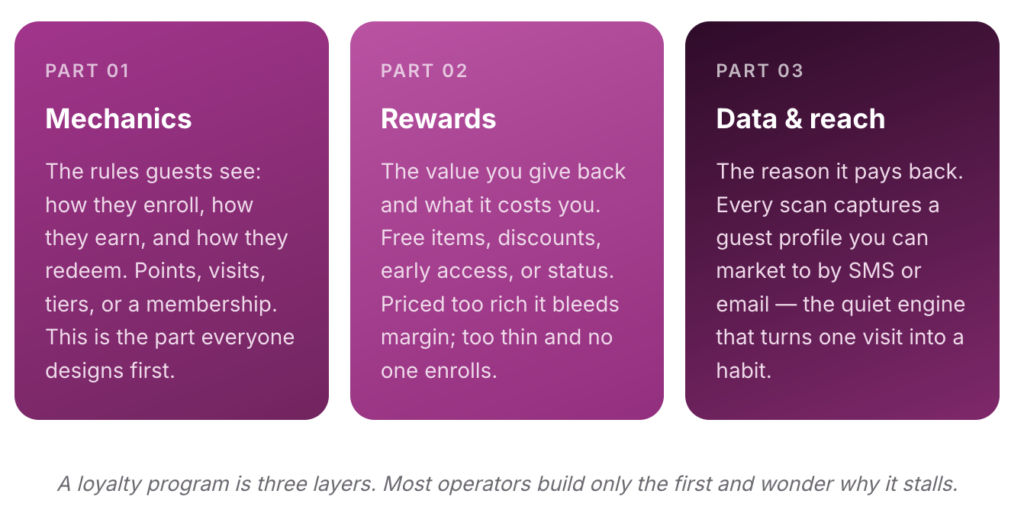
Rule of thumb: the mechanics get all the attention, but the data layer is where the return lives. A points system with no way to message the guests it captures is a discount, not a program.
Before choosing a structure, it helps to see why the category exists. The value of loyalty is not the discount, it is the shift in behavior it produces among people who already like you. Members come more often, spend more when they do, and are far less likely to defect to the restaurant down the street on price alone.
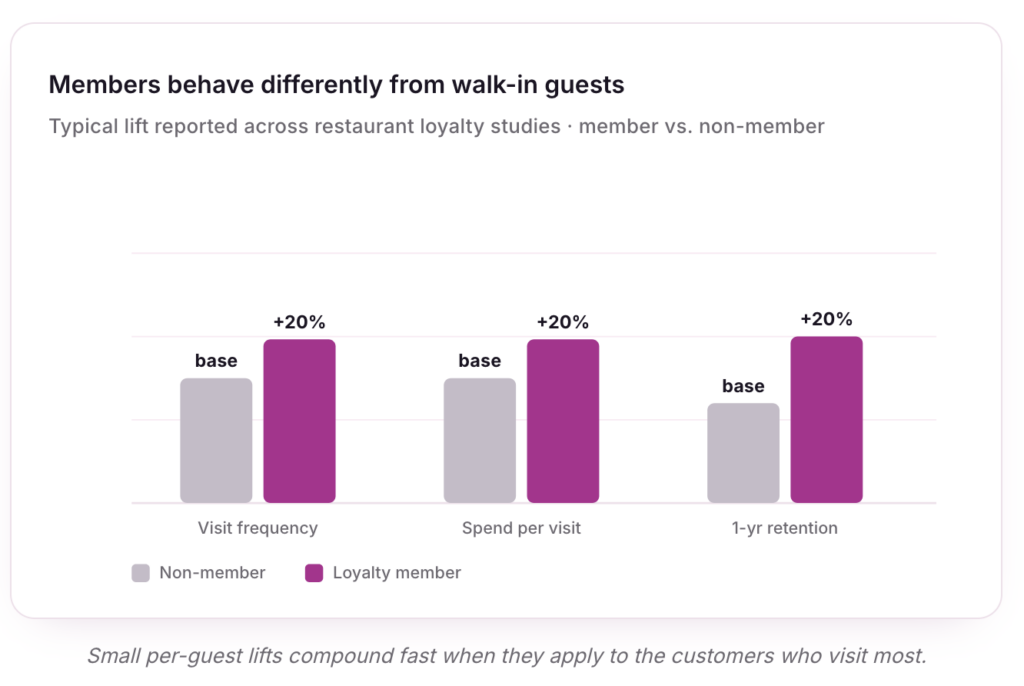
The compounding is the point. A modest per-visit lift matters little on a one-time guest, but applied to someone who visits weekly it reshapes their annual value. This is also why a 5% increase in retention can raise profit by 25% or more, you are adding margin on top of relationships that already exist, with none of the acquisition cost.
|
Model
|
How it works
|
Best for
|
Watch for
|
|---|---|---|---|
|
Points
|
Earn points per dollar or per visit, redeem for rewards. Flexible and familiar.
|
Most QSR, fast-casual, and full-service concepts.
|
Point inflation and unredeemed balances quietly building liability.
|
|
Visit-based
|
Reward after a set number of visits such as buy 9, get the 10th.
|
Cafés, coffee, and high-frequency, lower-check spots.
|
Little data depth; hard to reward spend, only frequency.
|
|
Tiered
|
Escalating status (Silver → Gold) unlocks richer perks as guests spend more.
|
Concepts wanting to grow average check and reward top guests.
|
More design and communication work; needs clear tier benefits.
|
|
Subscription
|
Guests pay monthly for defined benefits (free delivery, a daily perk).
|
High-frequency brands with a predictable core offer.
|
Only works if the recurring value is obvious and used often.
|
|
Cashback / card-linked
|
Rewards accrue automatically on a linked card, no app, no scanning
|
Operators who want zero checkout friction
|
Thinner engagement; the guest never actively "plays."
|
For most independents, a points program with a light tier on top is the pragmatic default: simple enough that staff and guests understand it instantly, but with room to reward your best customers as the program matures.
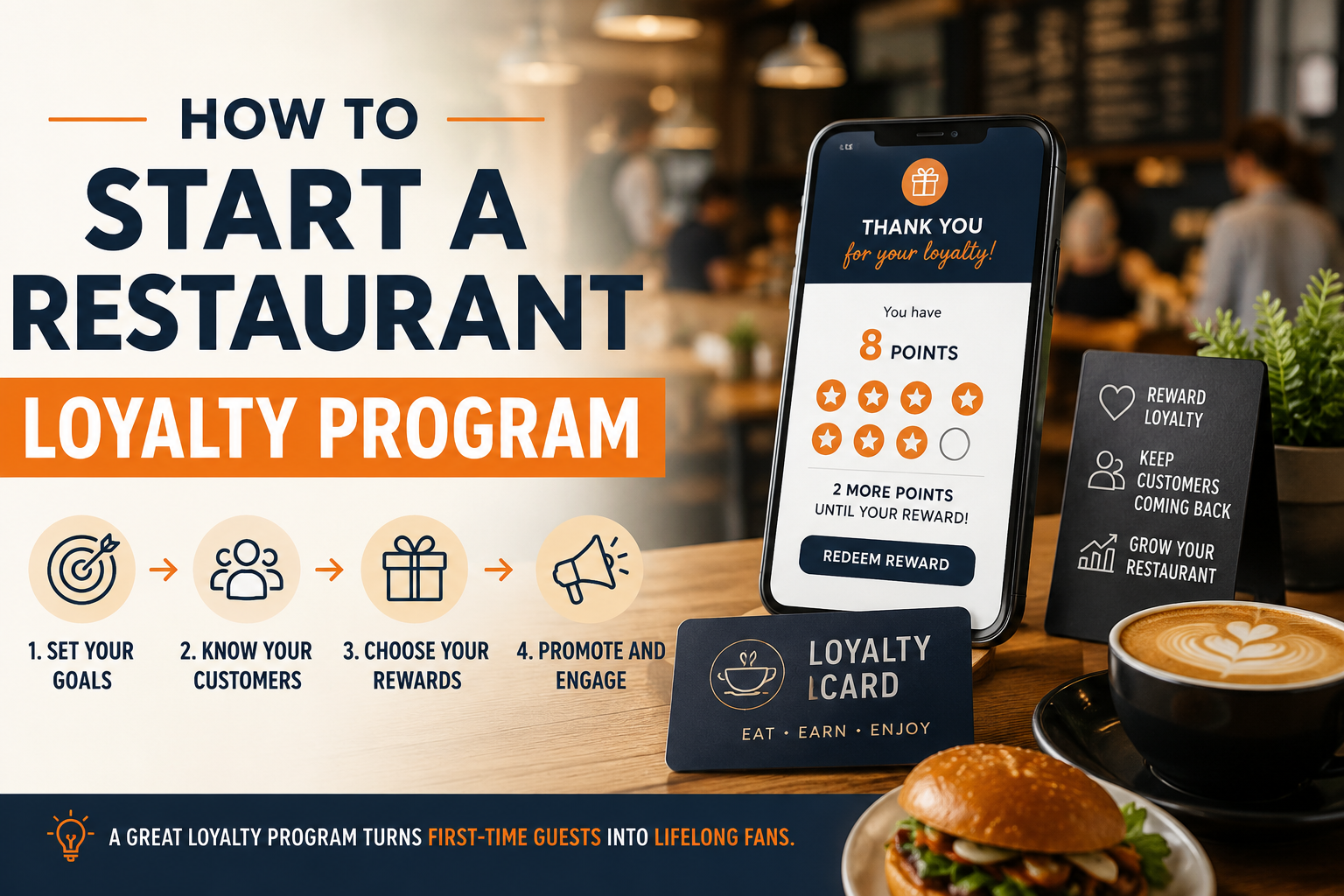
Once the model is chosen, the rollout is a short, disciplined project. The most common failure mode is not a bad reward structure, it is launching without staff buy-in or any way to measure whether it worked.
The right platform depends on your scale and your existing stack. Enterprise groups need deep personalization engines; a single café needs something it can launch this week. The table below covers the common options across that range.
|
Provider
|
Best Fit
|
Model Support
|
Pricing
|
|---|---|---|---|
|
Independents and multi-location groups wanting loyalty built into one restaurant platform (POS, online ordering, SMS).
|
Points in-store & online, tiered rewards, referrals, double-point items, birthday & email capture.
|
Bundled with the Snappy platform, book a demo for a quote. Request a demo to get detailed quote.
|
|
|
Toast Loyalty
|
Restaurants already on Toast POS.
|
Points, tiers, item-based rewards, card-linked enrollment.
|
~$185/mo marketing bundle
|
|
Square Loyalty
|
Small operators in the Square ecosystem.
|
Points, punch-card, discount tiers.
|
From ~$49/mo per location
|
|
Paytronix
|
Enterprise and multi-unit brands wanting deep analytics.
|
Points, visit, tiered, behavior-driven, CRM.
|
Custom-quoted
|
|
PAR
|
Large chains needing a customizable engine.
|
Points, tiers, wallet, subscription offers.
|
Custom-quoted
|
The distinction that matters most is POS-native versus bolt-on. A platform where loyalty lives alongside your point of sale, online ordering, and messaging (such as Snappy Loyalty) enrolls guests at checkout and keeps one guest profile across every channel. A separate loyalty app bolted onto a different POS tends to fragment your data and lose staff adoption within a few months.
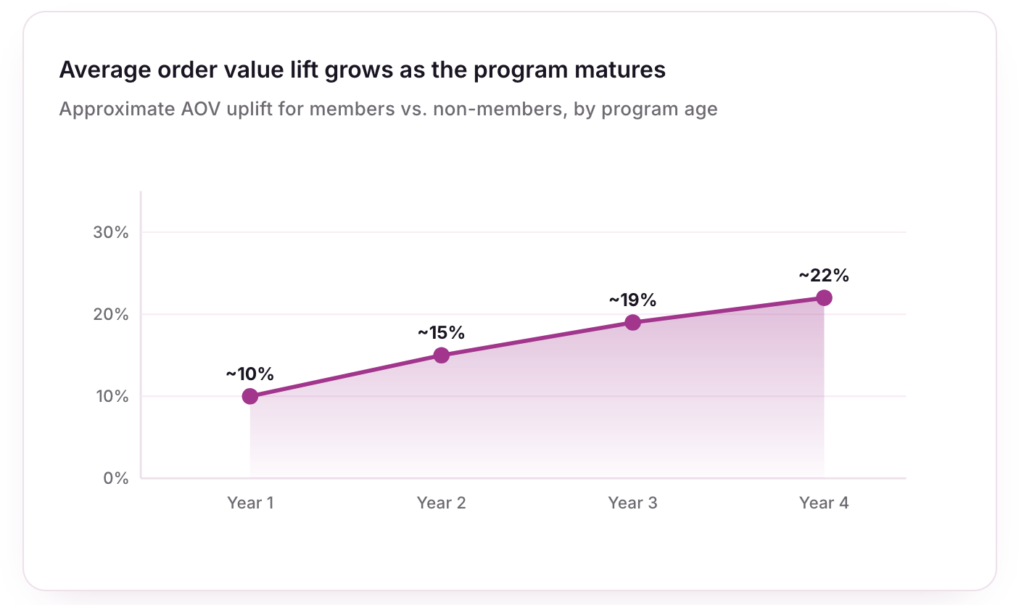
Loyalty programs are often judged on their first quarter and abandoned too early. The return builds as members accumulate history and your marketing sharpens. Average order value lift climbs from single digits in year one to the mid-twenties as a program matures.
Consider a single-location full-service restaurant doing $1,000,000 a year that launches a POS-integrated points program. Over year one, suppose 35% of guests enroll, skewed toward regulars, who already account for roughly $450,000 of revenue. A conservative 13% spend-and-frequency lift on that member base produces meaningful incremental revenue against modest costs.
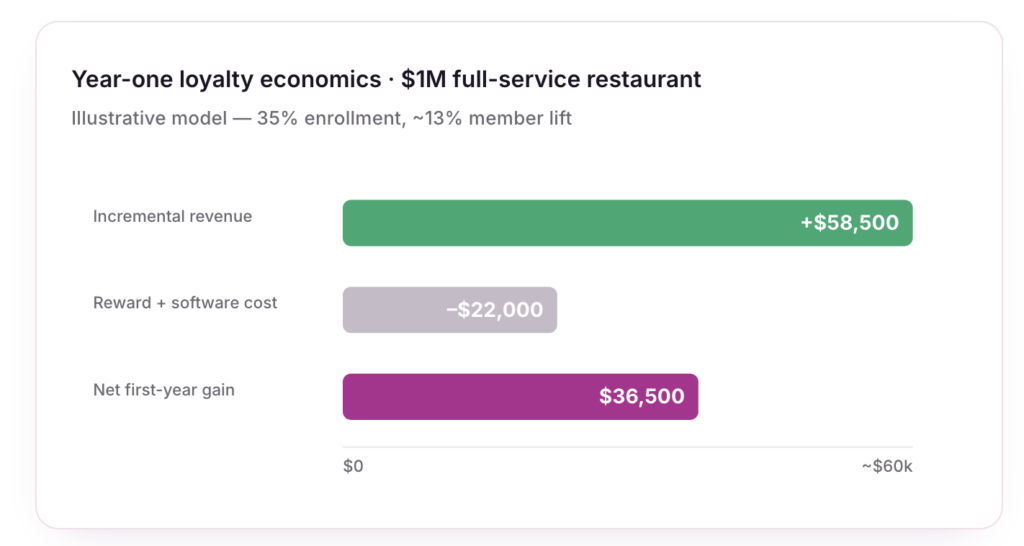
The overlooked line item: the ~$22,000 cost above is mostly reward redemption not the software subscription, which runs in the low thousands per year. Operators who budget only for software are surprised by the giveaway; those who model it price their rewards on margin and stay profitable.
Two things make this curve steeper in later years: the member base grows, and the marketing layer starts working with birthday offers, win-back campaigns, and point-expiry nudges that pull lapsed guests back at almost no incremental cost. By year three, the same restaurant can reasonably see the mid-tier of the $25,000–$60,000 annual range, with software still a rounding error against it.
|
Mistake
|
Cost
|
Risk
|
|---|---|---|
|
Rewards priced on menu price, not food cost
|
Margin erodes silently as redemptions climb.
|
High
|
|
No POS integration
|
Data fragmentation; staff stop enrolling within months.
|
High
|
|
Enrollment asks for too much
|
Every extra field cuts sign-up rate at the register.
|
Medium
|
|
No marketing layer
|
You capture guests but never message them, the return never arrives.
|
High
|
|
Judging the program in one quarter
|
The payback curve is back-loaded; early abandonment forfeits it.
|
Medium
|
Starting a restaurant loyalty program is less about the reward and more about the system behind it. Get the fundamentals right and the math takes care of itself.
A loyalty program is not a coupon. It is the cheapest, most durable growth lever a restaurant owns and the earlier you start compounding it, the more it returns.
Software ranges from around $29–$185 a month for independents, with enterprise platforms custom-quoted. But the larger recurring cost is reward liability which you should model at roughly 3–6% of member spend. Price rewards on margin and the program stays comfortably profitable.
It depends on check size and visit frequency. Digital punch cards suit high-frequency, lower-check spots like cafés. Points fit most full-service and fast-casual concepts. Tiers layer on top when you want to grow average check and reward your best guests. Many independents start with points and add a light tier as the program matures.
It is strongly recommended. POS integration lets staff enroll a guest with a phone number at checkout and captures every transaction automatically, so your guest data stays unified across dine-in, online, and delivery. Standalone loyalty apps that don’t connect to the POS tend to fragment data and lose staff adoption.
Most programs show a measurable average-order-value lift within the first few months, but the return is back-loaded. First-year lift is typically 8–12%, climbing to 15–25% by year three as the member base grows and your marketing sharpens. Judge the program over a year, not a quarter.
Four numbers: enrollment rate (share of guests joining), member visit frequency versus non-members, member average order value, and redemption rate. Review them monthly and adjust reward richness based on the data rather than on instinct.