
Wilson Wu
Chief Revenue Officer, Snappy
October 20, 2026·15 min read
A bubble tea loyalty program costs three things: the ingredients in every free topping or drink you give away, the discount rate your points rule sets, and the software that tracks it. It pays back when members visit more often than they did before, which you can only prove if the program reports repeat rate and visit frequency.
Every guide to bubble tea loyalty online either gives you no numbers or gives you numbers nobody sourced. This one shows the mechanics instead: what a redemption costs in pearls and milk, how the earn rule sets your real discount rate, what the chain apps already hand out for free, and the two figures in your own CRM that tell you whether it is working.
Summary
On this page
A bubble tea shop needs loyalty more than a sit-down restaurant does, because the ticket is small, the frequency is high and the competition is next door. There is no room to pay to acquire the same customer twice, so the second visit has to cost less than the first. That is the whole job of a loyalty program.
The frequency is the opportunity. A sit-down restaurant is pleased when a regular comes twice a month; a boba shop beside a high school, or one under an office tower, can see the same face three times a week. In a drinks-led format the same handful of names repeat through your order history visibly, and those regulars are the volume the program has to protect.
The competition is the threat. Presotea alone counts over 30 stores across Canada, including Toronto, Scarborough, Richmond Hill and Markham (Presotea), and Gong Cha runs more than 1,700 locations worldwide (IFPG). When three shops share a plaza on Highway 7 or a block of No. 3 Road in Richmond, the shop that already holds the customer’s points wins the tie.
Then there is the question of who remembers the regular. Gong Cha Canada’s own franchise guidance says “staff members are the face of the business” (Gong Cha Canada), which is true, and the faces keep changing. The person who knew the 30% sugar, extra grass jelly order has moved on; your system has to remember it instead.
If you are still deciding whether the investment makes sense for your shop at all, our guide to knowing whether your restaurant needs a loyalty program walks through the general case.
The chain apps give away more than most independents realise, and it sets the bar your regulars measure you against. The Kung Fu Tea app advertises “order ahead, delivery and contactless payment,” pays “every $1 spent = 2 bubbles” toward free drinks, and lets customers keep using “Scan to Pay” in store (Kung Fu Tea).
Ordering, paying and earning happen in one motion, with no card to stamp and no phone number for the cashier to key in during a rush.
Franchise economics explain why the chains get this right. Gong Cha’s franchise listing puts the initial investment at USD 177,430 to 335,400 and the initial franchise fee at USD 41,500 (US data), with a monthly royalty of 5.5% of gross sales, across more than 1,700 locations worldwide (IFPG). A franchisee handing over 5.5% of every sale watches every other recurring line, and head office builds the app once and spreads its cost across the whole network.
You will not match that app budget as a one- or three-location operator, and you do not need to. What you need to match is the mechanics: points on every channel, redemption that costs the cashier nothing, and a customer who never has to think about it. The rest of this article is how to get there without a franchise balance sheet.
For the broader steps of getting a program off the ground, see our guide on how to start a restaurant loyalty program.
A redemption costs less than the menu price, and the difference is where most loyalty math goes wrong. Fanale, a wholesale supplier, puts the average ingredient cost of a standard boba tea between USD 1.94 and 4.41 per drink (US data) (Fanale). When a member redeems a free drink, that ingredient band is what leaves your shop, not the $6 on the menu board.
A free topping is cheaper still. Fanale lists dried pearls wholesale at USD 3 to 8 per kilogram and ready-to-use pearls at USD 8 to 15 per kilogram, with minimum orders of 10 to 25 kg for dried and 5 to 10 kg for ready-to-use (US data) (Fanale).
A single serving is a small fraction of a kilogram, so the topping reward costs a fraction of the per-drink band. Weigh your standard scoop, multiply by your per-kilogram price, and you have the real number for your shop rather than one borrowed from a blog.
Two cautions on that arithmetic. Fanale’s figures are in US dollars while your menu is in Canadian dollars, so use your own invoices before you compare the two. And the menu price only becomes the true cost of a redemption if that member would have paid for the same drink on the same visit anyway, which is exactly the question the program is supposed to answer.
Not Sure What Your Free-Drink Rule Is Really Costing You?
Send your menu price, earn rule and a recent supplier invoice, and we will work out your real discount rate and redemption cost.
Show me my discount rateStart from the number no vendor prints: the implied discount rate. The implied discount rate is the share of a regular’s spend a loyalty program hands back as rewards, and it is what makes two different program designs comparable.
Divide the menu price of the reward by the spend required to earn it, and you have the percentage of every regular’s spend you are handing back. Three common designs land in very different places.
| Program design | Earn rule | Redemption | Implied discount rate | Ingredient cost of the reward | When it fits |
|---|---|---|---|---|---|
| Topping reward | 1 point per $1 spent (a common sample structure) | 50 points = one free topping | Your topping price divided by $50: a $1 topping is 2% of spend | A fraction of the USD 1.94 to 4.41 per-drink band (Fanale); weigh your scoop for the exact figure | High-frequency shops that want a cheap, frequent thank-you and a small points liability |
| Chain-style points | Every $1 spent = 2 bubbles (Kung Fu Tea) | Bubbles redeem for free drinks; the threshold is not published on the app page | Drink price divided by the dollars it takes to reach a redemption | A full drink: USD 1.94 to 4.41 in ingredients (Fanale) | Multi-location brands with an app, where the balance also drives order-ahead |
| Stamp card equivalent | One stamp per drink bought | Buy 9, the 10th is free | 11.1% of spend: $6 given back on the $54 it takes to earn it, or 10% of the drinks served | A full drink: USD 1.94 to 4.41 in ingredients (Fanale) | Single locations that want a rule any cashier can explain in one sentence |
The stamp card is the honest benchmark because its rate is fixed by design: ten drinks for the price of nine gives back 11.1% of your best customers’ spend, $6 on every $54, before you count the ingredients. That is not necessarily too high. It is only too high if it buys visits that were going to happen anyway, which is why the next section matters more than this table.
The topping reward is the low-cost end. A common sample structure is 1 point per dollar with 50 points for a free topping; the vendor guides that publish it also promise a higher average order value without publishing a measured result. At a $1 topping that is 2 cents on the dollar in menu value and far less in pearls, which makes it easy to afford and easy for customers to forget.
For a documented example of a loyalty redesign paying off outside bubble tea, see how Freshslice upgraded its loyalty program and increased revenue.
Thresholds and expiry are the two dials that keep either design solvent. Set the first redemption close enough that a normal regular reaches it within a month, or the program never delivers its first small win; set an expiry window so that unredeemed points do not pile up as an open-ended liability on your books. Both settings should be numbers you can change without a developer, because you will change them after the first sixty days.
Repeat rate and visit frequency, measured on your own members before and after launch. Repeat rate is the share of enrolled customers who come back within a set window, say thirty days of joining. Visit frequency is visits per active member per month. Average order value and redemption counts are worth watching, but those two answer the payback question.
The payback math is short once you have them. Incremental visits multiplied by the contribution on a drink, menu price less ingredients, has to exceed the ingredient cost of the rewards redeemed plus whatever your software and staff time cost. Work it with your own inputs, using this 200-member example as the pattern:
Those inputs are illustrations, not industry averages, and that is the point. The loyalty guides written for bubble tea shops make only qualitative claims, and the beverage loyalty vendors that do print a per-order or frequency lift cite no study and are not talking about bubble tea, so none of it should be typed into your forecast. The only lift number that matters is the one your CRM shows for your shop.
The measurement has a precondition: every order has to attach to a member, at the counter and on pickup, or the denominator is wrong. It also has to be automatic, because customers will not tell you when a habit changes.
A regular who drifts rarely writes a review or files a complaint on the way out. The regular who quietly switched to the shop across the plaza will not announce it; a falling visit frequency on a member profile is the only notice you get.
A bubble tea loyalty program should live wherever the orders already happen, and for a bubble tea shop that is two places at once: the counter and the pickup order. A program that only sees one of them undercounts every member and misses every redemption on the other side. Here is how the common homes compare.
| Where loyalty lives | Where points accrue | Who owns the member list | Works on pickup orders | Works at the counter |
|---|---|---|---|---|
| Standalone loyalty app (third-party) | Only when the customer opens the app or scans a code | The app vendor's database, exported on request | Usually only if the app also takes the order | Only with an extra step at the register |
| Loyalty built into the POS only | At the register, on every in-store sale | You, inside the POS | Not unless the ordering page is connected to the same system | Yes, automatically |
| Loyalty on the ordering page only | On online and pickup orders | You, inside the ordering platform | Yes | No; the walk-up regular is invisible |
| One system in-store and online (how Snappy lists Loyalty) | In-store and online, per the product page (Snappy) | You, in a member list you can use for personalized SMS and email campaigns (Snappy) | Yes, through the same commission-free online ordering (Snappy online ordering) | Yes, through the same POS |
Snappy’s Loyalty page says points can be collected in-store and online, and that the information you collect can be used to send personalized SMS and email marketing campaigns (Snappy). Next to it sit online ordering with a 0% commission fee on every online order and the option for customers to order directly from Google (Snappy online ordering), and digital and physical gift cards with membership bonuses (Snappy gift cards).
The retention argument for that structure is simple: regulars otherwise have no reason to order direct instead of through a marketplace that takes a commission on every order. Points that only exist on your own ordering page give them one.
Do you need your own app? Not to run loyalty. Snappy does offer a branded mobile app for your restaurant with push notifications and personalized offers to encourage repeat orders (Snappy custom app), which is the point at which an independent starts to look like the chain apps above. Treat it as the second step, after the member list exists, not the prerequisite for the first.
If you are still choosing the register itself, our guide to the best POS system for bubble tea shops covers the counter-speed side, and the coffee shop POS guide covers the same drink-counter format from a different cup.
You launch without annoying daily regulars by recognising them on day one instead of making them start from zero. The daily regular is the one customer a loyalty program can lose money on, because you are paying a discount for visits that were already happening.
The fix is to enrol them with a starting balance or an immediate first reward, so the program reads as thanks for what they already do rather than a hoop to jump through.
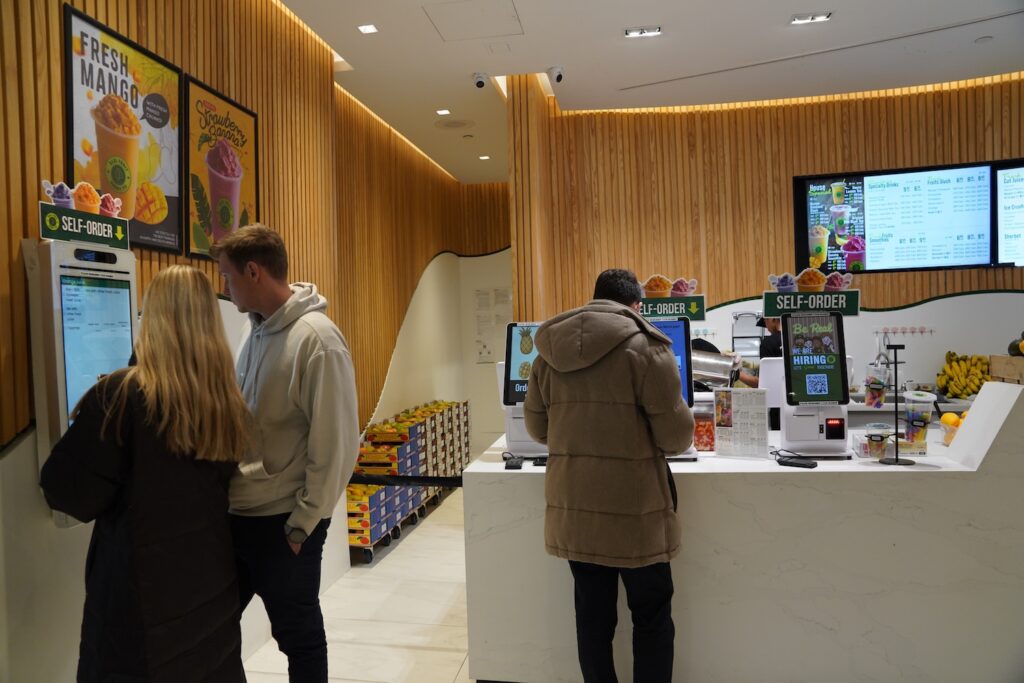
Do not slow the line to do it. A cashier keying a phone number into a screen at 3:15 pm when the high school lets out is a cost you will feel in the queue before you see it in a report, which is exactly what the chain apps avoid with scan-to-pay (Kung Fu Tea). Choose a setup where earning is part of the order and the payment rather than a separate step, and train the counter to say the balance out loud when it is close to a reward.
Speak the languages your counter already speaks. Statistics Canada reports that nearly half of Markham’s population, 47.9%, is Chinese, along with 31.9% of Richmond Hill’s (Statistics Canada). Signage at the register, the enrolment prompt and every push message should read naturally in Chinese as well as English, and a CRM with segmented campaigns lets you talk to the after-school crowd differently from the weekend families.
Give the daily regulars something better than points. Snappy’s Gift Card & Membership product covers digital and physical gift cards, auto-reload options and time-limited savings for members (Snappy gift cards), and for someone who already buys five drinks a week, a prepaid membership turns loyalty into cash in your account today instead of a discount later. That is the one case where the customer who comes every day is worth more to you inside the program than outside it.
The visible cost is the reward: a free drink costs you the USD 1.94 to 4.41 in ingredients Fanale publishes for a standard boba tea, and a free topping costs a fraction of that (US data) (Fanale).
The hidden cost is the discount rate your earn-and-redeem rule implies, which you set yourself; a buy-9-get-1 card gives back 11.1% of spend, $6 on the $54 it takes to earn the free drink. Software and staff time sit on top and vary by platform.
The specific lift figures circulating online are vendor claims without a cited study, and the ones from beverage loyalty vendors are not bubble-tea specific. Measure your own repeat rate and visit frequency for sixty days before launch and sixty days after; those are the only figures that matter for your shop.
Yes. The Kung Fu Tea app combines order-ahead, in-store scan-to-pay and points in one place (Kung Fu Tea), and that is the bar independents compete against. A program that sees only one channel undercounts every member.
Yes. Loyalty built into the POS and the ordering page avoids a separate app entirely, and Snappy’s Loyalty page says points can be collected in-store and online (Snappy). A branded app is a later step, once the member list is worth pushing to.
Set a redemption threshold and an expiry window, and track redemptions per member in the CRM. A member profile that redeems far more often than its visit count supports is obvious in a report and invisible on a paper card.
A bubble tea loyalty program costs three things: the ingredients in every reward, the discount rate your rule implies, and the software that runs it.
The first is a fraction of a USD 1.94 to 4.41 drink (US data) (Fanale). The second is a number you choose, and a stamp card’s 11.1% of spend is the honest benchmark. The third is only worth paying for if the program lives where your orders already happen.
It pays back when repeat rate and visit frequency rise on your own members, measured before and after, not when a vendor’s blog says they will. Wherever you are, the shop across the plaza is running the same math, and some of them have a chain’s app behind it. Your advantage is a member list you own and a counter that earns points without slowing down.
Want to see how loyalty, gift cards and your ordering page can share one member list? Talk to our team. Snappy has offices in Toronto, Vancouver and Montréal, and support runs 10 am to 10 pm ET, seven days a week.
Book a walkthrough
See What Your Loyalty Program Is Really Handing Back
Walk through your earn rule, your thresholds and the repeat rate and visit frequency you would want to watch after launch, using your own numbers instead of a vendor's estimate.
Written by
Wilson Wu
Chief Revenue Officer, Snappy
Wilson Wu is Chief Revenue Officer at Snappy, the restaurant technology company, and is based in Boston. His first job was in a restaurant kitchen, and he has spent his career since at the intersection of hospitality and software, working with operators across Canada on the systems their service runs on. He also builds the technology he writes about. His engineering work includes a per-location customer service agent that answers guests with a restaurant's real hours, menu and prices, deployed with independent restaurants, and a document-extraction model that reads supplier invoices and matches invoice numbers against what is owed. He writes here about what changes on a busy service: ordering, payments, loyalty, the phone, and the Canadian rules behind them. He holds an MBA from Duke University and a Master of Science in Computer Science from Georgia Tech.
Connect on LinkedInNo-obligation walkthrough
What Your Points Rule Actually Gives Back
See what your earn rule and redemption really cost, using your own menu price and ingredient invoices.
On this page
Get The Latest Restaurant Data, Trends & Tips