

Wilson Wu
Chief Revenue Officer, Snappy
October 1, 2026·16 min read
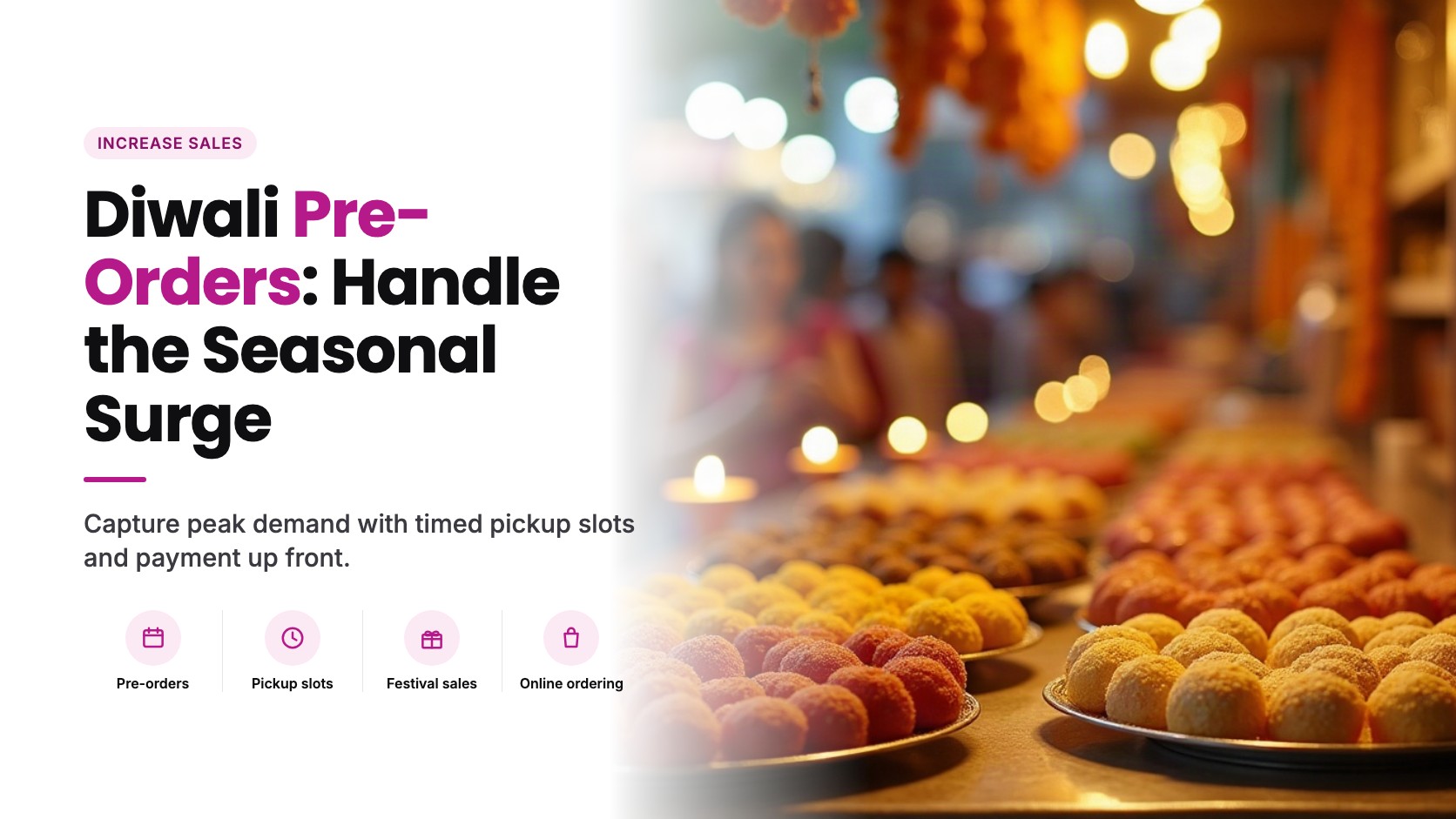
Diwali 2026 falls on 8 November, and the ten days in front of it are the most compressed order window a Surrey mithai shop or South Asian restaurant sees all year. The answer is not a second phone line. It is a published pre-order window: box sizes listed as items, timed pickup slots, payment taken at checkout, and dietary notes written once instead of repeated on every call.
Summary
On this page
Diwali 2026 falls on 8 November, inside a five-day festival window running 6 to 10 November (Wikipedia), and every order for it must be produced and handed over inside that same handful of days, which is what makes the week so compressed. Because the date moves with a lunisolar calendar, the season lands in a different week every year, which is exactly why customers ask you when to order rather than assuming.
That fixed date is the whole operational problem. A gift box ordered for Diwali is not a box the customer will accept on the 11th, so every order in the book has to be produced and handed over inside a handful of days.
Compare that to a normal week, where demand arrives smoothly and the kitchen levels it out with production planning. Diwali removes the levelling, which is why operators call the week before it the Diwali rush. You get the volume of a strong month landing inside the same seventy-two hours your counter line is at its longest.
Two things then break at once. The counter is full of walk-in customers buying by weight, and the phone is ringing with corporate tray orders, family gift-box orders and dietary questions from people who have never bought from you before.
The size of the opportunity is not in doubt, though the published data sits in the wrong country. Diwali sales in 2025 were expected to touch 4.75 lakh crore rupees ($57 billion) across India, and the organized packaged-sweets market there is worth around $751 million and could hit $3 billion by 2032, growing more than 16% a year (Bakery and Snacks, India data). Treat that as evidence that the category scales, not as a forecast for a shop on 128th Street.
For your own market, use Canadian numbers. In the 2021 census, South Asians in Surrey numbered 212,680 people, 37.8% of the city and its largest visible minority group, and Little India in Newton was completed in 2016 fronting the intersection of 128th Street and 80th Avenue (Wikipedia). Across the Metro Vancouver Regional District there are 369,295 South Asians, 14.2 percent of the region’s total population (Wikipedia).
Nationally, over 2.57 million individuals reported as South Asian in the 2021 census, making it the largest racialized group in Canada at 7.1% of Canada’s total population, and one in seven (14%) lived in the Vancouver CMA (Statistics Canada). Abbotsford operators can run the same playbook on the same calendar.
Most shops take Diwali pre-orders on three channels at once, and all three lose orders in a different way. Naming the specific failure is the first step, because each one has a different fix.
The phone during service. Someone behind the counter picks up with one hand while boxing an order with the other, writes the box size on a receipt roll, and either does not get a callback number or does not get a pickup time. When the same person is serving the counter, the third call in a row does not get answered at all.
The messaging app the customer already has open, and social DMs. These threads are convenient for the customer and terrible for the kitchen, because the order lives in one staff member’s phone and never becomes a ticket. Confirmations, changes and pickup times are scattered across a conversation nobody else can read on the day.
The walk-in deposit book. This one is the most reliable of the three, and it still costs you a queue. Every deposit taken at the counter is a paying customer standing behind the person taking it.
The pattern underneath all three is the same. Order intake is competing with order production for the same pair of hands during the exact hours you are busiest.
You cannot hire your way out of it in a single season either, and the labour problem in this segment is more specific than a general shortage. An owner in Lloydminster, Saskatchewan told CBC she posted job listings and received more than 100 applications, but none were from people with the training needed to prepare authentic Indian cuisine, and the Canadian Federation of Independent Business says tighter immigration and temporary foreign worker limits are putting similar businesses at risk (CBC). Read that across to a Surrey mithai shop and the same point lands in your own kitchen: the people who could take the pressure off the halwai are the hardest ones to add.
Before you change anything, measure it. Put a tally sheet by the till for one Saturday in October and mark every call that rang more than four times, every DM that took more than two replies to pin down, and every deposit that held up the counter line. Our breakdown of the cost of missed phone calls for restaurants walks through the same counting exercise for a full week.
A Diwali pre-order window, sometimes just called an order window, is four decisions, published in advance, that turn a week of improvisation into a production schedule. None of them require new equipment.
Decision one: a published order-by date. Pick a date, print it on the counter sign and put it at the top of your ordering page. Ambiguity about the cutoff is what drives the phone tag, because a customer who does not know the deadline calls to ask.
Decision two: box sizes as menu items. A 1 kg assorted box, a 2 kg assorted box, a 30-piece tray and a corporate hamper are four items with four prices, not four conversations. Once they are items, a customer can select quantity and the total is calculated for them.
Decision three: timed pickup slots. Offer pickup in defined blocks rather than “sometime on the 7th”. Slots convert an unmanageable spike into batches the kitchen can produce in sequence, and they stop forty people arriving at 4 PM on the same afternoon.
Decision four: one place all of it lands. Orders taken across three channels have to arrive in one queue or you will double-produce and under-produce in the same shift. Snappy’s Kitchen Display System consolidates orders from all sources into a real time display and tracks the status of all existing orders paperlessly, which is what makes slot batching real rather than aspirational.
The effect on the halwai is the part operators underestimate. When orders carry a slot, production planning for Diwali week becomes a list sorted by time rather than a pile sorted by whoever shouts loudest.
Still taking Diwali orders by phone, DM and deposit book?
Bring a Saturday of calls, DMs and deposits from October, and we will map your Diwali intake against pickup slots and payment at checkout.
Map my Diwali intakeYou take payment up front by collecting it at the point of order, not afterward: an online pre-order page charges at checkout, and Snappy AI Phone Ordering collects payment via a link before the order reaches the kitchen. Unpaid pre-orders are the quiet cost of a festival week. A phone order taken without payment is a box that gets made, boxed, labelled and then sometimes never collected, and at Diwali volumes even a small no-show rate is a real number of trays.
Taking payment at the point of order removes that exposure by design. It is also the difference between a deposit book, where you hold a partial amount and chase the rest at the counter, and a checkout, where the order is settled before the kitchen starts.
An online pre-order page does this natively. The customer pays at checkout and the order arrives complete, and because Snappy Online Ordering is commission-free and lets customers order directly from Google, you keep the margin on the highest-volume week of your year rather than sharing it. Our guide to commission-free online ordering systems for restaurants covers why that matters outside festival season too.
For the calls, Snappy AI Phone Ordering is the equivalent mechanism on the phone. It requires Snappy Online Ordering, takes every call at once, takes the complete order, collects payment up front via link and prints straight to the kitchen, which is exactly the gap the counter cannot cover at 5 PM on the 6th.
The Snappy Phone (AI) page sets out the two modes the line can run in. In missed-call mode, a call that goes unanswered triggers an automated SMS that links to online ordering or reservations and the guest completes the action with no staff needed. In AI voice mode, the assistant answers immediately, guides the guest to the correct next step, and the call is completed or routed to staff on request.
There is a second prepayment tool worth opening before the season rather than during it. Digital gift cards are cash-flow-positive prepayment: a customer who cannot decide which box to buy for a colleague buys the value instead, and you hold the funds before any production happens.
Not every Diwali gift box order should move online. The useful comparison is not “digital versus traditional”, it is what each channel actually captures and how much counter time it costs you during the spike.
| Intake channel | Captures pickup slot | Captures box contents and quantity | Payment up front | Reaches the kitchen as a ticket | Counter staff time |
|---|---|---|---|---|---|
| Phone during service | Only if staff remember to ask | Only as written on a receipt roll | No | No, someone re-enters it | High, and it competes with serving |
| Messaging app or social DM | Inconsistently, across a thread | Inconsistently, and changes are buried | No | No, it lives in one person's phone | High, spread across the whole day |
| Walk-in deposit book | Yes, if the book has a time column | Yes, written by hand | Partial, a deposit only | No, re-entered at production time | High, and it holds up the counter line |
| Online pre-order page (Snappy Online Ordering) | Yes, the customer selects it | Yes, box sizes are items with quantity | Yes, at checkout | Yes, into the ordering dashboard and kitchen screens | None |
| Snappy AI Phone Ordering (requires Snappy Online Ordering) | Yes, on the call | Yes, the complete order | Yes, collected up front via link | Yes, prints straight to the kitchen | None, it takes every call at once |
| Snappy AI Phone General Inquiries (no prerequisite) | Not applicable, it answers and routes | Not applicable | Not applicable | No, it routes the caller to staff | None for questions like "do you have a 2 kg box" |
Read the last two rows as a pair. General Inquiries is the low-friction starting point because it needs nothing else in place and immediately absorbs the question calls, which at Diwali are a large share of the volume: hours, order-by date, box sizes, whether you make a nut-free tray.
Ordering is the tier that recovers revenue rather than just answering. It only makes sense once your box sizes exist as items on an ordering page, which is why the prerequisite is there: the AI line does not bolt onto a separate ordering system, it runs on top of Snappy Online Ordering, which is why that product has to be in place first.
You flag Jain, vegan and nut-free requirements once by writing them into each item’s description on your ordering page, not on the phone. This is where the phone burden actually comes from in South Asian shops, and it is not a small thing. Jain, vegan and halal are three distinct and non-interchangeable frameworks, and copy that lumps them together as “vegetarian-friendly” reads to a knowledgeable customer as not understanding your own menu.
Add nut content to that. Mithai is built on cashew, pistachio and almond, so “nut-free” is a real production question about a shared kitchen, not a checkbox, and the honest answer is often a specific set of items rather than a whole-shop guarantee.
The fix is to write the answer once, on the item, rather than repeating it forty times a day. Put the composition in the item description on your ordering page: which items are Jain, which contain no dairy, which are made without nuts, and what you can and cannot promise about a shared production space.
That single edit does two jobs. Customers self-select before they call, and the ones who do call are asking a narrower question your staff can answer in fifteen seconds.
It also improves what an AI phone line can do for you, because AI Phone General Inquiries answers from your own FAQ. The quality of that FAQ is the quality of the answer, so the hour you spend writing dietary notes in September is the hour that keeps your counter clear in November.
One caution on wording. Describe what is true about the item and the kitchen, and never let a promotional line imply a certification you do not hold.
You keep the Diwali customer after Diwali by capturing their record in a CRM instead of a receipt roll, then inviting them back through segmented campaigns and a loyalty program they can use between festivals. A festival week hands you hundreds of new customers with a transaction attached, and most shops let all of them walk away anonymous. The purpose of taking orders through a system rather than a notebook is that the customer record survives the season.
Snappy’s Marketing product carries a CRM with customer profiles and segmented campaigns, so a Diwali order becomes a segment you can invite back rather than a name on a receipt roll. Segmented is the operative word: the corporate buyer who ordered twelve hampers and the family who ordered one 2 kg box do not want the same message.
The calendar gives you the reasons to write. Surrey’s festival weeks are enormous in their own right, with the 2026 Surrey Vaisakhi Parade drawing over 450,000 people, and hundreds of families and businesses serving free meals and refreshments known as langar along the route (Global News). That is a crowd figure and not a paid-covers figure, but it tells you plainly how many households in your catchment organize their year around the same dates you do.
Loyalty is the second half of it, and our guide on how to start a restaurant loyalty program walks through the setup. Points can be collected in-store and online, which gives the Diwali buyer a reason to come back for a birthday tray in February rather than defaulting to whichever shop is closest to their office. Snappy’s restaurant marketing services cover the other side of the same job: SEO, brand awareness and Google presence, so the next customer searching “mithai near me” in Newton finds you before they find a queue.
Set the cadence now, before the season, and our walkthrough on how to set up marketing automation for a restaurant covers building it once rather than remembering it four times a year. One message when the pre-order window opens, one when the order-by date is three days out, one thank-you after pickup, and one invitation before the next festival. Four messages a year to a well-built segment beats forty to a list nobody sorted.
Early enough that the kitchen can batch production by pickup slot, which in practice means opening the window four to six weeks before the festival and publishing a firm order-by date. Very few operators publish a cutoff at all, and that ambiguity is what generates the phone tag, because customers call to ask what you have not told them.
Yes, provided your ordering page carries box sizes as individual items with a quantity field and a pickup time. A commission-free branded ordering page keeps the margin on your highest-volume week, which matters more at Diwali than at any other point in the year.
An AI general inquiries line answers every call from your own FAQ and routes the caller to staff on request, with no other product required. An AI ordering line goes further: it takes every call at once, takes the complete order, collects payment up front via link and prints straight to the kitchen, and it requires Snappy Online Ordering to be in place. The line’s missed-call and AI voice modes are both described on the Snappy Phone (AI) page.
Write the notes once in the description of each item so customers self-select before they contact you. Jain, vegan and halal are three distinct frameworks and should never be collapsed into “vegetarian-friendly”, and nut content should be described honestly for a shared kitchen rather than promised away.
Capture the customer record at checkout instead of on a receipt roll, then send a segmented pre-order invitation before the next season from the CRM that order landed in. A points program that works in-store and online gives the same customer a reason to order between festivals.
Diwali 2026 lands on 8 November inside a 6 to 10 November window (Wikipedia), and the market around a Surrey shop is large and documented: 212,680 people, 37.8% of Surrey’s population in the 2021 census (Wikipedia), 369,295 South Asians across the Metro Vancouver Regional District (Wikipedia). The constraint is never demand. It is intake.
Fix intake with four published decisions: an order-by date, box sizes as items with quantity, timed pickup slots, and payment at checkout. Then give the calls somewhere to go, because the counter cannot serve a line and take pre-orders in the same hour and neither can the halwai.
If you want to see the difference this makes, look at your own tally sheet from one Saturday in October rather than at anybody’s industry average. Count the calls that rang out, the DMs that took four replies, and the deposits that held up the line. That number is your Diwali plan.
Ready to open a Diwali pre-order window on your ordering page before the season starts? Talk to our team. For inspiration on how the category presents itself in Canada, our roundup of the best Indian restaurants in Canada is a good place to start.
Book a walkthrough
Turn Diwali phone tag into a published pre-order window
Book a walkthrough on your own menu: box sizes as items, timed pickup slots and payment at checkout, so intake stops competing with production for the same pair of hands.
Written by
Wilson Wu
Chief Revenue Officer, Snappy
Wilson Wu is Chief Revenue Officer at Snappy, the restaurant technology company, and is based in Boston. His first job was in a restaurant kitchen, and he has spent his career since at the intersection of hospitality and software, working with operators across Canada on the systems their service runs on. He also builds the technology he writes about. His engineering work includes a per-location customer service agent that answers guests with a restaurant's real hours, menu and prices, deployed with independent restaurants, and a document-extraction model that reads supplier invoices and matches invoice numbers against what is owed. He writes here about what changes on a busy service: ordering, payments, loyalty, the phone, and the Canadian rules behind them. He holds an MBA from Duke University and a Master of Science in Computer Science from Georgia Tech.
Connect on LinkedInNo-obligation walkthrough
Stop losing Diwali orders to phone tag
See how a pre-order window with pickup slots and payment upfront would work on your own menu.
On this page
Get The Latest Restaurant Data, Trends & Tips
 Précommandes de Diwali : comment les boutiques de mithai et les restaurants sud-asiatiques de Surrey gèrent la pointe saisonnière sans ligne téléphonique supplémentaire
 How Halifax Restaurants Can Handle the 2026 Cruise Season Without Adding Staff
 How Do POS Systems Handle Menu Changes In Restaurants?


