
Wilson Wu
Chief Revenue Officer, Snappy
November 17, 2026·13 min read
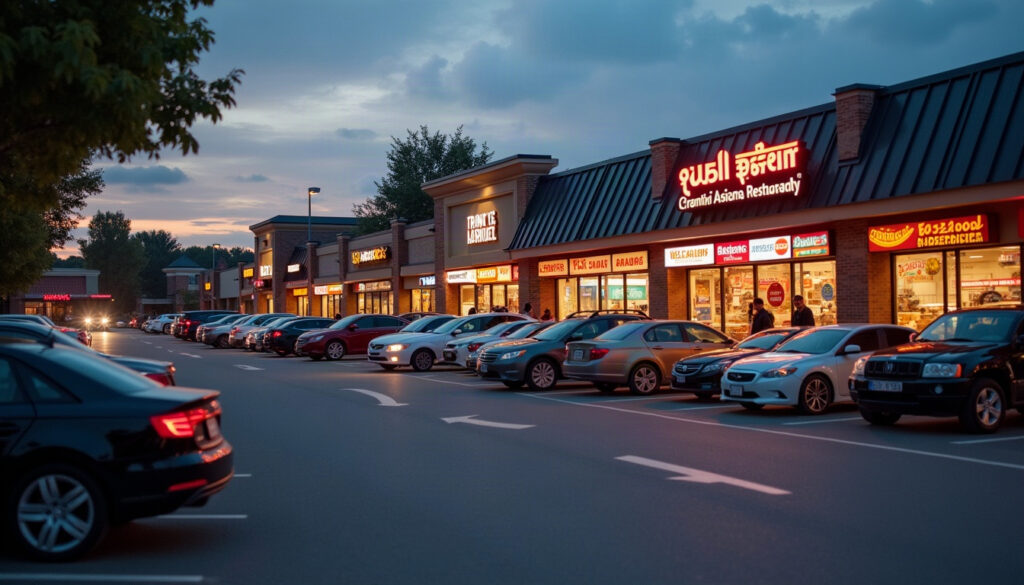
In a Mississauga or Brampton plaza, the guest has already parked. The decision between your kitchen and the one four doors down is made in the next ninety seconds. It comes down to three things that have nothing to do with your food: whether somebody picked up the phone, whether an order button appeared under your name on Google, and whether the wait you quoted sounded believable.
Summary
On this page
A restaurant plaza is a cluster of independent kitchens sharing one parking lot and one row of signs, where a guest can compare several restaurants without moving the car. A main street sells to people walking past one door at a time. A plaza sells to people who have already parked, and who can see six other signs from where they are standing.
Ridgeway Plaza in Mississauga is the cleanest local example of the format. Because of its “large collection of Pakistani, Middle Eastern, Afghan, Turkish, Indian and other halal restaurants concentrated in one destination, many visitors refer to Ridgeway as the halal food plaza,” and the combination of halal dining, desserts and restaurants “operating late into the evening has helped turn the plaza into a social destination as much as a place to eat” (The Halal Food).
Read that as an operator, not a diner. A destination plaza does your marketing for you and then makes you fight for the traffic it delivers, which is why operators here keep asking why a customer picked the restaurant next door when the food is just as good. The guest arrives without a decision made, which is the best possible moment to win them and the easiest possible moment to lose them.
The demand under that plaza is not thin. Peel Region is the second largest municipality in Ontario, with a population of more than 1.4 million people and 143,000 businesses in Brampton, Mississauga and Caledon (Immigration Peel). Per the 2016 census figures on the same page, 51.5 percent of Peel’s population are immigrants and 35.5 percent of Peel’s recent immigrants were born in India, which is why one parking lot can support a row of kitchens with a different flag on each menu.
The supply is not thin either. Nationally there are 80,157 full-service restaurant businesses in Canada, an industry that has grown at a CAGR of 1.2% between 2021 and 2026 (IBISWorld).
Not the food. Your neighbours are good too, or the plaza would not be a destination. What decides it is friction: whether the phone gets answered, whether an order button shows up on Google, and whether the guest believes the wait you quote.
What decides it is friction, and friction shows up in a fixed sequence. The guest searches the plaza or the cuisine on a phone, sees which names have an order button and which do not, calls the one they want, and gives up on the one that rings out. If they are walking in, they ask what the wait is and believe the answer or they do not.
Every one of those steps is a system you either run or do not run. None of them require a renovation, a new hood, or a chef. They require that the phone gets answered, that the link exists where people look, and that the wait is a text message instead of a guess from behind a podium.
That is the uncomfortable part of plaza economics. The guest who chose your neighbour tonight was not choosing against your food. They were choosing the unit that answered.
More than you think: quick-service restaurants miss 40.1% of calls in one 2026 study, and the number varies enormously by format, so use the row that matches your restaurant rather than an industry average.
One 2026 report built from 12,091 restaurant call recordings covers quick service, fast casual, full service and pizza. Quick-service restaurants answered 59.9% of calls, a miss rate of 40.1%. Fast casual answered 75.3%, which the report pairs with a 24.8% miss rate. Pizza restaurants answered 93.1%, the best in the study, which works out to a miss rate of 100 minus 93.1, or 6.9% (QSR Web, US data).
The same report estimates the quick-service miss rate costs roughly $73,000 per location per year, and $3.65 million across a 50-location chain (QSR Web, US data). Those are American restaurants and an American ticket average, so treat them as the shape of the problem rather than your invoice.
Then ask the real question: how many calls is your own restaurant actually missing on a Friday? As an illustration only: a takeout counter that takes 60 calls on a Friday night, at the study’s quick-service miss rate, loses 60 x 0.401, or roughly 24 calls, in one service. Run that with your own call log, not with the American average, and see what missed phone calls actually cost a restaurant for the full method.
In a plaza, a missed call is worse than a lost order. The caller does not go home. They call the unit next door from the same parking lot, and if the food is good they never call you again.
Snappy’s AI Phone is built for exactly this window: it converts missed calls into revenue, captures reservations and orders automatically, gives guests instant SMS or AI voice responses, and reduces staff interruptions during peak hours (Snappy). The suite starts with General Inquiries, which answers every call from your own FAQ and requires no other Snappy product. AI Phone Ordering, which takes the complete order, collects payment up front through a link and prints straight to the kitchen, requires Snappy Online Ordering underneath it. If your line takes ten or more calls a day, the phone is where the money is leaking.
Is your phone or your neighbour's winning tonight's order?
Bring one Friday of call logs and search your plaza name on your phone. We will walk through both against your own parking lot, not an industry average.
Show me my Friday callsFor most plaza independents, the honest answer is nowhere. There is a website, or an Instagram page, and the phone number, and that is the whole digital footprint.
That matters because the guest in the parking lot is not on your website. They are on a Google result or a map pin, comparing your name against five others, and the unit with an order button under its listing gets the tap. The one with a phone number gets a call that may or may not be answered.
Snappy Online Ordering is built to close that gap directly. It gives the restaurant online ordering at 0% commission, keeps 100% of the customer data, and accepts direct pickup and delivery orders from the restaurant’s own website and from Google Search and Maps, including an Order Now button on the Google Business Profile (Snappy). The specific property matters more than the platform: the button lives where the comparison happens.
The rest of the profile is doing work too, or failing to. Photos, hours that are correct at 11 PM in a plaza that trades late, a menu that matches what you actually sell, and replies on reviews. Our guide to promoting a restaurant on Google walks the profile top to bottom.
Reviews are the cheapest of these to fix and the most commonly ignored. Snappy’s Reputation Management uses AI to draft personalized, on-brand replies in seconds rather than hours, posts them once you confirm, and removes the copy-paste step between Google and internal tools (Snappy).
The restaurant next door usually has no better food, just a phone that gets answered, an order button on Google, a wait guests believe, and replies on its reviews. Run this table down the left column and be honest about which side of each row your unit sits on. The right column is what the fix actually is, not what it costs, because pricing is quoted per location.
| Friction point | The unit that loses the order | The unit that wins it | What it takes to fix |
|---|---|---|---|
| Phone rings out at 7 PM | Nobody free to answer during the rush, calls roll to voicemail or to nothing | Every call answered on the first ring, orders taken and paid before the ticket prints | Snappy AI Phone General Inquiries, no other product required; AI Phone Ordering where the volume justifies it |
| Ordering link on the Google profile | A phone number and a link to a menu PDF | An Order Now button on the Google Business Profile, Google Search and Google Maps (Snappy) | Snappy Online Ordering with the Google integration turned on |
| The wait quoted at the door | A clipboard nobody can read from the car, and a number the host guessed | Guests join online, in person or by phone, see their wait, and get automated alerts (Snappy) | Snappy Waitlist, configured once and then it runs |
| The order re-keyed from a phone note | A sticky note walked to the line, then typed into the register at the end of the rush | Order lands in the POS and routes straight to the kitchen station on a screen | Snappy KDS with online ordering and phone ordering feeding it |
| Regulars with no reason to order direct | The restaurant knows the face, owns none of the contact data | Restaurant owns 100% of customer phone numbers, emails and order history (Snappy), with points and campaigns on top | Snappy Loyalty plus direct online ordering |
| Reviews left unanswered | Months of reviews with no owner reply, and a rating that drifts | Personalized replies drafted in seconds and posted with one click, not hours (Snappy) | Snappy Reputation Management |
None of those rows is a menu change, and that’s the point: when operators ask why the other restaurant is getting their customers, the honest answer is almost never the food. In a plaza, the operating gap between the unit that fills and the unit that watches is almost entirely a systems gap.
They flatten the plaza. On a delivery marketplace, your unit and the five around it appear as tiles on the same screen, sorted by the app’s logic rather than by your sign, your smell, or your line out the door.
That is a fair trade for incremental demand and a bad trade for demand you already own. The marketplaces charge a commission on every delivery order, so the neighbour who wins a customer on the app pays for that customer, and so do you. The plaza regular who could have tapped an order button on your Google profile and paid you directly is the one you cannot afford to route through a marketplace.
The practical answer is not to leave the apps entirely, since operators often ask whether they should even be on delivery apps if everyone else in the plaza already is. It is to stop paying for the orders you would have received anyway. Snappy Online Ordering runs direct orders at 0% commission and keeps the customer data with the restaurant (Snappy), while Snappy’s delivery app integration pushes third-party orders into the same POS and kitchen screen so the tablet farm on the counter disappears.
Then give the regular a reason to come back through your own channel. Snappy Loyalty is built for repeat business and reports up to 99% open rates and 10% conversion rates on integrated SMS and loyalty campaigns (Snappy). For the wider version of this argument, see our breakdown of commission-free online ordering systems for restaurants.
Four things, in this order, because each one is cheap and each one is measurable: the order button on Google, an AI line on the phone, a texting waitlist instead of a clipboard, and a reply on every review.
Week one, put the order button on Google. Claim and correct the Google Business Profile, then connect direct online ordering so an Order Now button appears on the profile, in Search and on Maps (Snappy). Measure it the honest way: count direct online orders in week four against week zero.
Week two, put something on the phone. Pull one week of call logs by hour first, so you know whether your problem is volume at 7 PM or nobody free at 2 PM. Then start with answering only, which is the lowest-risk tier because the AI is never authorized to change anything, and widen its authority once you have listened to real calls.
Week three, retire the clipboard. A digital waitlist lets guests join online, in person or by phone, gives them visibility into their wait, and sends automated alerts (Snappy). In a plaza this is worth more than it looks, because a guest with a text on their phone will wander the lot and come back, while a guest with no information walks four doors down. Our roundup of digital waitlist systems for restaurants covers what to look for.
Week four, answer every review. Not the five-star ones, all of them. A reply drafted in seconds rather than hours is the entire product claim, and it is achievable now that the copy-paste step between Google and internal tools is gone (Snappy).
One more thing to do in the same month and it costs nothing. Walk the plaza on a Friday at 7 PM with your phone. Search the plaza name. Note which units have an order button, call three of them and time how long they take to pick up, and ask two hosts what the wait is. You will have a competitive audit of your own parking lot in forty minutes.
Because the decision is made before the food. A call that rings out, an ordering link that is missing from the Google profile, or a wait nobody believes sends a guest who is already in the parking lot four doors down.
Quick-service restaurants answered 59.9% of calls in a 2026 report built from 12,091 recordings, a 40.1% miss rate, while pizza restaurants answered 93.1% (QSR Web, US data). Pull your own call log by hour before you assume either number applies to you.
They add reach and they charge commission on delivery orders, and they put every unit in the plaza on the same screen, so they level the field rather than differentiate you. A direct ordering link on your Google profile at 0% commission is the part that is yours alone (Snappy).
Peel Region is Ontario’s second largest municipality with more than 1.4 million people and 143,000 businesses (Immigration Peel), which is the demand base sitting under a plaza like Ridgeway.
The Google Business Profile and the ordering link on it, because the traffic already exists and you are currently handing it to whoever has a button where you have a phone number.
A destination plaza in Mississauga or Brampton hands you demand and then makes you compete for it against neighbours who are also good at their food. The competition happens in the ninety seconds before anyone tastes anything, on the phone and on a Google result.
Fix the four cheap things: the order button on the profile, the phone that always gets answered, the wait that arrives as a text, and the reviews nobody has replied to. All four are systems, all four are measurable in thirty days, and none of them touch the kitchen.
Snappy runs those four on one system with one support line, from offices in Toronto, Vancouver and Montréal, and direct orders come through at 0% commission with the customer data staying with the restaurant (Snappy).
Get your ordering link onto Google and your phone answered this month. Talk to our team.
Book a walkthrough
Put your phone and your Google button to work in your plaza
Book a walkthrough and we will go through your phone line, your Google order button, your waitlist and your reviews together, one at a time, on your own unit.
Written by
Wilson Wu
Chief Revenue Officer, Snappy
Wilson Wu is Chief Revenue Officer at Snappy, the restaurant technology company, and is based in Boston. His first job was in a restaurant kitchen, and he has spent his career since at the intersection of hospitality and software, working with operators across Canada on the systems their service runs on. He also builds the technology he writes about. His engineering work includes a per-location customer service agent that answers guests with a restaurant's real hours, menu and prices, deployed with independent restaurants, and a document-extraction model that reads supplier invoices and matches invoice numbers against what is owed. He writes here about what changes on a busy service: ordering, payments, loyalty, the phone, and the Canadian rules behind them. He holds an MBA from Duke University and a Master of Science in Computer Science from Georgia Tech.
Connect on LinkedInNo-obligation walkthrough
Find out where your plaza orders go
A short walkthrough of your phone line and Google order button, built around your own plaza.
On this page
Get The Latest Restaurant Data, Trends & Tips