
Wilson Wu
Chief Revenue Officer, Snappy
November 4, 2026·11 min read
The Richmond Night Market has run its last season at its Number 3 Road site, and no replacement has been announced. If you ran a food stall there, the question is not whether to rebuild but which of four paths fits the capital and foot traffic you have: other markets and pop-ups, a food-court stall, catering or a ghost kitchen, or a small storefront. Each path needs a different amount of technology in the first 90 days, and for most of them it is less than a vendor will tell you.
This guide is for stall operators and the families who work alongside them.
Think of the night market as a big busy street where the crowd came to you. Every stall owner rented a small spot and the crowd did the work of finding them. Now the street is closed, so each owner has to decide where to stand. Some will pop up on other streets for a few nights, some will rent a spot inside a shopping mall, some will cook in a back kitchen and deliver, and some will open a small shop of their own. In every case, the new job is to make sure customers can find you, order from you and pay you, even when the crowd is not there to do it for you.
The market opened its 2026 season on April 24, and its last scheduled day was Sunday, September 20. Daily Hive reported in 2024 that the market was running on a three-year lease extension at the Duck Island site that expired in 2026, and that lease was not renewed (Daily Hive). The founder, Raymond Cheung, said he had organized the market for 26 years (Richmond Sentinel).
The City of Richmond said it is not part of the lease negotiations and does not control commercial terms between private parties, but that staff would advise on land use, permitting and licensing if organizers look at other Richmond locations (Daily Hive). We found no vendor transition program and no date for a successor event. Plan as if there is none.
Which path fits your budget?
Tell us your budget and where your regulars are, and we will map what each path needs on day one.
Map my next stepIt gave you three things you did not pay for separately: a crowd, a short operating window and a shared infrastructure. Every path below replaces them in a different way.
The crowd is the big one. At up to roughly 10,000 visitors a night, a stall did not have to advertise (Daily Hive). The City says the market drew more than one million visitors a year, while the Richmond Conservatives, citing Tourism Richmond, put it near 800,000 (Daily Hive). The two estimates disagree, so do not build a forecast on either.
The window was short: 7 p.m. to midnight on Fridays, Saturdays and Sunday holidays, and 7 p.m. to 11 p.m. on regular Sundays (Daily Hive). Labour and prep were packed into a handful of hours a week. A storefront with seven-day hours spreads the same labour across far more time, and that changes the arithmetic.
Shared infrastructure meant power, a site and a ticket line someone else managed. Off the market, each becomes your problem. Your regulars, though, were buying your cooking, and they will follow you if they can find you.
Yes, and it is the lowest-capital path, but it is seasonal and you are renting someone else’s crowd again. In 2026, Metro Vancouver ran several smaller night and pop-up markets. White Rock held five dates from May 1 to September 4, the Shipyards Night Market in North Vancouver ran May 15 to September 11, Fridays on Front in New Westminster ran six Fridays in July and August, and the Vegan Night Market ran various dates through September 3 (604 Now). Those are 2026 dates. Confirm each organizer’s 2027 calendar and vendor application directly.
Two rules apply on any food booth. First, FOODSAFE Level 1 or a recognized equivalent is required under the Food Premises Regulation for the operator of a food service establishment and for at least one employee when the operator is absent (Government of British Columbia). Second, temporary food service at events is permitted by your regional health authority, and the lead time is set by that authority, so ask for the current application and deadline before you pay any booth fee. Check which regional health authority covers each site you apply to.
What the first 90 days need on this path:
It is the best fit if you want daily lunch traffic instead of a few nights a week, and it is the path with the most overlap with what you already do: a small menu, fast service, one counter. The trade-off is lease terms and mall hours. Aberdeen Centre, for example, lists mall hours of 11 a.m. to 7 p.m. Monday to Thursday and Sunday, and 11 a.m. to 8 p.m. on Friday and Saturday, with a note that some retailers keep other hours (Aberdeen Centre). You are trading the night market’s late evenings for a lunch rush.
Food courts also turn over. NOMS Magazine’s March 2026 roundup of Richmond closures listed three Aberdeen Centre tenants, including a noodle outlet that closed after 16 years (NOMS Magazine). That is one report, not a trend. Read the lease for term, rent structure and exit terms before you buy equipment. We cover the throughput side in Running a Food Court Stall at a Richmond or Burnaby Mall.
If your food travels well and holds heat, this path replaces the crowd with customers who already know you. Catering is also kind to your tax setup: BC’s PST guidance says catering services such as menu planning, preparing, plating and serving food are not subject to PST, and sales of food for human consumption, including meals, are exempt (Government of British Columbia). Goods the client keeps after the event can be taxable, so check the page for your case.
If you go the delivery-app route to reach new customers, remember the BC cap on what a delivery company may charge a restaurant: no more than 20% of the dollar value of an order, effective January 1, 2023 (Government of British Columbia). The same release says fees reached as high as 30% during the pandemic, and delivery companies may still offer optional enhanced services at your discretion. Your own ordering page does not charge that, which is why the first thing to build is a direct link you can send to every regular. Our OWA savings calculator guide walks through the comparison.
What the first 90 days need: an online ordering page with a menu built for travel (portion sizes, minimum order, lead time), a phone line that answers catering enquiries when you are in the kitchen, and a way to take a deposit. Snappy’s AI Phone General Inquiries has no prerequisite and answers every call from your own FAQ, so a caller asking about tray sizes gets an answer. Snappy AI Phone Ordering requires Snappy Online Ordering, takes the complete order, collects payment up front through a link and prints it straight to the kitchen (Snappy). Catering leads vanish when a call goes unanswered. See what a restaurant loses when the phone rings during the rush.
When you have the capital, a loyal base and a menu that sells at a counter all week. It is the highest-capital path because of the lease, the build-out and the labour, and the market’s seasonal economics do not carry over. If the storefront needs seven days of trade to break even and you have only ever proven two, run Path 1 or 3 for a season first.
Labour is the fixed cost to check. BC’s general minimum wage rose from $17.85 to $18.25 an hour on June 1, 2026 (Government of British Columbia). One employee on a 40-hour week is $18.25 x 40 = $730 in wages before payroll costs, and your storefront has to cover that before it pays rent.
The technology is a simple register with a payment terminal, an online ordering link and a correct Google profile. Snappy Go lets servers take orders, send them to the kitchen and collect payment on the same device (Snappy), which suits a small counter. Ask our team which setup matches your menu, and get the full monthly cost in writing.
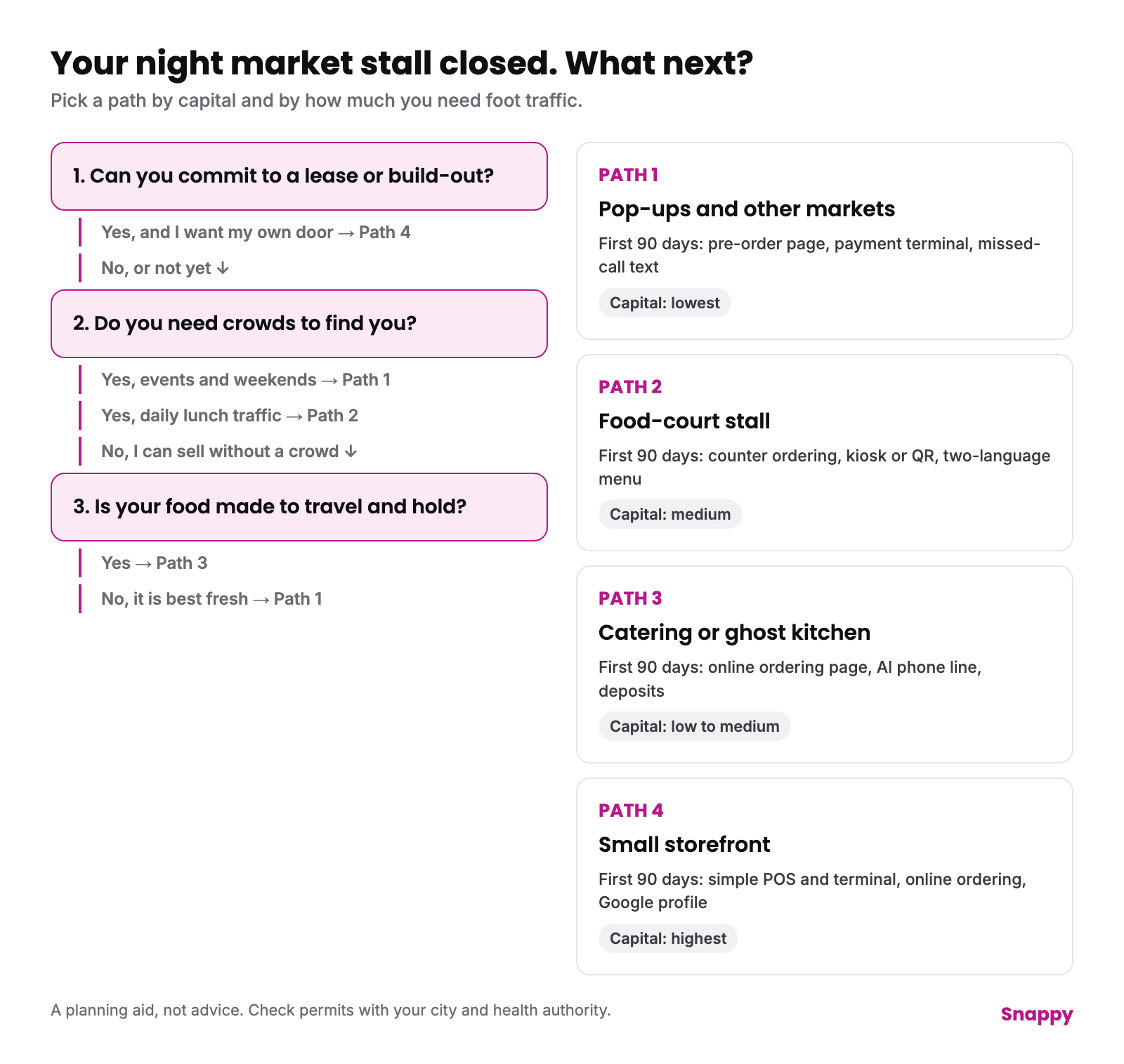
| Path | Capital needed | Foot traffic | First-90-day tech | Main risk |
|---|---|---|---|---|
| 1. Pop-ups and other markets | Lowest: booth fees, equipment you already own | Rented, seasonal, event days only | Pre-order page, SIM payment terminal, missed-call answer | Seasonal, application deadlines, permits per event |
| 2. Food-court stall | Medium: rent, build-out, deposit | Daily lunch crowd inside mall hours | Counter ordering, kiosk or QR, two-language menu | Lease terms, mall hours, tenant turnover |
| 3. Catering or ghost kitchen | Low to medium: kitchen access, packaging | None needed; customers come to you by phone or link | Direct ordering page, AI phone line, deposits | Needs a base of customers who already know you |
| 4. Small storefront | Highest: lease, build-out, wages | Whatever the location provides | Register and terminal, online ordering, Google profile | Fixed costs seven days a week |
Anything with a multi-year term. Operators leaving a market tend to buy fast, because the booth is gone and someone is offering a hardware discount. Before you sign for any terminal, POS or ordering system, get five answers in writing: the monthly fee, the processing rate, any per-order fee, the contract term and what exiting costs. Hold off on a custom app or a big website build too. A direct ordering link, a correct Google profile and a working phone line do more in the first 90 days than a brand project.
Daily Hive reports it will permanently conclude its run at the end of the Summer 2026 season, with the Duck Island lease expired and no new location named. We found no confirmed 2027 venue as of October 30 (Daily Hive).
Possibly. Several smaller markets ran in 2026, including White Rock, the Shipyards in North Vancouver and Fridays on Front in New Westminster (604 Now). Contact each organizer for 2027 dates and vendor applications, and ask your health authority what a temporary food permit requires.
FOODSAFE Level 1 or a recognized equivalent is required for the operator of a food service establishment, and for at least one employee in the operator’s absence (Government of British Columbia). Confirm with your health authority what applies at a temporary booth.
A payment terminal with a built-in cellular SIM, so it does not depend on the venue’s network. Snappy offers one with LTE backup. Ask our team for current pricing.
BC’s guidance says catering services are not subject to PST and that food for human consumption, including meals, is exempt, though goods the client keeps after the event can be taxable (Government of British Columbia). Verify your own case with the Ministry of Finance or an accountant.
The night market did the hardest part of your job for you, which was bringing the crowd. Wherever you go next, you will need to bring customers yourself, and the cheapest way to do that is to give your regulars three things: a link they can order from, a phone line that always answers and a terminal that always works. Pick your path on capital and foot traffic, sign nothing long until you have, and keep the first 90 days simple.
Call our team at 1-855-818-0058 and tell us what you cooked at the market. We will map the lightest setup for your next step. Book a demo.
Book a walkthrough
Ready to take orders before the line forms?
Book a walkthrough and see ordering and payments set up for wherever you land next.
Written by
Wilson Wu
Chief Revenue Officer, Snappy
Wilson Wu is Chief Revenue Officer at Snappy, the restaurant technology company, and is based in Boston. His first job was in a restaurant kitchen, and he has spent his career since at the intersection of hospitality and software, working with operators across Canada on the systems their service runs on. He also builds the technology he writes about. His engineering work includes a per-location customer service agent that answers guests with a restaurant's real hours, menu and prices, deployed with independent restaurants, and a document-extraction model that reads supplier invoices and matches invoice numbers against what is owed. He writes here about what changes on a busy service: ordering, payments, loyalty, the phone, and the Canadian rules behind them. He holds an MBA from Duke University and a Master of Science in Computer Science from Georgia Tech.
Connect on LinkedInNo-obligation walkthrough
Picking your next spot after the market?
Talk through the first 90 days: taking orders ahead, payments and not missing calls.
On this page
Get The Latest Restaurant Data, Trends & Tips