Demand Forecasting
Estimate future sales and ingredient needs using historical data, seasonality, and relevant demand signals to avoid over-ordering.

October 19th, 2026
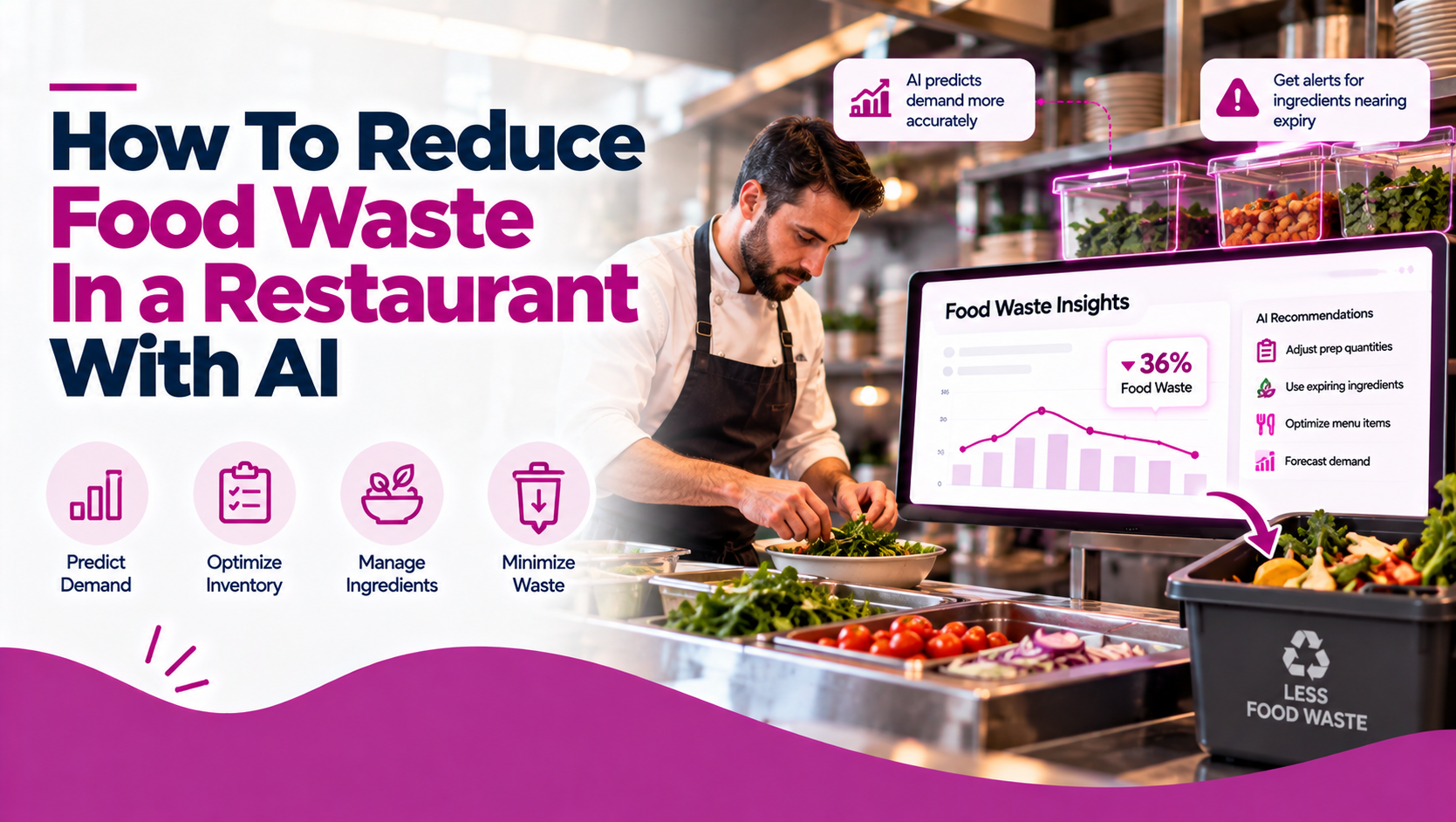
Food waste is one of the most persistent challenges in restaurant operations. Overstocked ingredients, inaccurate demand forecasts, oversized portions, spoilage, and last-minute menu changes can all eat into profit margins. While traditional inventory checks and manual forecasting help, they can make it difficult to identify waste patterns before they become expensive problems.
Artificial intelligence (AI) offers restaurants another way to manage food costs. By analyzing sales history, forecasting demand, monitoring inventory, and flagging potential issues, AI-powered tools can help operators make more informed purchasing and preparation decisions.
This guide explains how to reduce restaurant food waste with AI, which features to look for, and how to choose the right solution for your operation.
Forecast demand more accurately: Use historical sales, seasonality, and weather-related patterns to estimate how much food your restaurant will need.
Improve inventory visibility: Track ingredients, purchasing, recipe costs, and stock levels to identify potential waste.
Optimize food purchasing: Use demand projections and supplier pricing information to make better purchasing decisions.
Prepare the right quantities: Align food preparation with anticipated customer demand instead of relying exclusively on intuition.
Identify recurring waste patterns: Compare expected ingredient usage with actual inventory counts to investigate unexplained discrepancies.
Use AI-powered alerts: Get notified about potential inventory issues and changing demand before they create bigger problems.
Consider Snappy: Its AI platform supports demand forecasting, inventory alerts, and automated reminders, while Snappy Inventory connects purchasing, recipe costing, POS sales, and stock counts.
AI-powered food waste management uses artificial intelligence, historical data, forecasting models, and automation to help restaurants prevent avoidable food loss.
Rather than relying exclusively on staff estimates or periodic manual inventory checks, these tools use operational data to reveal patterns and support more informed decisions.
For example, an AI-powered system may help a restaurant anticipate higher demand during a seasonal rush, identify ingredients that are being purchased in excessive quantities, or flag inventory issues that need attention.
Depending on the platform, the data analyzed may include:
The goal is not simply to track the food a restaurant throws away. It is to identify the operational decisions that lead to waste and help teams prevent those problems earlier.
AI is most effective when combined with accurate inventory records, consistent food preparation procedures, and staff training. It supports decision-making rather than replacing food safety practices or experienced kitchen management.
AI can support food waste reduction at several stages, from purchasing ingredients to preparing dishes and reviewing performance.
Ordering too much food is a common source of spoilage. Ordering too little can create stockouts, disrupt service, and force managers to make expensive last-minute purchases.
AI-powered demand forecasting analyzes historical sales and other relevant signals to estimate future demand.
A restaurant may use these projections to answer questions such as:
Practical tip: Start with ingredients that spoil quickly or account for a significant share of food spending. Even modest improvements in forecasting these products can help reduce avoidable purchasing and spoilage.
A restaurant cannot reliably reduce waste if it does not know what it has, what it has purchased, and how much it uses.
AI-powered forecasting becomes more useful when it is supported by dependable inventory information. Inventory management software can connect purchase records, recipes, POS sales, and physical counts to create a clearer picture of ingredient movement.
For example, if a restaurant sells 50 portions of a dish, its recipe information can help estimate how much of each ingredient should have been used. Managers can compare that theoretical usage with actual inventory counts to investigate differences.
Snappy Inventory supports this workflow by connecting POS sales to theoretical ingredient usage, tracking purchases and receiving, and providing product consumption reporting. Its inventory tools also support mobile counts and recipe costing based on recorded purchase prices.
These capabilities can help operators identify unusual usage patterns and investigate potential waste, although they do not automatically prove that every discrepancy is caused by food waste.
Inventory problems are easier to address when teams have time to respond.
An ingredient sitting unused in storage may indicate that purchasing quantities are too high, a menu item is underperforming, or preparation plans have not kept pace with customer demand.
AI-powered inventory alerts and automated reminders can help staff pay attention to potential issues earlier.
Restaurants can use these signals to:
These tools should complement, not replace, proper date labeling, first-in-first-out practices where appropriate, and required food safety procedures.
Preparing large quantities in advance can save time during busy service periods, but it also creates a risk of overproduction when customer demand is lower than expected.
AI-based demand projections can help kitchen managers estimate how much food to prepare for different service periods.
For example, if sales data suggests that weekday lunch demand is usually lower than weekend demand, managers can use that information to adjust batch sizes and preparation schedules.
Useful practices include:
Forecasts are estimates, not guarantees. Restaurants should combine them with staff knowledge, reservation information, local events, and real-time conditions.
Food waste reduction is closely connected to purchasing and recipe management. When ingredient costs change or portions are inconsistent, a restaurant may spend more than expected on each dish.
Inventory software can help operators understand the cost of ingredients and how they contribute to the cost of each recipe.
Snappy Inventory provides live recipe costing and food-cost percentages based on recorded purchase prices. Its published features also include supplier price comparisons, purchase recording, receiving, and cost trend lines.
This information can help managers evaluate supplier price changes, review recipe profitability, and make more informed purchasing decisions.
For example, if a supplier increases the price of an ingredient, updated recipe costs can help the operator assess whether to adjust the menu price, compare suppliers, or review how the ingredient is used.
Lower purchasing costs alone do not guarantee less waste. The aim is to buy appropriate quantities at a reasonable cost while maintaining ingredient quality and food safety.
Some dishes sell consistently, while others have unpredictable demand. Ingredients used primarily in low-selling dishes can be particularly vulnerable to spoilage.
Sales analytics can help restaurants identify menu trends and investigate which items contribute to unnecessary inventory.
Managers can use this information to:
Snappy Intelligence combines restaurant data and operational insights to support recommendations and decision-making. Its analytics and inventory capabilities can help operators examine performance, though specific recommendations and workflows depend on the features and configuration in use.
The difference between expected ingredient usage and actual inventory movement can reveal operational problems.
Possible causes include over-portioning, incorrect recipe measurements, unrecorded waste, receiving errors, inaccurate counts, or theft. A discrepancy should be investigated rather than automatically classified as waste.
Restaurants can use inventory counts and consumption reports to establish a baseline and identify recurring variances.
For example, if actual usage of a high-cost ingredient consistently exceeds the amount expected from recorded sales, a manager can review portion sizes, recipe mapping, stock transfers, receiving records, and waste logs.
This process turns inventory data into a practical improvement plan.
Not every restaurant needs an advanced AI platform. The right solution depends on the size of the operation, the complexity of its menu, its current systems, and the main sources of waste.
Estimate future sales and ingredient needs using historical data, seasonality, and relevant demand signals to avoid over-ordering.
Monitor stock levels, purchases, inventory counts, and ingredient movement to identify excess stock and potential spoilage.
Connect sales data with ingredient usage to estimate how much inventory should have been consumed by orders.
Calculate ingredient and menu-item costs to understand food spending and identify opportunities to improve profitability.
Flag low stock, changing demand, or other inventory issues so staff can investigate and respond before problems escalate.
Record orders, deliveries, and supplier prices to improve purchasing decisions and keep inventory information accurate.
Compare expected ingredient usage with inventory records to investigate discrepancies, over-portioning, or unrecorded waste.
Track inventory and transfers across restaurant locations to improve visibility and coordinate stock where needed.
Turn sales, inventory, and food-cost data into practical insights that help managers improve purchasing and preparation plans.
Restaurants can approach food waste reduction through dedicated inventory management software, AI-powered restaurant platforms, or a combination of existing tools.
Best for: Restaurants looking to connect AI-powered demand forecasting with practical inventory and food-cost management.
Snappy offers an AI platform designed to support restaurant sales, operations, inventory, and decision-making.
Its AI-related waste-control capabilities include demand forecasting, inventory alerts, and automated reminders.
Snappy Inventory complements these capabilities with tools for:
Together, these functions can help restaurants connect what they buy, what they sell, and what they count, giving managers more information to identify potential waste and improve purchasing decisions.
The distinction matters: Snappy Intelligence provides the published AI forecasting and waste-control capabilities, while Snappy Inventory provides the inventory tracking, costing, and usage workflows. Confirm the specific features, integrations, and configuration available for your restaurant.
Best for: Restaurants that need more accurate stock records, ingredient tracking, and food-cost visibility.
Inventory management systems help restaurants record purchases, track ingredients, conduct counts, and calculate recipe costs. Depending on the platform, they may also support usage forecasting, alerts, and integrations with POS systems.
These tools can be valuable even when advanced AI capabilities are limited. Reliable inventory records and consistent counting practices provide the foundation for effective waste reduction.
When comparing options, prioritize accurate ingredient tracking, practical reporting, and compatibility with your existing restaurant systems.
Best for: Restaurants that want to use existing sales information to improve purchasing and preparation decisions.
POS systems collect valuable data about sales volumes, menu performance, and customer ordering patterns. When connected to inventory and analytics tools, this information can help operators estimate ingredient requirements and spot changes in demand.
Some platforms offer AI-powered recommendations or forecasting, while others rely on conventional reporting. Check whether the system supports ingredient-level usage calculations or simply reports sales totals.
A sales report can tell you how many dishes sold, but recipe mapping and inventory data are needed to estimate how much food those sales should have consumed.
| Solution Type | Main Strength | Potential Limitation | Best Fit |
|---|---|---|---|
| AI-Powered Restaurant Platform | Combines demand forecasting, operational data, inventory alerts, and automated reminders to support proactive planning. | Forecast accuracy depends on data quality, system configuration, and how consistently the team uses the platform. | Restaurants seeking data-driven purchasing, preparation, and inventory decisions. |
| Inventory Management Software | Tracks stock levels, purchases, ingredient usage, recipe costs, and inventory counts. | May require regular physical counts, accurate recipe setup, and staff input to maintain reliable records. | Restaurants that need stronger inventory control and food-cost visibility. |
| POS With Analytics | Provides sales trends and menu-performance data to help estimate demand and plan food preparation. | Sales data alone may not reveal actual ingredient usage, spoilage, or the amount of food discarded. | Restaurants starting with sales-based improvements to purchasing and preparation. |
| Separate Inventory and Forecasting Tools | Lets restaurants choose specialized tools for inventory tracking, forecasting, and waste monitoring. | Multiple subscriptions, disconnected data, and integration requirements can increase complexity. | Restaurants with specialized needs or existing systems they want to keep. |
Technology works best when supported by a clear operational process. Use these steps to get started.
Step 1: Establish a baseline
Track food waste before introducing new tools. Record what is discarded, how much is wasted, why it happened, and which ingredients or menu items are involved.
Separate spoilage, overproduction, preparation errors, plate waste, and inventory discrepancies where possible. This helps identify which problems deserve attention first.
Step 2: Improve inventory and recipe data
Review ingredient units, recipe quantities, supplier prices, product records, and POS menu mappings. Inaccurate data can undermine both inventory calculations and demand forecasts.
Step 3: Start forecasting for priority ingredients
Focus initially on high-cost or highly perishable ingredients. Compare forecast demand with actual sales and adjust purchasing and preparation plans based on the results.
Step 4: Introduce alerts and regular reviews
Use available inventory alerts, reminders, and consumption reports to flag issues. Assign responsibility for reviewing alerts and documenting the action taken.
Step 5: Train staff on waste prevention
Train employees on portion control, labeling, storage, receiving, inventory counts, and recording discarded food. Explain how accurate data helps the restaurant make better decisions.
Step 6: Measure results and refine the process
Review waste quantities, purchasing patterns, stock discrepancies, and food costs regularly. Compare results with your baseline and adjust the workflow when a particular approach is not working.
Restaurants should measure results rather than assume that implementing AI automatically reduces waste.
Useful metrics include:
Compare metrics over consistent periods and account for changes in sales, menu mix, seasonality, and supplier prices. A reduction in waste cost might reflect lower ingredient prices rather than less waste, so use multiple measures for a clearer picture.
Yes. AI can help restaurants reduce avoidable food waste by improving demand forecasts, identifying potential inventory issues, and supporting better purchasing and preparation decisions. However, the results depend on data quality, staff adoption, and consistent operational processes.
Restaurants should start by identifying their biggest sources of waste, establishing baseline measurements, and improving inventory accuracy before investing in additional technology.
Snappy is worth considering for restaurants that want to connect AI-powered forecasting and waste-control alerts with day-to-day inventory management. Snappy Intelligence offers forecasting based on sales history, seasonality, and weather, while Snappy Inventory provides POS-driven ingredient usage, recipe costing, purchasing records, and inventory counts.
For operators looking to make more informed decisions about what to buy, prepare, and track, these capabilities can provide a useful foundation for a more proactive food waste reduction strategy.
AI can analyze sales history, seasonal patterns, weather-related factors, and inventory information to help restaurants forecast demand and identify potential stock issues. These insights can support better purchasing, preparation, and inventory decisions.
AI-powered demand forecasting can estimate future demand using available historical and contextual data. Forecasts are not guarantees, so restaurants should combine them with staff experience, current reservations, local events, and real-time sales trends.
Not necessarily. Software can automate calculations and use recorded sales to estimate ingredient usage, but physical counts remain important for checking actual stock and identifying discrepancies. Some systems support mobile counts to make the process easier.
Start with ingredients that are expensive, highly perishable, frequently wasted, or used in large quantities. Produce, dairy, seafood, and other short-shelf-life items may be good candidates, depending on the restaurant’s menu and purchasing patterns.