
October 9th, 2026
Labour is one of the most significant operating expenses for restaurants. When schedules do not match customer demand, managers can end up paying for unnecessary hours during quiet periods or struggling to serve guests during unexpected rushes. At the same time, employees often spend valuable time answering phone calls, managing reservations, processing orders, and completing repetitive administrative tasks.
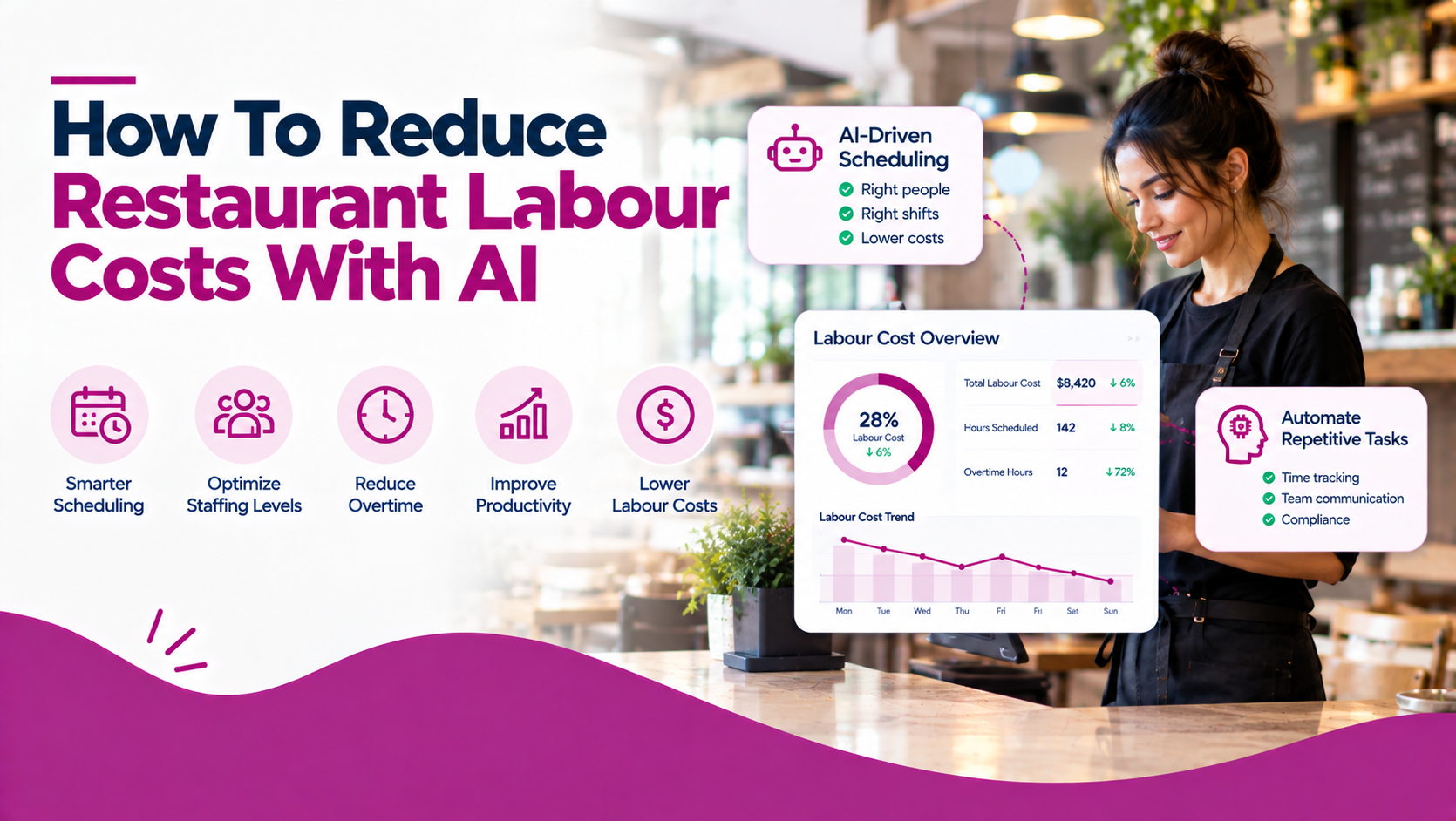
Artificial intelligence (AI) gives restaurants new ways to manage these challenges. By forecasting demand, improving staff scheduling, automating routine tasks, and providing actionable operational insights, AI can help restaurants control labour costs while maintaining service quality.
Restaurant operators can use AI-powered workforce management tools, scheduling platforms, and integrated restaurant technology to identify inefficiencies and make better decisions. Solutions such as Snappy Intelligence, Toast Scheduling, Fourth iQ, and 7shifts offer different approaches to improving restaurant labour efficiency.
AI-powered restaurant labour management uses data analysis, forecasting, and automation to help restaurant operators make better staffing and operational decisions.
Traditional labour management often depends on managers reviewing previous sales, estimating upcoming demand, building schedules manually, and adjusting staffing when business conditions change. AI tools can support this process by analyzing historical sales, demand patterns, and other available information to generate forecasts and recommendations.
Depending on the platform, AI may help restaurants:
Not every AI platform offers all these capabilities. Some focus primarily on employee scheduling and labour forecasting, while others automate customer-facing tasks or connect insights across multiple restaurant operations.
1. Use AI to Forecast Demand More Accurately
One of the most effective ways to control labour costs is to schedule employees according to expected customer demand.
AI forecasting can help restaurants anticipate demand using historical sales, day-of-week patterns, seasonality, promotions, and other available data. Some platforms also incorporate additional factors, such as weather, to improve planning.
With better forecasts, managers can:
The goal is not simply to schedule fewer employees. It is to schedule the right coverage for the work that needs to be done.
2. Automate Repetitive Tasks With AI
Scheduling is only one part of restaurant labour management. Staff also spend time answering phones, taking orders, managing reservations, responding to common questions, and completing administrative work.
AI automation can reduce the time employees spend on these repetitive tasks, allowing them to focus on food preparation, guest service, and other activities that require human attention.
Examples include:
These capabilities can help reduce repetitive work, although the actual labour impact will depend on restaurant volume, configuration, and how the tools are deployed.
3. Improve Employee Scheduling and Control Overtime
Manual scheduling can take managers hours each week, especially when they must account for employee availability, time-off requests, changing demand, and labour budgets.
AI-supported scheduling tools can help managers prepare schedules more efficiently and identify potential labour cost issues before shifts begin.
When evaluating these tools, look for features such as:
A useful practice is to compare the schedule with actual results after every shift. If labour costs repeatedly exceed targets on certain days, managers can investigate whether the cause is inaccurate forecasts, inefficient workflows, unplanned overtime, or a genuine need for more coverage.
4. Reduce Labour Costs by Improving Operational Efficiency
Labour costs are not determined by staffing levels alone. Inefficient processes can require employees to spend more time completing the same work.
AI can help restaurants identify bottlenecks and streamline operations by connecting data from sales, orders, inventory, and other restaurant systems.
Examples include:
A restaurant that receives a high volume of phone orders, for example, may find that employees are frequently interrupted while serving in-person customers. An AI voice agent could handle eligible calls and orders, allowing employees to focus on customers already in the restaurant.
5. Use AI Insights to Make Better Labour Decisions
AI is most useful when it helps managers decide what to do next, rather than simply displaying information in a dashboard.
Restaurant operators should look for tools that make it easier to understand the relationship between labour, sales, customer demand, and operating performance.
For example, AI-powered insights might help managers investigate:
For multi-location groups, centralized insights can be particularly useful because they allow managers to compare performance across restaurants instead of relying on separate manual reports
| Platform | Main Focus | Demand Forecasting | Scheduling Support | Customer-Facing Automation | Broader Operational Insights |
|---|---|---|---|---|---|
| Snappy Intelligence | Restaurant-wide AI and task automation | ✓✓✓ | Operational insights; verify specific scheduling needs | ✓✓✓ | ✓✓✓ |
| Toast Scheduling / Toast IQ | Scheduling and sales-informed staffing | ✓✓✓ | ✓✓✓ | ✓ | ✓✓ |
| Fourth iQ | Workforce and inventory forecasting | ✓✓✓ | ✓✓✓ | ✓ | ✓✓✓ |
| 7shifts | Scheduling and labour budgeting | ✓✓ | ✓✓✓ | — | ✓✓ |
Best for: Restaurants looking to combine labour-saving automation with broader operational insights.
Snappy Intelligence is an AI platform built for restaurant operations. Rather than focusing exclusively on employee schedules, it connects AI capabilities with areas such as sales, customer service, inventory, ordering, and decision-making.
Its features include:
These capabilities can support labour efficiency in several ways. Automating eligible phone calls and reservations can reduce interruptions during service. Better demand and inventory insights can help managers prepare for shifts more effectively. Centralized reporting can also reduce the time spent manually reviewing operational data.
Snappy Intelligence may be particularly relevant to restaurants that want to automate customer-facing work as well as improve operational decision-making. Its approach differs from a scheduling-only tool because it addresses multiple workflows across the restaurant.
2. Toast Scheduling and Toast IQ
Best for: Restaurants that want to connect staff scheduling with sales forecasts and labour targets.
Toast offers restaurant scheduling tools that help managers plan shifts and manage employee schedules. Its scheduling capabilities include forecasts based on historical POS sales, while its Scheduling Agent can help build schedules using projected sales and employee availability.
Relevant features include:
These capabilities can help managers spend less time building schedules manually and make it easier to identify potential labour cost overruns.
3. Fourth iQ
Best for: Restaurant groups focused on workforce planning, forecasting, and labour optimization across locations.
Relevant capabilities include:
Fourth iQ may be a good fit for restaurant groups that need a more comprehensive workforce management approach, particularly where scheduling and inventory decisions are closely connected.
4. 7shifts
Best for: Restaurants that want scheduling tools with sales projections and labour budget visibility.
7shifts provides restaurant employee scheduling and labour management tools. Its labour budget functionality helps managers compare projected sales and labour targets while building schedules. The company also documents machine-learning-based sales projections within this workflow.
Relevant capabilities include:
7shifts may be a practical option for restaurants whose primary goal is improving scheduling discipline and controlling labour budgets without adopting a broader AI operations platform.
Implementing AI does not automatically reduce expenses. Restaurants should establish a baseline and track whether the tools improve efficiency without hurting service.
Useful metrics include:
Where possible, compare performance before and after implementation over several weeks or months. Account for seasonality, changes in sales, wage increases, promotions, and other factors that could affect results.
Reducing restaurant labour costs is not simply about cutting hours. It is about matching staffing to demand, removing unnecessary manual work, improving operational visibility, and helping teams spend more time on activities that matter to customers.
Its combination of AI-powered voice assistance, demand forecasting, inventory alerts, and restaurant analytics makes it relevant for operators looking to address labour efficiency beyond scheduling alone.
The best starting point is to identify where labour time is being lost, choose a solution that addresses that problem, and measure the impact on both costs and service quality.
AI can help restaurants reduce avoidable labour expenses by improving demand forecasts, supporting more efficient scheduling, identifying overtime risks, and automating repetitive tasks. Results depend on the restaurant’s workflows, data quality, implementation, and how managers use the recommendations.
AI scheduling helps managers plan staffing around expected demand, employee availability, and labour targets. AI task automation handles selected tasks, such as customer inquiries, phone orders, or reservations, that would otherwise require staff time. Some restaurant platforms offer one approach, while others combine several.
Yes. Smaller restaurants may benefit from simpler scheduling tools, labour budget visibility, or automation for high-volume repetitive tasks. The right choice depends on the restaurant’s size, budget, existing systems, and the time-consuming tasks it needs to address.