
Wilson Wu
Chief Revenue Officer, Snappy
November 9, 2026·10 min read
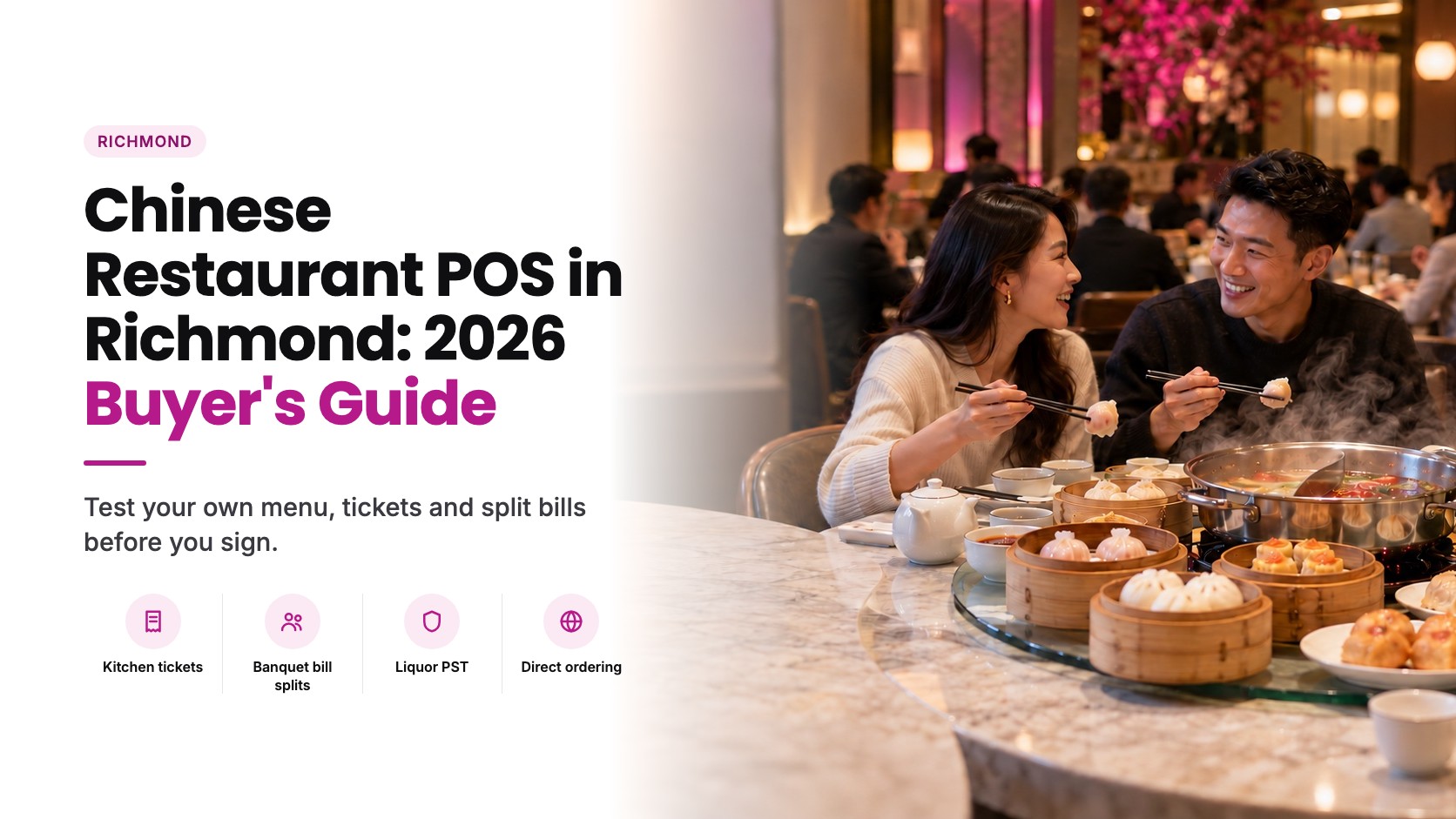
A Richmond Chinese restaurant does not buy a POS the way a coffee shop does. The kitchen reads Chinese. The server may take the order in Cantonese or Mandarin. A table of twelve wants one dish at a time and then wants the bill split five ways. Liquor carries a different tax from the food. And the owner is often the person who answers the phone when the system goes down on a Saturday night.
This guide is a buyer’s checklist built around those realities. It covers what to demand on Chinese-language kitchen tickets, how to handle split bills and group bookings, what to ask about support hours in Pacific time and contract length, and a table of questions you can take to any vendor, including us.
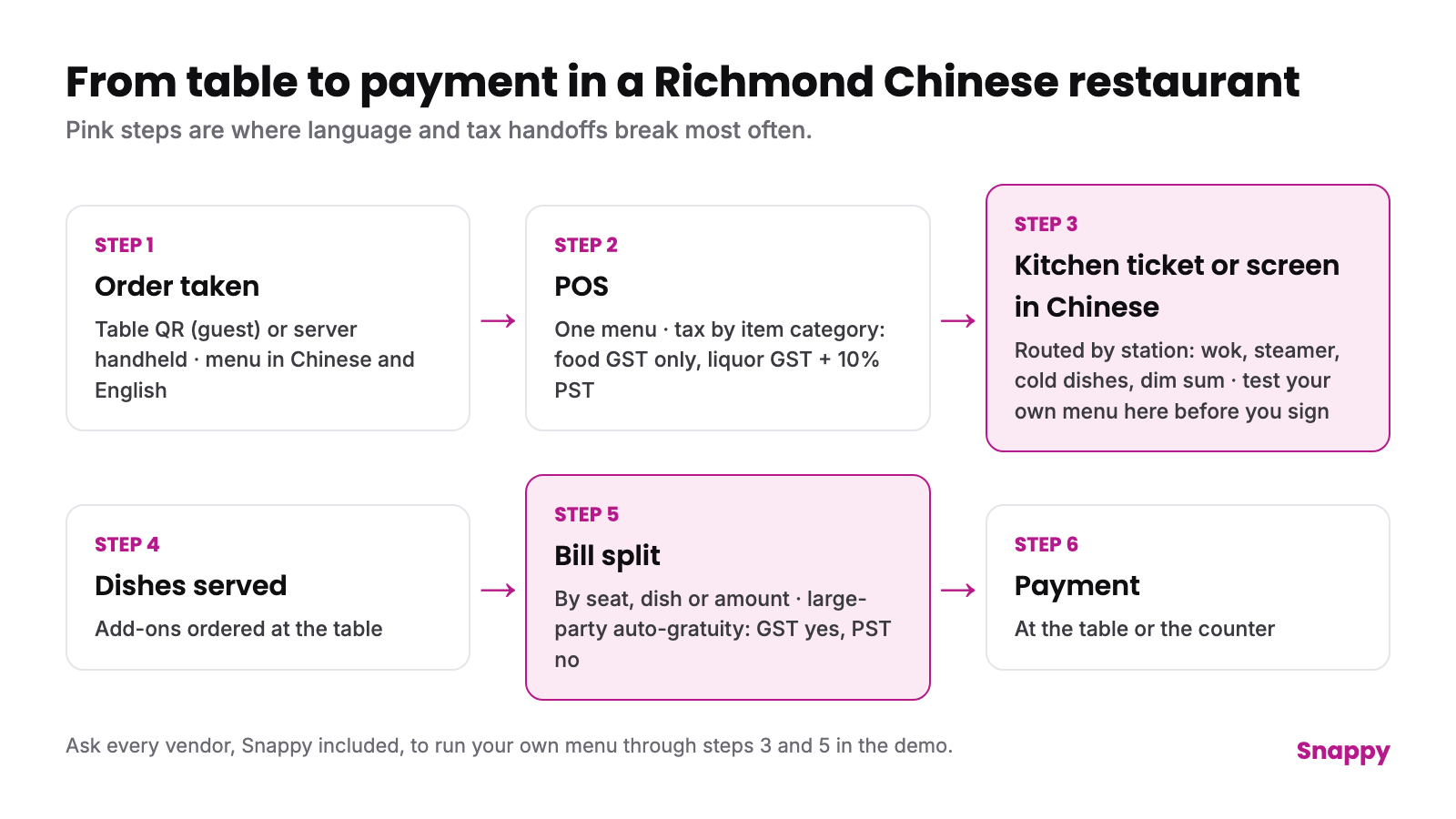
Picture a busy restaurant as a relay race. The server runs the first leg with the order, the kitchen runs the second leg with the dish, and the cashier runs the last leg with the bill. A POS is the baton. If the baton is written in a language the next runner cannot read, or it breaks when twelve people want to pay separately, the whole team slows down. The best system is the one where the baton passes cleanly all the way around, in the language each runner reads.
Because the operation has more moving parts than most POS demos assume, and most of them involve language. The numbers show why one language setting is not enough: Cantonese and Mandarin are almost tied as mother tongues in Richmond (21.5% and 21.1% in the 2021 Census), and at home Mandarin is spoken most often by 17.7% of residents and Cantonese by 17.5%, while English leads at 46.1% (City of Richmond, citing Statistics Canada).
Translate that into restaurant terms. Your menu may be bilingual. Your front-of-house team may switch between Cantonese, Mandarin and English within one shift. Your kitchen reads Chinese dish names, and sometimes a particular shorthand your cooks have used for years. A system built around English-only tickets fails at the one handoff that matters most: the one between the person who takes the order and the person who cooks it.
The service styles add their own demands:
Will your kitchen ticket read right?
Bring ten dishes from your menu, with modifiers and notes, and test them in the walkthrough before you decide.
Test my menuIt should print or display your dish names in the script your cooks read, with modifiers and notes intact, routed to the right station. That is the checklist, and the only way to verify it is to see your own menu on it.
Ask for these four things in a live test, not a slide:
Do not accept “it supports Chinese” as an answer. Ask whether the menu, the kitchen ticket and the receipt each support it, and ask to see all three. We would rather you test us on your menu than take our word.
The test is a table of twelve with one dish still arriving and three people who want to pay separately. If your cashier needs a calculator, so will your servers during the weekend rush.
Ask the vendor to show you these in the demo:
For tables you can see coming, bookings matter as much as the bill. Snappy’s reservation product includes table merge and split, and its advanced tier adds prepaid deposits and events booking, which suits banquet and group enquiries.
They are three different channels with three different jobs, and your POS should not force you to choose. WeChat is where many of your regulars already talk to you. Delivery apps bring new faces at a price. A direct ordering page on your own Google profile keeps the customer record.
On the fee side, British Columbia gives you a ceiling. The Food Delivery Service Fee Act caps what delivery companies can charge restaurants at no more than 20% of the dollar value of an order, with the permanent cap effective January 1, 2023. The same release notes that delivery companies may offer optional enhanced services that restaurants choose, and those sit on top of the capped fee (Government of British Columbia).
Snappy’s online ordering is commission-free and integrates with Google, so the order link surfaces on your Google profile. Snappy’s delivery app integration brings third-party orders into the POS and kitchen display instead of onto a separate tablet. We cover how WeChat ordering fits in our guide to WeChat mini programs versus direct ordering.
Ask any vendor which payment methods your regulars use work in store, including mobile wallets. Do not assume. Get the answer in writing.
Take this table to every demo. The right-hand column tells you what a good answer sounds like.
| Question | Why it matters in Richmond | A good answer |
|---|---|---|
| Can you print my own menu in Chinese on a kitchen ticket, right now? | The kitchen is where language errors cost money | A live test print from your menu, with modifiers |
| Do the menu, kitchen ticket and receipt each support Chinese and English? | Many systems support one of the three | A yes for each, shown on screen |
| How do you route tickets by station? | Wok, steamer and cold stations work in parallel | Station routing on tickets or a kitchen display |
| Show me a split bill on a table of twelve | Banquets are your biggest checks | Split by seat, dish and amount without a calculator |
| How is tax set up for liquor, food and auto-gratuity? | BC taxes meals and liquor differently | Rules by item category, not one flat rate |
| What are your support hours in Pacific time? | Your dinner rush runs into the evening | Hours stated in Pacific time and who answers a Friday-night outage |
| Who is my contact, and do they speak my staff's language? | Fixing a ticket problem by email in English is slow | A named contact and a stated language, in writing |
| What is the contract length, and what does leaving cost? | A long term can be the largest cost in the deal | Term, renewal and exit terms in writing before signing |
| Who owns my menu and customer data if I leave? | Rebuilding a bilingual menu is real work | You do, with an export |
| What happens when the internet drops? | Saturday service cannot stop | A stated fallback you can test |
Ask for support hours in your own time zone, and ask who answers during your busiest hour. This is an easy question to forget until a rush.
Whatever vendor you choose, ask who answers after hours, in which language, and what it costs, and get the answer in writing. Ask us the same questions.
On contract length, the question is the term, the renewal terms and the exit cost, in writing. Compare every quote on those three points, ours included, and see our guide on what a “free” POS costs over three years.
Snappy runs the POS, order-from-table, kitchen display, reservations and waitlist, and online ordering as one stack, so an order placed by QR or by a server lands in the same menu and the same kitchen flow. Ask us, like any vendor, to show tax by item category on a test ticket with liquor, food and an auto-gratuity.
What we ask you to verify in your own demo: the Chinese-language kitchen ticket on your menu, the split-bill flow on a large table, and the support hours against your service hours. Read more in our guide to a Chinese restaurant POS system.
If your cooks read Chinese, yes. Ask for a live test print of your own dishes and modifiers, and check the menu, ticket and receipt separately.
Both Cantonese and Mandarin. In the 2021 Census, 21.5% of residents reported Cantonese and 21.1% Mandarin as their mother tongue, so plan for staff and guests who use either (City of Richmond, citing Statistics Canada).
No. Meals are exempt from PST, while liquor carries 10% PST, and mandatory gratuities carry no PST (Government of British Columbia).
No more than 20% of the dollar value of an order for the base fee, plus any optional services you choose (Government of British Columbia).
Term length, renewal terms, exit cost, who owns your data, and what happens to your processing rate during the term.
Ask for a live demo on your own menu with your own test orders, and ask every vendor the same questions in the table.
Buy a Richmond restaurant POS by testing it on your own menu, not the vendor’s. Print your dishes in Chinese on a kitchen ticket. Split a twelve-top bill. Check that liquor and meals are taxed differently. Get support hours in Pacific time and the contract terms in writing.
The best vendor is the one that passes your test, not the one with the longest feature list. Call our team at 1-855-818-0058, or book a demo and bring your own menu.
Book a walkthrough
Bring your hardest table
Book a walkthrough with a banquet bill in mind: twelve guests, three payers, one bottle of wine.
Written by
Wilson Wu
Chief Revenue Officer, Snappy
Wilson Wu is Chief Revenue Officer at Snappy, the restaurant technology company, and is based in Boston. His first job was in a restaurant kitchen, and he has spent his career since at the intersection of hospitality and software, working with operators across Canada on the systems their service runs on. He also builds the technology he writes about. His engineering work includes a per-location customer service agent that answers guests with a restaurant's real hours, menu and prices, deployed with independent restaurants, and a document-extraction model that reads supplier invoices and matches invoice numbers against what is owed. He writes here about what changes on a busy service: ordering, payments, loyalty, the phone, and the Canadian rules behind them. He holds an MBA from Duke University and a Master of Science in Computer Science from Georgia Tech.
Connect on LinkedInNo-obligation walkthrough
Test it on your own menu
Bring your dish names and modifiers, and test them before you decide.
On this page
Get The Latest Restaurant Data, Trends & Tips