
November 5th, 2026
Restaurant phone calls often come at the worst possible time. A server is taking orders, the host is seating guests, and the kitchen is busy preparing meals. Meanwhile, the phone keeps ringing. Every unanswered call could mean a missed takeout order, a lost reservation, or a customer choosing another restaurant.
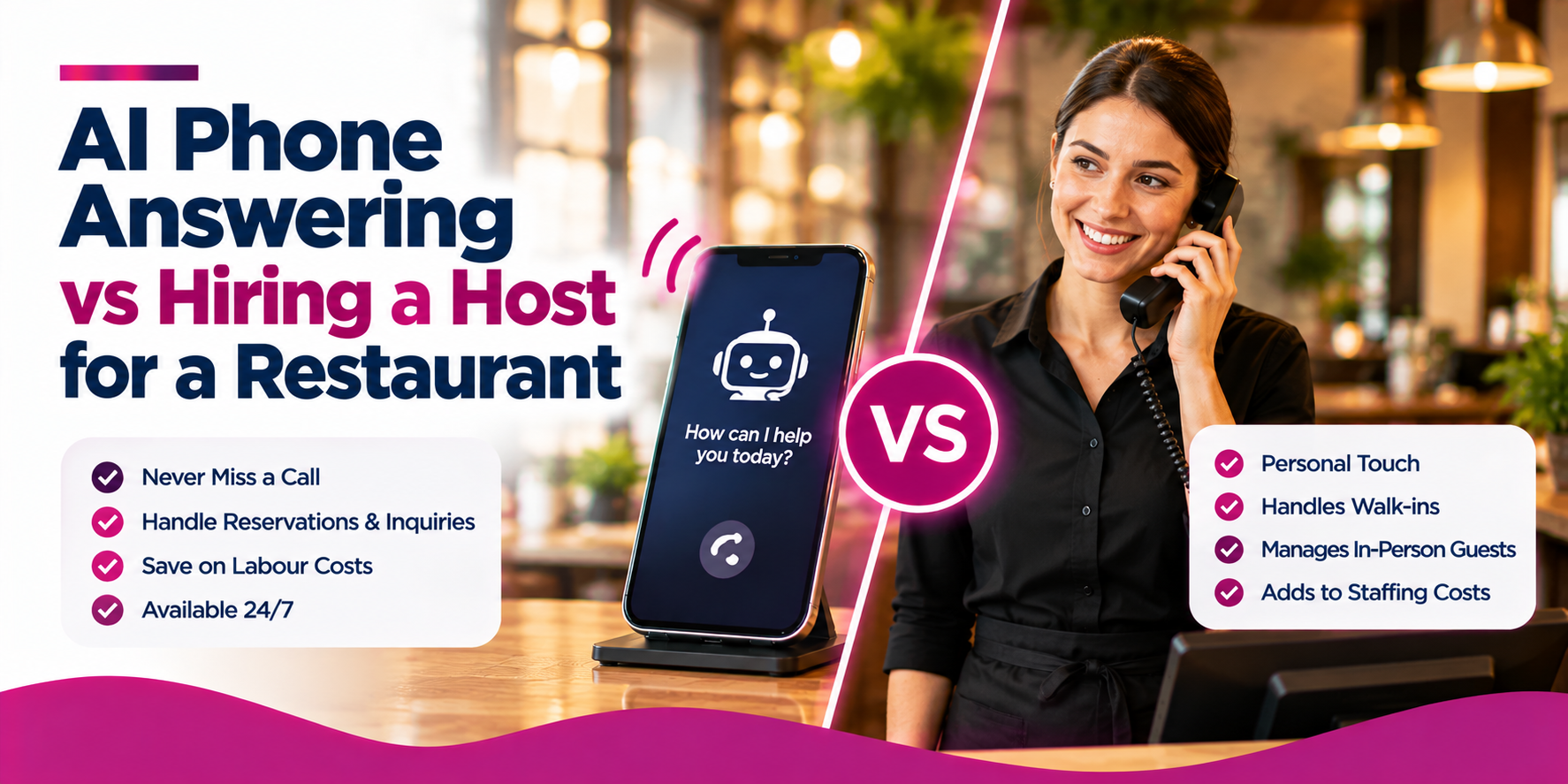
For restaurant owners, this raises an important question: Should you hire a host to answer calls, or use an AI phone answering system?
Both options can help manage customer inquiries, but they serve different purposes. A human host welcomes guests, manages seating, and supports the dining room. An AI phone answering system can handle routine calls, answer common questions, capture orders or reservations, and provide coverage outside regular staff hours.
Interest in restaurant automation is growing. In its November 2026 research, the National Restaurant Association found that 38.6% of surveyed restaurant operators already use AI tools, while 77.9% expect technology, automation, data, and AI to be at least moderately critical to their businesses over the next five years. The research surveyed 212 restaurant operators in the United States. Read the National Restaurant Association research.
AI handles incoming calls: Depending on the system, it can answer questions, take orders, assist with reservations, and route calls.
Hosts do more than answer phones: They greet guests, manage waitlists, coordinate seating, and support dining-room operations.
AI can provide extended coverage: It can answer calls during rush periods, after closing, and outside regular staff shifts.
Human hosts provide personal service: They can handle complex requests, resolve sensitive situations, and build relationships with guests.
Costs are different: Hiring involves wages, payroll expenses, training, and scheduling. AI involves subscriptions, usage fees, and setup costs.
A hybrid approach can work best: AI can manage routine phone interactions while hosts focus on guests in the restaurant.
AI phone answering uses artificial intelligence to answer incoming restaurant calls and help customers complete common tasks.
Depending on the provider and integrations, an AI voice assistant may:
Some systems simply answer frequently asked questions, while others can complete transactions and connect directly to a restaurant’s POS or reservation platform. Restaurants should confirm which functions are included before choosing a solution.
A restaurant host is a front-of-house employee responsible for welcoming guests and helping coordinate the dining experience.
Typical responsibilities include greeting customers, managing reservations and walk-ins, assigning tables, maintaining waitlists, communicating wait times, answering questions, and coordinating with servers and managers.
Hosts may also answer telephone calls, but their role extends well beyond the phone. They provide personal hospitality and respond to situations that require judgment, flexibility, and face-to-face interaction.
This distinction is important: AI phone answering can automate selected phone tasks, but it cannot independently perform the full role of a restaurant host.
| Comparison | AI Phone Answering | Human Restaurant Host |
|---|---|---|
| Incoming calls | Answers automatically, based on configuration. | Answers when available. |
| Availability | Can offer extended or 24/7 coverage. | Limited to scheduled shifts. |
| Common questions | Responds using configured restaurant information. | Answers using knowledge and judgment. |
| Phone orders | Possible with supported integrations. | Can take orders manually. |
| Reservations | Possible with reservation integration. | Can manage bookings and special requests. |
| In-person greetings | Not available. | Yes. |
| Seating and waitlists | May support connected digital tools. | Manages guests in person. |
| Complex complaints | Routes or escalates to staff. | Can respond directly. |
| Multiple calls | May handle concurrent calls, subject to capacity. | Usually handles one conversation at a time. |
| Main strength | Consistent phone coverage and automation. | Personal hospitality and dining-room coordination. |
AI phone answering is worth considering when the primary challenge is managing incoming calls rather than providing in-person guest service.
It may be a good fit when:
Additional phone coverage is needed without scheduling more employees solely to answer calls.
Best-fit restaurants: Pizzerias, takeout businesses, quick-service restaurants, busy casual dining locations, and multi-location restaurant groups.
A human host is the better choice when the restaurant needs someone to manage the guest experience in person.
Consider hiring a host when:
If the restaurant needs someone to welcome guests and manage the dining room, AI phone answering cannot replace that position.
Yes. A hybrid approach can offer a practical balance between automation and personal service.
AI can handle common questions, phone orders, reservation inquiries, and after-hours calls. Human employees can focus on greeting guests, managing seating, resolving complex requests, and providing hospitality.
| Restaurant Task | AI Phone Assistant | Human Host or Employee |
|---|---|---|
| Routine phone inquiries | Primary responsibility. | Backup when needed. |
| Phone orders | Handles orders if supported by integration. | Handles exceptions and special requests. |
| Reservations | Assists if connected to a booking system. | Manages complex requests. |
| Call transfers | Routes calls to the appropriate employee. | Handles transferred calls. |
| Greeting arriving guests | Not applicable. | Primary responsibility. |
| Managing walk-in waitlists | May support connected digital tools. | Coordinates guests in person. |
| Complaints and special requests | Escalates to staff. | Responds directly. |
| After-hours inquiries | Can provide coverage. | Responds during staffed hours. |
The best provider depends on whether the restaurant primarily needs phone orders, reservation assistance, general inquiries, or a combination of services.
Snappy Voice Agent is designed for restaurant phone interactions. It helps businesses answer calls, handle guest inquiries, assist with orders and reservations, and reduce the number of calls employees need to manage manually.
Features include:
Snappy also describes custom voice flows based on restaurant menus and hours, automated SMS fallback, and support for single-location and multi-location brands. https://gosnappy.io/products/snappy-phone.html
Best for: Restaurants looking for AI phone answering connected to restaurant ordering workflows, with support for customer inquiries, orders, and reservations.
Slang AI offers an AI voice assistant for hospitality businesses, particularly restaurants handling frequent reservation inquiries.
Its capabilities include automated phone answering, reservation assistance, multilingual conversations, custom greetings, and call routing.
Best for: Full-service restaurants and restaurant groups that want to automate reservation-related phone interactions.
SoundHound AI offers voice AI solutions for restaurant phone answering and ordering.
Its restaurant solutions describe automated responses to common questions, phone ordering, and connections to supported POS systems.
Best for: Restaurants exploring voice automation for phone orders and other customer interactions.
ConverseNow specializes in voice AI for restaurant ordering, including phone and drive-thru interactions.
Its published capabilities include automated ordering, customizable voice experiences, multilingual support, and integrations with supported restaurant systems.
Best for: Quick-service restaurants and operators looking to automate high-volume voice ordering.
The cost of each option depends on the restaurant’s needs. Hiring a host involves employment expenses, while AI phone answering generally involves software and usage costs.
For a Canadian benchmark, the Government of Canada’s Job Bank reported a national median wage of $17.58 per hour for restaurant hosts and hostesses, based on Labour Force Survey data from 2023–2024 and updated November 19, 2025. The Ontario median was $17.95 per hour. Actual wages vary by region, experience, and employer, and these figures do not represent the full cost of employing someone.
| Cost Factor | Human Host | AI Phone Answering |
|---|---|---|
| Base cost | Hourly wages or salary. | Monthly software subscription. |
| Additional expenses | Payroll costs, benefits where applicable, and related employment expenses. | Per-call, per-minute, or usage-based fees. |
| Recruitment | Job postings, interviews, and hiring time. | Vendor selection and onboarding. |
| Training | Staff training and ongoing supervision. | Menu setup, knowledge configuration, and system testing. |
| Scheduling | Requires shift planning and staff coverage. | Can provide coverage outside regular shifts. |
| Scaling | May require additional staff hours. | May require a higher usage allowance or subscription plan. |
| Maintenance | Employee management and ongoing training. | System configuration, subscription management, and vendor support. |
To compare costs fairly, consider how much time your employees currently spend answering calls and what other responsibilities a host performs.
For additional context, the National Restaurant Association’s 2025 Restaurant Operations Data Abstract reported that wages and benefits represented a median of 36.5% of sales for U.S. full-service restaurants and 31.7% for limited-service restaurants in 2024. The findings were based on data from more than 900 U.S. restaurant operators. These are overall restaurant labour-cost benchmarks, not the cost of hiring a host specifically.
AI may be more economical for phone coverage, but it is not a replacement for the full range of front-of-house duties.
Before selecting a provider, evaluate these important capabilities:
Restaurants should test realistic scenarios before launch, including complicated orders, unavailable menu items, complaints, and requests for a human employee.
AI phone answering and hiring a human host solve different operational problems.
A human host is essential for restaurants that need personal guest reception, seating coordination, and dining-room support. AI phone answering is better suited to routine inquiries, phone orders, reservation assistance, and extended call coverage.
For many restaurants, a hybrid approach makes the most sense: let AI handle routine phone interactions while human employees focus on the in-person hospitality customers value.
Not completely. AI can answer calls and assist with orders or reservations, but a human host is still needed for in-person greetings, seating, waitlist coordination, and complex guest interactions.
It may cost less than scheduling employees solely for phone coverage. However, hosts perform broader front-of-house duties, so compare the full employment cost with the AI subscription, usage fees, and setup costs.
A properly configured system should have an escalation process, such as transferring the call to an employee or collecting a callback request. Restaurants should test these scenarios before launch.
Some can check availability and create bookings through supported integrations. Others only provide information or direct callers to an online booking page.