
Wilson Wu
Chief Revenue Officer, Snappy
October 3, 2026·15 min read
Bill 96 is Quebec’s 2022 overhaul of the Charter of the French Language, and it reaches every screen a guest touches. Your menus, receipts, kiosk flow, QR ordering page and online checkout all have to work in French, and where another language appears next to it, French cannot be less prominent or harder to get to.
It is not a separate restaurant law with its own portal, certificate or filing deadline, which is exactly why it gets missed. There is nothing to install and nothing to submit. There is a statute your point of sale either respects or does not, and an enforcement path that ends with an order from the Office québécois de la langue française.
Summary
On this page
Bill 96 applies to every restaurant operating in Quebec, with no size threshold: a twelve-seat casse-croûte and a forty-location chain face the same rules on menus, receipts and signage. Only francization registration scales, and it starts at 25 employees.
Bill 96 was tabled on 13 May 2021, adopted on 24 May 2022 and assented to on 1 June 2022, becoming chapter 14 of the 2022 statutes (Publications Québec). Its French title is Loi sur la langue officielle et commune du Québec, le français.
Here is the part operators get wrong. Bill 96 is an amending act, so you will not find “Bill 96” printed on an inspector’s notice.
The live obligations sit in the Charter of the French Language (chapter C-11) and the Regulation respecting the language of commerce and business (chapter C-11, r. 9). The Charter text quoted here is the official consolidation current to 7 April 2026 (LégisQuébec).
What does scale is francization: an enterprise employing 25 persons or more over a six-month period must register with the OQLF within six months of the end of that period (Charter, s. 139). Most independents never trigger it.
Underneath everything sits section 5: “Consumers of goods and services have a right to be informed and served in French.” Every rule below is that principle applied to a surface.
Bill 96 governs the language of menus, receipts, screens and software, enforced by the OQLF; Bill 72 governs pricing and tipping transparency, enforced by the Office de la protection du consommateur; and WEB-SRM governs the fiscal recording of every sale, enforced by Revenu Québec. A POS that passes two of these can still fail the third.
These three get conflated constantly, usually by a vendor answering “yes, we are Quebec compliant” to a question about only one of them.
| Bill 96 (Charter of the French Language) | Bill 72 | WEB-SRM / MEV-Web | |
|---|---|---|---|
| What it governs | Language of menus, receipts, screens, signage, software and contracts | Consumer pricing and tipping transparency | Fiscal recording and transmission of every sale |
| Legal instrument | Charter of the French Language, ch. C-11, as amended by 2022, c. 14 (LégisQuébec) | An Act to protect consumers against abusive commercial practices and to offer better transparency with respect to prices and credit, 2024, chapter 32 (National Assembly of Québec) | Sales recording rules in the Act respecting the Québec sales tax, Division XXII.1 (LégisQuébec) |
| Who enforces it | Office québécois de la langue française (Charter, s. 177) | Office de la protection du consommateur (OPC) | Revenu Québec (Act respecting the Québec sales tax, s. 350.60.4) |
| What it touches in your stack | Every guest-facing string: menu items, modifiers, kiosk flow, QR page, checkout, receipt, confirmation email, digital board | The tip prompt on your terminal and the pre-tax base it is calculated on | The register itself and the certified transmission of transaction data |
| Key date | Assented 1 June 2022; the amended commerce and business obligations are already in force | Assented 7 November 2024, with further provisions in force 7 May 2025 (OPC) | Ongoing obligation for covered sectors including restaurants (Act respecting the Québec sales tax, ss. 350.51, 350.60.4) |
A certified sales recording system and a compliant tip screen tell you nothing about your French. Those two answer to the Office de la protection du consommateur and to Revenu Québec; this article covers the third.
Section 57 is short and unambiguous: “Invoices, receipts, acquittances and other documents of the same nature must be drawn up in French. No person may send such a document in a language other than French if the French version is not available to the recipient on terms that are at least as favourable” (Charter, s. 57).
Note what it does not say. It does not ban English. It requires French, and forbids a situation where the English version is the easy one and the French version is the one you have to ask for.
On a thermal receipt that covers item names, tax lines, header and footer text, and the thank-you line. A template built for a Quebec dining room labels its tax lines TPS and TVQ, the acronyms Quebec’s own consumer protection office uses for the two sales taxes (Office de la protection du consommateur), rather than GST and QST.
It puts French first where both languages appear, and it prints accented characters correctly. Broken accents are a common defect and usually trace to a character-encoding setting on the printer, not a translation gap.
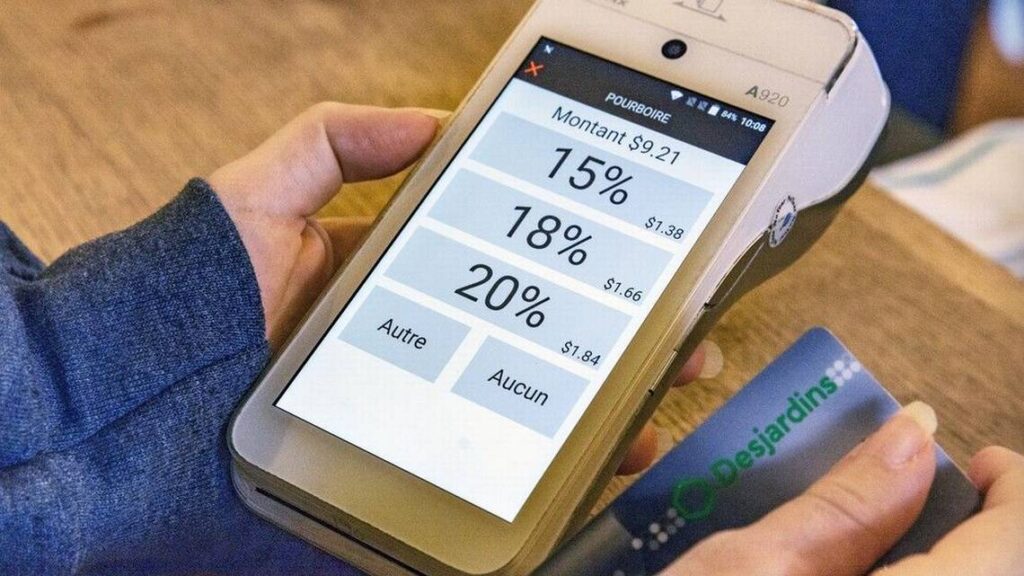
The same logic covers the customer-facing display on the counter. Item names, running total, tip prompt and payment instructions all inform the guest, which puts them inside section 5. Ask your vendor one question here: is the guest-facing language a separate setting from the staff-facing one? On many systems it is not, so switching the display to French also switches the language your cashiers work in.
Not sure your French flow is actually equivalent?
Send us your receipt template and one kiosk screenshot. We'll walk through what the French-language rules actually require, surface by surface.
Check my French screensA self-serve kiosk or QR menu must meet French-language rules as a menu, a public order form and a piece of software, all at once. That triple classification is why it is the hardest surface to reason about.
It is a menu. Section 51’s rule “applies also to menus and wine lists,” and translations may accompany the French, “but no inscription in another language may be given greater prominence than that in French or be available on more favourable terms” (Charter, s. 51). A QR code that opens a menu is a menu; the medium does not change the classification.
It is a document available to the public. Section 52 begins “Regardless of the medium used” and covers order forms explicitly (Charter, s. 52). A kiosk ordering flow is an order form.
It is software. Section 52.1 requires software to be available in French unless no French version exists, and where other languages are offered, the French version must come on terms no less favourable with technical characteristics at least equivalent (Charter, s. 52.1). “At least equivalent” is the clause that catches a French mode missing the loyalty step or the allergen notes.
Then there is the attract screen. If your kiosk idle loop or digital menu board alternates between languages, the regulation is specific: French has a much greater visual impact when “it is visible at least twice as long as the text in another language.”
For static bilingual signage in the same visual field, French must occupy a space “at least twice as large,” with equivalent legibility and permanent visibility (Regulation, ss. 27.4, 27.6). The duration test is written as an exception to the legibility and permanent-visibility condition, not to the space condition, so read it as an addition rather than a substitute: the safe build meets both.
Nobody hits a two-to-one ratio by accident. A ten-second English slide and a ten-second French slide is the defect, and it is a settings change rather than a hardware problem.
The Canadian Federation of Independent Business puts the service obligation plainly: “In Quebec, you must serve customers in French. If you also provide a service to an individual or another business in another language, make sure that the service is available in French on terms that are at least as favourable” (CFIB). Applied to a kiosk, the conservative reading is to open in French, or on a language selector with French listed first. We found no restaurant-kiosk-specific OQLF guidance, so treat “French first by default” as sections 51, 52 and 52.1 read together rather than a separately codified rule.
Yes, and this is where half-finished localizations show up.
Section 52’s “Regardless of the medium used” wording came in with Bill 96 precisely so digital surfaces are not treated differently from print (Charter, s. 52). CFIB reads the same clause the same way: commercial documents “regardless of the medium used” already had to be available in French, and “this includes websites and social media posts” (CFIB).
Your ordering site is a catalogue and an order form. Section 55 adds that contracts pre-determined by one party must be drawn up in French, which is arguably what an online order is, and the confirmation email carrying the itemized total is a receipt under section 57.
The failure pattern is consistent across platforms and it is almost never the menu. It is the tail of the flow:
The same test applies if your online orders arrive through one of the big delivery apps rather than your own storefront. The menu copy lives on their side, the checkout is theirs, and the confirmation the guest receives is theirs, so the French question has to be asked of them, and answered for the whole flow rather than the menu alone.
Hold your vendor to section 52’s “on terms that are at least as favourable.” A French flow that takes more taps, drops the loyalty step or exposes fewer payment methods is not equivalent. Walk a real order end to end in French, all the way to the email, before you accept a build. That test is the same whoever built your online ordering storefront.
Start from the prominence rule rather than a word count. Section 51 permits translations alongside French but prohibits any other-language inscription being “given greater prominence” or “available on more favourable terms” (Charter, s. 51). A bilingual menu is fine. A menu where English is bold and French is a small grey subtitle is not.
Three practical rules, in the order that saves the most time:
Translate at the field level, not the menu level. Item names almost always get translated. Modifier groups, option labels, size names, combo prompts and upsell copy frequently do not, because they are separate objects in the POS data model. Export the full modifier list and audit it as its own document. This is the biggest single source of half-French kiosk screens.
Treat allergen and safety text as non-negotiable French. A guest cannot exercise the section 5 right to be informed in French if the allergen note is English only. Keep the French at least on par, and never behind a toggle.
Separate guest-facing language from kitchen-ticket language. Nothing in the Charter dictates what appears on a chit for your own staff. If your line reads faster in English, keep it. Optimize guest surfaces for compliance and kitchen surfaces for speed, then confirm your vendor can decouple the two.
One structural point underneath all of it: the fewer places a menu string is stored, the fewer places it can be half-translated. If your printed menu, kiosk, QR page and storefront each hold their own copy of an item name, that is four translation jobs and four chances to drift out of sync. How you buy your stack decides how many of those jobs you own.
| How the stack is assembled | Where the guest-facing strings live | Translation jobs you own | Who answers the section 52 question |
|---|---|---|---|
| A different vendor for each surface (register from one, kiosk from another, ordering site from a third) | One copy per system | One per surface, each with its own modifier table and email templates | Three vendors, each responsible for one piece |
| Marketplace apps for online orders | On the app's side, edited through its tools | Your listing, but their checkout, confirmations and error messages | The app, for the whole flow, and you have no control over the tail |
| One integrated suite such as Snappy (point of sale, self-serve kiosk, dine-in QR and online ordering from the same vendor) | Managed by one vendor | Fewer, and one place to audit the modifier list | One vendor to ask, and one place the answer applies |
None of these is compliant or non-compliant on its own. What changes is how many written answers you have to collect, and how many places a French string can quietly go missing between the menu and the receipt.
Run this against the system you have today. It takes about an hour.
On enforcement, the sequence matters more than the headline number. The OQLF first issues an order to comply under section 177, which explicitly reaches “any operator of an establishment where menus or wine lists that do not comply with the provisions of section 51 are presented to the public.” Restaurants are named in the statute.
Contravening the order triggers the fine: $700 to $7,000 for a natural person, $3,000 to $30,000 in all other cases, doubled for a second offence and tripled after that, with directors and officers exposed at double the natural-person amounts and every additional day treated as a separate offence (Charter, ss. 177, 205, 207, 208, 208.0.1).
That last clause is the one to plan around. With 41% of Canadian foodservice businesses already operating at a loss or just breaking even and 46% of operators expecting profitability to worsen in 2026 (Restaurants Canada), a per-day accumulation is not a line item anyone budgets for. Fixing a receipt template costs an afternoon.
This is an operator’s summary of published law, not legal advice. For anything close to the line, confirm with a Quebec lawyer or with the OQLF.
No. Section 51 of the Charter requires menus and wine lists to be drafted in French and permits translations alongside, but “no inscription in another language may be given greater prominence than that in French or be available on more favourable terms” (Charter, s. 51). A bilingual menu is allowed. A menu where the English is larger, bolder or easier to find than the French is not.
Yes. Section 52.1 allows software in languages other than French provided the French version can be obtained on terms “no less favourable”, except price where it reflects higher production or distribution costs, and with “technical characteristics that are at least equivalent” (Charter, s. 52.1). The English path cannot be the faster or fuller one. CFIB’s summary of the service rule, French “on terms that are at least as favourable” (CFIB), is why the safe default is a kiosk that opens in French or on a selector with French listed first.
Enforcement begins with an OQLF order under section 177, which explicitly covers operators presenting non-compliant menus or wine lists to the public. Contravening that order carries $700 to $7,000 for a natural person and $3,000 to $30,000 in all other cases, doubled for a second offence and tripled after that. Directors and officers face double the natural-person amounts, and an offence continuing more than one day “constitutes a separate offence for each day it continues” (Charter, ss. 177, 205, 207, 208, 208.0.1).
No, and this is the assumption most worth correcting. WEB-SRM is a Revenu Québec fiscal requirement about recording sales and sending the prescribed information to the Minister (Act respecting the Québec sales tax, s. 350.60.4). Bill 96 amends the Charter of the French Language and is enforced by the OQLF. No shared certification, regulator or test. Ask about each by name and get both answers in writing.
Bill 96 is not a project. It is a set of properties your existing system either has or does not, spread across surfaces you already own: the point of sale and its customer display, the self-serve kiosk, the QR menu, the checkout, the receipt printer and the confirmation email.
Most of what fails is not a translation problem. It is a data-model problem: modifier names in a table nobody exported, an email template that only exists in English, a board alternating on an even timer, a French flow that quietly drops a step. Those are configuration fixes, cheap the week you find them and expensive the week someone else does.
Take the ten-point checklist to whoever runs your stack and ask for written answers. To walk it through with a team that already supports Quebec restaurants on WEB-SRM and has offices in Montréal, Toronto and Vancouver, talk to us.
Book a walkthrough
Take your checklist to a Quebec specialist
Walk through your menus, modifiers, receipts, kiosk and checkout with a team that already supports Quebec restaurants on French-language compliance.
Written by
Wilson Wu
Chief Revenue Officer, Snappy
Wilson Wu is Chief Revenue Officer at Snappy, the restaurant technology company, and is based in Boston. His first job was in a restaurant kitchen, and he has spent his career since at the intersection of hospitality and software, working with operators across Canada on the systems their service runs on. He also builds the technology he writes about. His engineering work includes a per-location customer service agent that answers guests with a restaurant's real hours, menu and prices, deployed with independent restaurants, and a document-extraction model that reads supplier invoices and matches invoice numbers against what is owed. He writes here about what changes on a busy service: ordering, payments, loyalty, the phone, and the Canadian rules behind them. He holds an MBA from Duke University and a Master of Science in Computer Science from Georgia Tech.
Connect on LinkedInNo-obligation walkthrough
Find where your French compliance breaks
Menus, receipts, kiosks and checkout each face Quebec's French rules differently. See where yours might fall short.
On this page
Get The Latest Restaurant Data, Trends & Tips