

Wilson Wu
Chief Revenue Officer, Snappy
November 14, 2026·16 min read
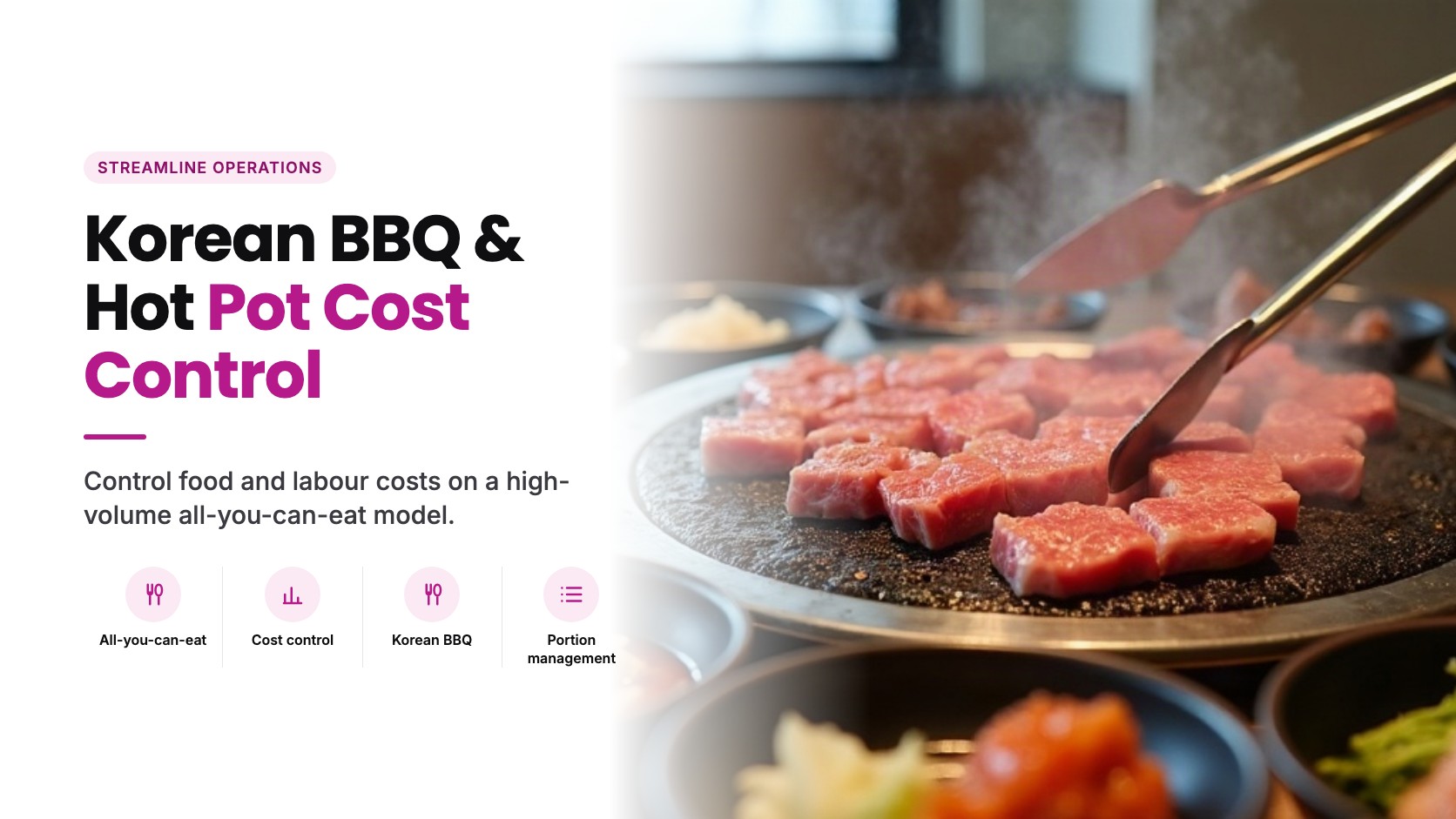
All-you-can-eat (AYCE) service is a fixed-price format: the guest pays one price per person and can order as many rounds as the posted rules allow, so a Korean BBQ or hot pot room running it makes its money on the seat, not the plate. It holds that margin through four controls a la carte service never needs: per-person pricing tiers, a posted time limit, a posted leftover policy, and a deposit rule for large parties. Let any one run on staff memory instead of the system, and cost per seat drifts with nobody deciding it should.
That drift matters more in Canada than it used to. 41% of Canadian foodservice businesses are operating at a loss or just breaking even, up from 12% five years ago, and 46% of operators expect profitability to worsen in 2026 (Restaurants Canada). AYCE carries the least forgiving cost structure in full-service dining. Ask most AYCE operators what their food cost is by tier, not just overall, and few can answer, because a room can run for years without a single per-tier number in front of the owner.
Summary
On this page
Because a la carte cost control runs on the plate, and AYCE cost control runs on the seat: a rising ingredient cost gets solved by repricing one dish, but an AYCE price is fixed once the guest picks a tier, so the only lever left is the seat’s cost, not its price.
In a la carte service every dish carries its own recipe cost. If the ribeye runs hot, you reprice the ribeye. Industry-wide, food and labour each absorb roughly 33 cents of every sales dollar, other operating expenses take about 29%, and a typical restaurant lands near a 5% pre-tax margin, with total expenses up 36% between 2019 and 2026 (National Restaurant Association, US data).
An AYCE room inverts that. Revenue per seat is fixed the moment the guest picks a tier. Cost per seat is not: it is set by how much that guest eats, which cuts they choose, how much comes back uneaten, and how long the seat stays occupied. You cannot reprice your way out of a bad night, because the price was agreed before the first plate hit the grill.
That leaves four levers, each a rule rather than a recipe: what each tier costs you, what the guest wastes, how long the table is held, and whether the booking shows up. This guide walks through each one in the order an operator would ask about it: what to charge, what gets wasted, how long to hold the table, and what to do about no-shows.
Cost per cover by tier, not one blended food cost percentage. A blended number is a weighted average of which tiers sold and how much each table ate, so it can look healthy while one tier loses money every time it is ordered.
A blended number hides the thing that moves it. Your nightly food cost is a weighted average of which tiers sold, how heavily each table ate and what came back on the plate, so a healthy blend can sit on top of one tier that loses money every time it is ordered. The only way to see that is to cost the tiers separately, on your own invoices.
The arithmetic is simple and the inputs are yours: beef cost per pound by cut, pork and chicken per pound, seafood per portion, and the two lines almost nobody counts, banchan and rice. Run each against a realistic consumption estimate for a heavy table and a light table, and you have a cost range per guest for every tier. Beef usually dominates that number, so a small change in beef spec moves the whole tier. Our restaurant food cost calculator runs the same arithmetic on your real purchase prices.
They raise average revenue per guest faster than they raise cost per guest, which is why tiers exist. A prime tier with a high food cost percentage can be the better business in dollars, as long as the upgrade actually reaches the check.
Two posted menus show the shape. KOSOO Korean BBQ in Coquitlam posts four tiers: AYCE A at $26.99 lunch and $29.99 dinner, AYCE B at $34.99 lunch and $36.99 dinner, AYCE C at $48.99 all day and AYCE Prime at $59.99 all day, with children aged 6 to 10 at $12.99 to $19.99 depending on the menu (KOSOO Korean BBQ). That is a $30.00 spread between the entry dinner tier and the top tier: 59.99 minus 29.99. Hot Spot Buffet in Vancouver runs it the other way: one $45.99 regular BBQ and skewers price, a lunch and late-night special from $24.99, a seafood upgrade at +$13 and a hot pot add-on at +$2.99 (Hot Spot Buffet).
| Tier design | How the guest buys | What it does to cost per cover | What to watch |
|---|---|---|---|
| Single price, add-on upgrades | One AYCE price, paid extras for seafood or premium cuts | Predictable base cost; upgrades are pure incremental margin | An add-on relayed verbally and never rung in is a straight loss |
| Two-tier ladder | Basic and premium, split lunch and dinner | Premium absorbs heavy eaters at a higher ticket | Check the premium tier sells, not just that it prints |
| Three or four tiers plus prime | Entry, mid, wide selection, wagyu or prime | Highest average ticket; the top tier can run a high food cost % and still win on dollars | Mix shift: a quiet week of entry-tier tables moves the blend on its own |
| Order caps inside the tier | Unlimited rounds, but capped plates of premium cuts per person | Puts a ceiling on the worst case at the top tier | Guests need to see the cap on the menu, not hear it from a server |
That last row is the one operators underuse. KOSOO caps meat at 8 orders per person and premium beef cuts at 3 orders per person, and requires that all guests at one table choose the same AYCE menu (KOSOO Korean BBQ). The same-tier rule matters because a single premium guest at an entry-tier table means premium cuts reaching six people at an entry price.
The failure mode is not the prime tier’s percentage, it is the upgrade that never gets rung in. If a server can hand over a premium plate without touching a terminal, some share of them will, every service. That is a system design question, not a training question.
Do You Know What Each of Your AYCE Tiers Actually Costs?
Bring your tier prices and your beef invoices. We'll walk through cost per cover on one of your own tiers with you, no spreadsheet required.
Show me my tier costsPost the policy. It is the highest-return, lowest-cost move in this format, and every room cited in this guide posts some version of it.
An estimated 5% to 25% of any given dish is wasted, through the house misjudging demand or the guest over-ordering, and the buffet owners interviewed put the heavy over-eaters at about 1 in every 20 diners (The Hustle, US data). Waste is wide, and the guests who drive it are a small minority you can price for without insulting everyone else.
What’s a fair leftover fee? Three posted policies show the range, from a flat surcharge to a per-weight charge on unfinished food. Jongro BBQ in Toronto charges $5 extra for excessive food waste (Jongro BBQ). Oz Korean BBQ posts a flat $10 fee for excess leftovers (Oz Korean BBQ, US data). KOSOO charges $10 per 100 g of unfinished food and does not allow leftovers to go (KOSOO Korean BBQ).
None of these is a revenue line, and treating it as one is the mistake. The fee exists so that guests order in smaller rounds, and smaller rounds are fresher rounds.
Three implementation notes:
Cap round size, not round count. Limiting plates per round keeps the meal generous while keeping the grill from filling with meat nobody will eat; KOSOO’s per-person order caps do the same job at the tier level (KOSOO Korean BBQ).
Banchan is the quiet one. Refills are unlimited and almost never counted, which makes it the one food line with no upper bound. Track it as its own line in daily counts, not a rounding error inside “sides.”
Enforce at the last round. KOSOO’s rule that last call comes 30 minutes before the time ends is the model (KOSOO Korean BBQ). A waste charge raised conversationally at the final order lands differently than one appearing on a printed check.
By living in the system, not in the server’s head, because every AYCE rule held in someone’s memory slips on a busy Saturday. An enforceable timer starts on the first order, alerts staff before the limit, updates table status for the host stand, and lets the guest see it so last call is expected.
Two hours is the ceiling every room cited here posts, with variation by daypart. Oz Korean BBQ sets a 2 hour limit from the time the first order is taken (Oz Korean BBQ, US data). KOSOO limits dining to 2 hours per visit with last call 30 minutes before the end (KOSOO Korean BBQ).
Hot Spot Buffet posts a standard dining time limit of 120 minutes (Hot Spot Buffet). Jongro runs 1 hour 45 minutes at lunch and 2 hours all day (Jongro BBQ).
If you’re wondering how long to give a table for all-you-can-eat, the Oz wording is the one to copy: two hours from the first order, not from seating. A clock that starts on something the guest did is a clock you can defend.
An enforceable timer needs four things. It starts on the first order. It alerts staff before the limit rather than at it, which is what KOSOO’s 30-minute last call does. It updates table status so the host stand sees the server’s clock. And the guest can see it, so last call is expected rather than awkward.
Per-seat charging has the same shape. Oz Korean BBQ requires that all party members choose the All-You-Can-Eat and are charged per person, with an 18% service charge for parties of 7 or more, children included (Oz Korean BBQ, US data). Every one of those rules is easy to post and hard to apply at 7:30 PM on a Friday unless the system asks the question.
| Enforcement approach | Where the rules live | What it catches | Where it leaks |
|---|---|---|---|
| Paper and memory | Laminated card on the table, server's watch | Nothing reliably | Every rule, on every busy shift |
| Standalone timer app | A tablet or kitchen timer separate from the order system | Time limits | Nothing about upgrades, headcount or leftovers; host stand cannot see it |
| POS with round-by-round orders | Every round entered on a terminal as its own order | Time from first order, upgrade capture, per-person headcount | Whatever a server hands over without ringing in |
| Snappy: POS, Order-from-Table and KDS on one stack | Every round ordered from the table lands in the POS, then routes to kitchen stations on the kitchen display | Uncharged upgrades, round timing, headcount, plus daily counts and COGS in the same system | Test the AYCE countdown and per-tier pricing on a live table before you sign |
A modern stack helps upstream of the timer. Guest-driven ordering through Order-from-Table sends every round to the POS, the order hub that feeds the rest of the stack, at the moment the guest orders it instead of relaying it verbally, and a kitchen display system routes those rounds to stations with no paper ticket in between. That closes the uncharged-upgrade leak whether or not your point of sale ships a native AYCE countdown.
Deposits scale with party size, no-show fees scale with the seats you cannot resell, and in Quebec the ceiling is set by law rather than by you. A large-party no-show is a full turn of fixed-price revenue you staffed for and cannot resell at 8 PM, and Quebec’s rules on notice, reminders and cancellation windows differ from a BC-style refundable deposit.
One Vancouver room has posted the complete schedule. Dae Bak Bon Ga lists dining deposits of $500 for 20 to 25 guests, rising through $650, $750, $900 and $1,000 to $1,150 for 46 to 50, with a no-show fee and/or forfeiture of the deposit; the deposit is otherwise refundable or applied to the final bill (Dae Bak Bon Ga).
Below 20 guests it runs no-show fees instead: $50 for 1 to 3, up to $200 for 17 to 19. Modifications or cancellations need at least 6 hours’ notice, and tables are held for up to 15 minutes (Dae Bak Bon Ga). Its karaoke rooms run a separate, smaller schedule: price the room you are actually holding.
What does a no-show actually cost you? The cost of doing nothing is documented in Canada. An association representing Quebec restaurant owners estimates that no-shows cost the average eatery about $49,000 per year (CBC News). At the Cambridge Mill in Ontario, the general manager put weekend brunch no-shows at about 10 per cent of a service that sells out every Sunday (CBC News). For an AYCE room, a no-show on a 30-seat private booking is a full turn of fixed-price revenue you staffed for and cannot resell at 8 PM.
Quebec needs a different playbook. Since July 17, 2025, restaurants in Quebec can charge up to $10 for each no-show (CBC News), with no additional penalties or administrative fees, and only when the group is two or more, the guest had advance notice, a reminder went out 6 to 48 hours ahead, the guest did not cancel at least three hours before, and nobody in the party showed (Snappy). The Canadian restaurant industry association noted that Quebec had been the only province whose consumer protection law expressly forbade no-show fees at all (CBC News). A BC-style refundable deposit that is forfeited on a no-show is not a policy you can copy into Quebec. Deposits and no-show fees are not governed by the same rules, so confirm any Quebec private-room deposit structure with the Office de la protection du consommateur or your own counsel first.
Enforcement is where most policies quietly die. A rule the host stand applies to some bookings and not others is not a policy, it is a mood. Centralising bookings so every reservation carries identical terms is the fix, which is what Snappy Reservation on the dashboard the floor already runs on is for, with AI Phone Reservations answering concurrent booking calls into that same dashboard.
Five, and none of them is your daily sales total. They are cost per cover by tier, cost per cover by daypart, leftover charges applied versus rounds served, table duration against your posted limit, and upgrade attachment rate by server and shift.
Cost per cover by tier, weekly. Monthly hides mix shift, and mix shift is how a healthy blend becomes an unhealthy one without a single price changing.
Cost per cover by daypart. Lunch and dinner behave differently enough that averaging them tells you nothing, and rooms like KOSOO and Jongro already price and time them separately (KOSOO Korean BBQ, Jongro BBQ).
Leftover charges applied versus rounds served. If the posted fee is never charged, either your guests are unusually disciplined or your servers are not enforcing it.
Table duration against your posted limit. Look at the tail, not the average. A table that runs 20 minutes past a two-hour limit on a Friday is a seating you did not get, and a floor full of them is a full turn.
Upgrade attachment rate by server and shift. A server at half the floor average is either not offering upgrades or not ringing them in, and those problems have opposite fixes.
That means daily counts feeding a real COGS number instead of a monthly guess. Inventory management with daily counts and COGS control, plus live sales and month-over-month comparison in the Snappy Team App, cover the raw data. The discipline is yours: pick a day, run the same five numbers, act on the one that moved.
Cost per cover by tier, costed on your own invoices, rather than one blended percentage. A blended number can look healthy while one tier loses money every time it is ordered, and in a fixed-price format the only place to defend the margin is the cost side of each seat.
They post a fee and cap premium orders. Jongro BBQ in Toronto charges $5 for excessive food waste (Jongro BBQ); KOSOO in Coquitlam charges $10 per 100 g of unfinished food and caps premium beef at 3 orders per person (KOSOO Korean BBQ).
Not when they are posted and explained. Two hours is the ceiling at the rooms cited here, with shorter lunch limits at some: Jongro posts 1 hour 45 minutes at lunch (Jongro BBQ). Oz Korean BBQ counts its two hours from the first order (Oz Korean BBQ, US data), Hot Spot Buffet in Vancouver posts 120 minutes (Hot Spot Buffet), and KOSOO gives last call 30 minutes before the end so nobody is surprised (KOSOO Korean BBQ).
No. Since July 17, 2025 restaurants in Quebec can charge up to $10 for each no-show (CBC News), with no additional penalties or administrative fees, and with conditions on notice, reminders and cancellation windows (Snappy). One Vancouver room posts deposits from $500 to $1,150 for parties of 20 or more (Dae Bak Bon Ga); Quebec consumer protection law does not permit that structure. Confirm any Quebec deposit structure with the Office de la protection du consommateur or legal counsel first.
Ask us to show you on a live table rather than take it from a blog post. What we state plainly is that Order-from-Table sends every round to the POS, the kitchen display routes those rounds to stations, and daily counts and COGS live in the same system.
AYCE is a fixed-revenue format, and fixed revenue means every dollar of margin is defended on the cost side of the seat. Four controls do almost all the work: tier the pricing and capture every upgrade at the point of order, post a leftover policy and enforce it at the last round, run a real timer that starts on the first order, and put deposits on the bookings that can cost you a whole room. None of that needs a bigger menu or a higher price, just rules that live in the system instead of a server’s memory, and somebody to read five numbers a week.
Bring your tier mix and your beef cost and we will run the numbers with you. Talk to our team.
Book a walkthrough
Your AYCE Rules Belong in the System, Not a Server's Memory
Book a walkthrough and bring your tier list, your posted time limit and your deposit rule. We'll go through them on a live table, using your own numbers.
Written by
Wilson Wu
Chief Revenue Officer, Snappy
Wilson Wu is Chief Revenue Officer at Snappy, the restaurant technology company, and is based in Boston. His first job was in a restaurant kitchen, and he has spent his career since at the intersection of hospitality and software, working with operators across Canada on the systems their service runs on. He also builds the technology he writes about. His engineering work includes a per-location customer service agent that answers guests with a restaurant's real hours, menu and prices, deployed with independent restaurants, and a document-extraction model that reads supplier invoices and matches invoice numbers against what is owed. He writes here about what changes on a busy service: ordering, payments, loyalty, the phone, and the Canadian rules behind them. He holds an MBA from Duke University and a Master of Science in Computer Science from Georgia Tech.
Connect on LinkedInNo-obligation walkthrough
What Does Your AYCE Room Actually Cost You?
Bring your tier prices and beef invoices, and we'll cost one of your own tiers together, on your own numbers.
On this page
Get The Latest Restaurant Data, Trends & Tips
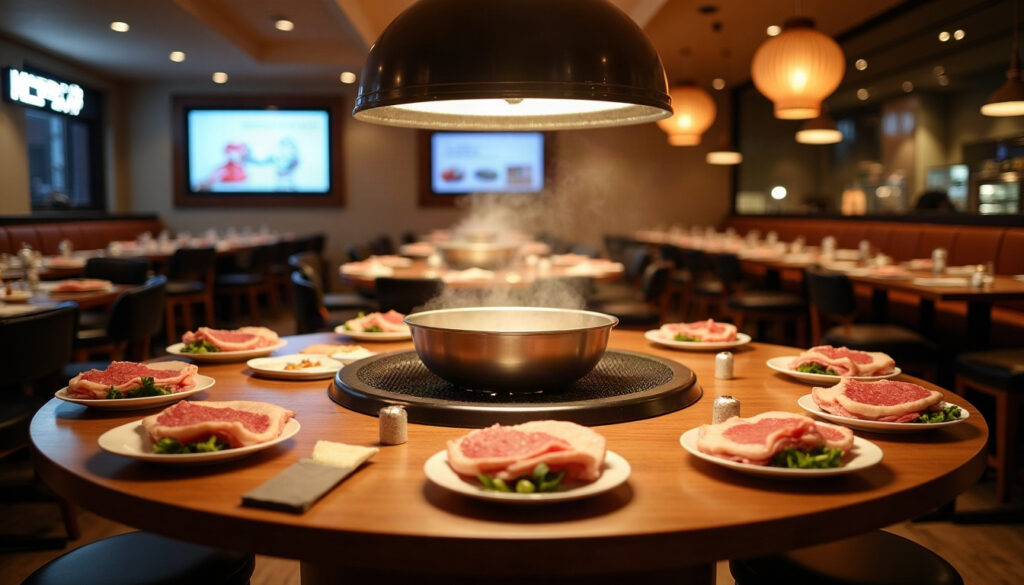 AI Phone Reservations and Waitlist for Hot Pot and Korean BBQ: Booking the Big Table Without Tying Up the Host Stand
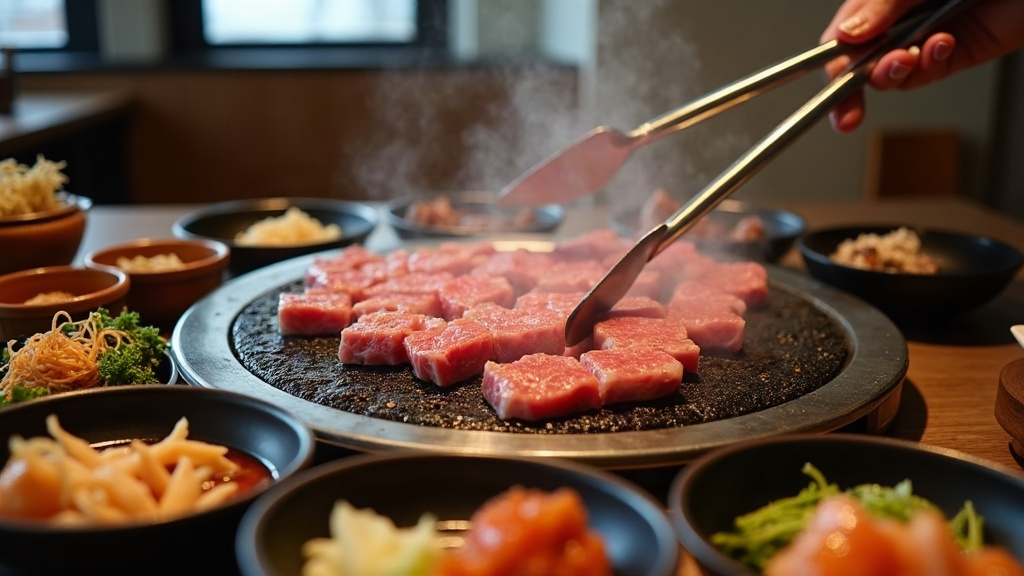 BBQ coréen et fondue chinoise : un guide de contrôle des coûts pour le service à volonté
Réservations et liste d’attente par IA téléphonique pour la fondue chinoise et le BBQ coréen : réserver la grande table sans bloquer l’accueil


