

Wilson Wu
Chief Revenue Officer, Snappy
November 10, 2026·15 min read
A restaurant website and online ordering platform is the vendor that builds your site, takes direct orders on it and usually runs your loyalty, email and branded app from the same login. In Canada the decision comes down to four checks: whether the vendor operates here, whether direct orders carry a per-order fee, who owns your domain and customer list when you leave, and whether checkout works in French.
Most of the advertising in this category is American, and most of the comparison articles are written by vendors. This guide is built for the operator who is opening a restaurant or switching online ordering platforms in Canada, and it uses only figures you can verify: a national industry association, a provincial government and the vendors’ own published pages. Below is what the category includes, how the main approaches differ, the arithmetic that decides the fee question, and what to get in writing before you sign.
Summary
On this page
A restaurant website and online ordering platform today typically bundles a website with ordering built in, a branded mobile app, loyalty and rewards, email and SMS campaigns, review tools and catering order forms, all under one subscription. That is a wider bundle than five years ago, when a restaurant website vendor built a menu page and a contact form and ordering came from somewhere else.
That width is the point and also the trap. One login and one bill is genuinely simpler than four vendors, but it means the platform holds your domain, your menu, your order history and your customer list at once. Everything you gain in convenience you can lose on the day you want to leave, which is why the ownership questions later in this guide matter as much as the price.
What you are actually buying is a direct channel. Every order that lands on your own site instead of a delivery app is an order you keep the margin on and the customer from. Our guide to commission-free online ordering systems for restaurants covers the ordering side in depth; this piece covers the whole platform decision.
Three pressures come up in almost every conversation we have with operators, and none is about features: tightening margins, platforms that were never built for the Canadian market, and ownership changes that are entirely outside your control.
1. The economics have tightened. Restaurants Canada reports that 41% of foodservice businesses are operating at a loss or just breaking even, up from 12% five years ago, and that 46% of operators expect profitability to worsen in 2026 (Restaurants Canada). At those margins, a platform fee that scales with your sales is a real line item, not a rounding error.
2. The loudest platforms are not built for Canada. The US bundles that dominate the ads and the search results often do not operate here at all.
Several of the most heavily advertised ones do not publish Canadian availability, Canadian-dollar billing or French-language checkout. Country and language are the first questions to resolve, not the last.
3. Ownership changes. A platform can be acquired, repriced or retired without asking you. None of that is a scandal, and none of it is something you get a vote on. Your contract, not the vendor’s roadmap, decides what happens to your site and your ordering flow when it does.
Instead of a table of brand names, compare the six ways a Canadian restaurant can put a website and direct ordering in front of guests, the fastest way to see which type of platform actually fits your restaurant. Every platform on the market fits one of these rows.
| Approach | Where the cost sits | Per-order fee on direct orders | Canada and French fit | Best fit |
|---|---|---|---|---|
| US all-in-one website-and-ordering bundle | Flat monthly subscription, quoted in US dollars; published prices in this category are rare | Varies by plan; confirm in writing whether your tier adds a percentage on direct orders | Several do not publish Canadian availability, Canadian-dollar billing or French-language checkout; ask for all three in writing | US independents that want one bundled subscription |
| Delivery marketplace storefront (the big three delivery apps) | No subscription; the app takes a commission on every order | Commission on every order; BC caps core fees at 20% of order value (Government of BC) | Operate across Canada in both languages; the guest relationship belongs to the app | Discovery for a new restaurant, never the home base |
| General website builder plus an ordering plug-in | Two subscriptions, two vendors, two support lines | Set by the plug-in, not the site builder; read both contracts | Builders offer bilingual templates; the ordering plug-in has to be checked separately | Owners who enjoy maintaining their own site |
| Free ordering widget | No subscription; the vendor earns on payment processing or upsells | Usually none | Varies; ask who owns the customer data and what happens if the product is retired | A first ordering page while volume is unproven |
| POS-bundled ordering page | Ordering priced as an add-on to the register you already rent | Usually none; card processing applies | Depends entirely on the POS vendor's Canadian presence and French interface | Operators who chose the POS first and want one more module |
| Snappy | Three published website tiers, each listing "Online Ordering included" (Snappy); check the tier page for current pricing and get the other modules quoted in writing | "0% commission fee on every online order" (Snappy) | Offices in Toronto, Vancouver and Montréal; French language option | Canadian and bilingual operators who want website, ordering, POS, loyalty and app from one vendor |
Two things stand out. First, only two rows make the per-order fee disappear by design: the POS-bundled page and Snappy. Second, the row with the widest feature list is also the row with the narrowest geography. Feature width and Canadian fit are not the same axis, and the ads only show you one of them.
Which plan actually wins at your volume?
Bring the quote you're holding and one month of direct online sales. We'll run the crossover with you, line by line, before you sign anything.
Show me my crossoverWhether a per-order fee plan or a flat subscription costs less depends on your monthly direct online volume: below the crossover point the fee plan is cheaper, and above it the flat plan is cheaper, with the gap widening every month you grow. This is arithmetic, not opinion, and you can run it on any quote in five minutes.
Most bundles that charge a percentage also sell a flat plan that removes it. The crossover is the monthly price gap between the two plans divided by the fee rate. Written out: crossover volume in monthly direct online sales = (flat plan price minus fee plan price) divided by the percentage fee rate on order value.
Below that volume in direct online orders, the fee plan costs less. Above it, the flat plan does, and the gap widens every month you grow.
Use illustrative figures to see the shape. If the flat plan costs $300 a month more than the fee plan and the fee is 5%, a rate you should get in writing from your own quote, they cross at $300 divided by 0.05, which is $6,000 a month in direct online orders. At $20,000 a month the fee plan is paying $1,000 in fees against a $300 premium, so the flat plan saves $700 a month, or $8,400 a year. Plug your own quote and your own volume in; the direction is always the same.
Two things this arithmetic leaves out. Card processing sits on top of every model in this category, so ask for the effective rate on your real card mix rather than the headline rate. And some bundles charge the guest a separate service fee on top of your subscription. It is not your line item, but your guests read the total on the checkout page, and they compare it to the app.
The comparison that actually pays for itself is against the delivery apps. British Columbia’s government capped the fees delivery companies can charge restaurants at “no more than 20% of the dollar value of an order” after “delivery companies charging fees to restaurants as high as 30% of an order’s value during the pandemic”, in what it called “Canada’s first permanent cap on fees charged to restaurants by food-delivery companies”, effective January 1, 2023 (Government of British Columbia).
Outside BC there is no cap. Every approach in the table above beats the commission you pay a delivery app on the orders you move to your own site; the only question is how much of the saving the platform keeps.
By default, whoever is named as the domain registrant and whoever holds your customer database owns them when you leave, not you, unless your contract says otherwise in writing. Operators tend to leave this question for later, and it is the one they regret. A bundle that holds your domain, your site and your customer list is only as safe as the exit clause.
Snappy’s own position is a useful benchmark for what to ask everyone. Its website services FAQ states: “we highly recommend that all of our clients register a domain that is unique to their restaurant,” and that “All of our professional website services come with our own hosting” (Snappy). Read that as the arrangement to ask for: the restaurant holds the domain, the vendor holds the hosting. Confirm the registrant name on your own record either way.
Four questions to get answered in writing before you sign anything:
The pattern behind all four: the platform should be replaceable and your assets should not be. If a vendor cannot answer these in writing, the price does not matter.
If you operate in Quebec, checking language compliance is not optional: the law requires a French version of your website once you have a Quebec address and serve Quebec customers, and requires service in French once you employ five or more people. Éducaloi, the Quebec legal information organization, summarizes the rules plainly: “You must have a French version of your website if your business, company or organization has an address in Quebec, and you offer your products or services to Quebecers,” and “If your company, your organization or you have at least 5 employees, you must be able to serve customers in French” (Éducaloi).
The penalties are not symbolic. Éducaloi notes a business “could be fined between $3,000 and $30,000 for each day that the offence continues,” with the fine doubled for a second offence and tripled for any additional offence (Éducaloi). Public signs and commercial advertising must generally be in French, with other languages allowed alongside only where French is “markedly predominant.”
Your website, your ordering checkout, your order confirmation emails and your branded app are all customer-facing surfaces. A translated marketing page is not the test. Ask each vendor to demonstrate a complete French checkout, from menu to payment to confirmation, and get their compliance position in writing.
Language is not the only Quebec-specific technology obligation to check: our guide to Quebec’s sales-recording requirements covers the separate receipt rules a Quebec restaurant also has to plan for. This is not legal advice; confirm your own obligations with a professional. It is a buying filter that removes half the category in one demo.
Outside Quebec, bilingual capability is still a revenue question. Wherever your guests order in both languages, a checkout that only speaks one of them loses the other half quietly.
There is no single best restaurant website and online ordering platform for every restaurant: the right answer changes with volume, and picking as if you were already at scale is the common mistake.
Opening now, volume unproven. Your enemy is fixed monthly cost against revenue that does not exist yet. A per-order fee or a free ordering page is rational at this stage because you pay in proportion to what you sell. The trade is that you are building your customer list on someone else’s terms, so apply the four ownership questions above even harder. Get your own domain from day one; it is the cheapest asset in this entire decision.
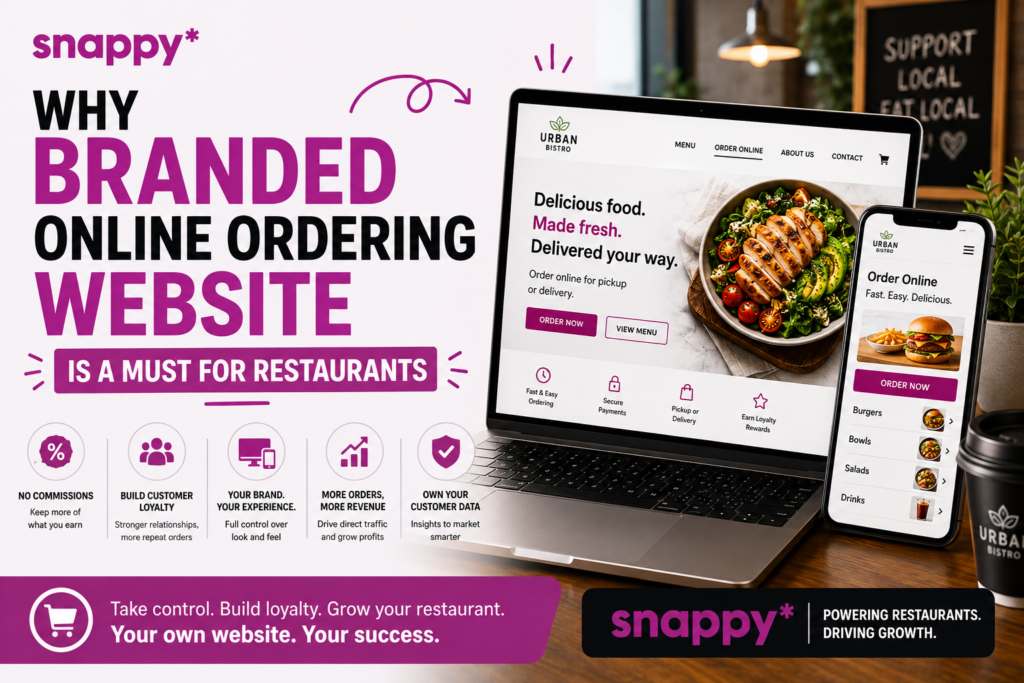
Established, with real online volume. The flat subscription now wins on arithmetic, per the crossover above, and the decision shifts to consolidation. A website vendor, an ordering vendor, a loyalty vendor and a POS run separately means four bills, four support numbers and four sets of customer data that never reconcile. That is the case for a single stack, and the argument behind why a branded online ordering website is a must for restaurants.
Multi-location or growing there. Now the question is whether the platform handles centralized menu control, per-location reporting and a single loyalty balance across stores. Snappy’s online ordering lists “Multi-location support with centralized control” (Snappy), its POS synchronizes menus across ordering channels, and its loyalty points can be collected in-store and online. Ask any vendor to show the same three things on a live account, not a slide.
Published prices in this category are rare and mostly American, and the loudest bundles quote in US dollars. Snappy publishes three website tiers, each listing “Online Ordering included” (Snappy); check the tier page for current pricing and get the other modules quoted in writing. Whatever the number, get the all-in monthly cost with every module you will actually turn on, the effective card processing rate on your card mix, and the per-order fee, if any, on a direct order.
Not always, and the ads will not tell you. Several of the most heavily advertised bundles do not publish Canadian availability, Canadian-dollar billing or French-language checkout. Ask for written confirmation of all three before you book a demo.
Start with whatever costs the least per month and keeps your domain and customer list in your name; a per-order fee is acceptable while volume is unproven. If you are Canadian and would rather not assemble a website, ordering, POS, loyalty and an app from separate vendors, Snappy covers all of them from one company with “0% commission fee on every online order” (Snappy) and offices in Toronto, Vancouver and Montréal.
Only if your contract says so. Confirm four things in writing: that your company is the registrant on the domain, that you can export customer emails and order history in a usable file, what happens to the site content on cancellation, and whether a custom domain requires a paid tier. Platforms in this category change owners and retire products; the exit clause is what protects you when they do.
If your business has an address in Quebec and offers products or services to Quebecers, you must have a French version of your website, and businesses with at least five employees must be able to serve customers in French (Éducaloi). Treat the checkout, confirmation emails and app as part of the website, and verify your specific obligations with a professional.
The website-and-ordering category is crowded, loud and mostly American. The bundles with the widest feature lists are often the ones that do not operate in Canada, do not bill in Canadian dollars and do not check out in French. Verify country and language before you look at a single screenshot.
Then run the arithmetic. Divide the price gap between a fee plan and a flat plan by the fee rate, and you know the monthly volume where the flat plan starts winning. Compare both against the delivery-app commission on your own statements: BC caps those fees at 20% of order value, and before the cap delivery companies charged as high as 30% during the pandemic (Government of British Columbia). The case for a direct channel makes itself.
Finally, get three things in writing: your name on the domain, an export of your customer list on request, and a full French checkout if you serve Quebec. For a Canadian or bilingual independent that wants website, ordering, POS, loyalty and a branded app from one vendor with local support, Snappy is Canadian, publishes a French language option and is built to be checked against exactly those three questions. Ask us what French coverage looks like on the tier you are quoting before you sign.
Want to see how Snappy compares against your current quote, with commission-free direct ordering and Canadian support on the table from the first conversation? Talk to our team.
Book a walkthrough
Bring your platform quote before you sign
We'll walk through your quote and your direct ordering setup on a live account, and answer the domain, customer data and French checkout questions before you commit.
Written by
Wilson Wu
Chief Revenue Officer, Snappy
Wilson Wu is Chief Revenue Officer at Snappy, the restaurant technology company, and is based in Boston. His first job was in a restaurant kitchen, and he has spent his career since at the intersection of hospitality and software, working with operators across Canada on the systems their service runs on. He also builds the technology he writes about. His engineering work includes a per-location customer service agent that answers guests with a restaurant's real hours, menu and prices, deployed with independent restaurants, and a document-extraction model that reads supplier invoices and matches invoice numbers against what is owed. He writes here about what changes on a busy service: ordering, payments, loyalty, the phone, and the Canadian rules behind them. He holds an MBA from Duke University and a Master of Science in Computer Science from Georgia Tech.
Connect on LinkedInNo-obligation walkthrough
Not sure if your fee plan is winning?
Send us your quote and one month of direct online sales. We'll show you the crossover, plan by plan.
On this page
Get The Latest Restaurant Data, Trends & Tips