
Wilson Wu
Chief Revenue Officer, Snappy
October 8, 2026·14 min read
Most restaurants shopping for loyalty program software are really asking one question: do I need a separate loyalty app at all? A standalone loyalty platform sits on top of somebody else’s point of sale, so it costs a monthly fee your POS bill does not cover. This guide compares the approaches, not the logos, and shows you what to check before you sign.
Summary
On this page
Restaurant loyalty program software is any system that identifies a returning guest, tracks their visits or spending, and issues a reward once they cross a threshold, whether it runs as its own app or lives inside the POS. Strip the marketing away and every loyalty product does four jobs. It identifies the guest at checkout by phone number, card, app or QR code, then records the visit or the spend against that profile.
It issues a reward when a threshold is reached, and stores the profile so you can message that guest later.
The differences are in where those four jobs happen. A standalone loyalty platform does them on its own tablet or app, then reports back to your register through an integration of varying depth. A POS with loyalty built in does them inside the same screen your cashier already uses, so the enrolment prompt, the points and the receipt are one transaction.
That structural fact decides most of what follows. A tool that lives beside the register arrives as a second device at your counter, a second monthly bill and a second support number. A tool that lives inside the register arrives as a feature.
Restaurants switch loyalty providers over cost fatigue, shallow POS integrations that leave a second tablet at the counter, hardware that wears out, and exit costs that surface only when they try to leave. Start with the fair part: the well-known standalone platforms are competent products, and operators rarely leave because the points stopped working, though the branded app some of them build is something a single restaurant could never afford to build alone.
The complaints that push operators to shop around are narrower, and they repeat across every category of vendor.
Cost fatigue. The base fee is only the start. SMS and email volume caps add charges on top, and any branded app carries its own platform account cost. Owners describe being tired of paying so much for a rewards program, and the feeling sharpens every time a new add-on appears on the invoice.
Integration depth, not integration presence. The most common structural complaint is the second tablet. A vendor can list your POS as supported and still deliver a link that amounts to a code typed at the tablet, not a true data connection. When the loyalty balance and the sales record live in different systems, reconciliation becomes a weekly chore.
Hardware. A free customer-facing tablet is a perk at signup and a complaint two years later, when the battery swells and the replacement is on you.
Exit costs. The discovery that leaving costs money, and might cost the customer list, is what turns a grumble into a switch. We cover the exact clauses below.
Every listicle that ranks for loyalty software compares standalone tool to standalone tool, which quietly assumes you have already decided to pay a second vendor. That is the decision worth reopening. The table compares the approaches an operator can actually choose between, with Snappy named as itself.
| Approach | Where loyalty lives | How it is usually billed | Contract pattern | Best for |
|---|---|---|---|---|
| Paper punch card | A card in the guest's wallet | Printing cost only | None | Testing whether guests want a program at all |
| Standalone digital stamp card | A wallet pass on the guest's phone | Low monthly fee per location | Month to month | Replacing paper cheaply at one site |
| Standalone loyalty platform with branded app | A vendor tablet at the counter plus a white-label app | Monthly fee per location, plus app platform account, plus messaging overages | Often a fixed annual term | Small chains that want their own app above all else |
| Enterprise loyalty platform | Head-office system integrated into every store | By quote | Multi-year | Franchises and national chains |
| POS add-on loyalty, billed per location | Inside the register, but priced as a separate module | Monthly fee that multiplies by store count | Month to month | Restaurants already committed to that vendor's hardware |
| Loyalty built into an all-in-one POS (Snappy) | Inside the register, kiosk, QR ordering, online ordering and gift cards | Quoted per restaurant as part of the platform, no public list price | By quote | Operators who want one system and one support contact |
Two rows deserve a note. The “POS add-on billed per location” row is the trap for small groups: it looks POS-native, but five locations means five loyalty fees with no volume discount. And the enterprise row is real, but no independent or ten-store group should be on it.
Run your loyalty bill against your own margin
Bring your annual loyalty cost and your year-end margin. We will walk the math with you on your own numbers, not an industry average.
Show me my loyalty mathA standalone loyalty app wins on exactly two things. Portability: if you plan to change your POS this year, a platform that integrates with several registers survives the switch. And a feature your POS will never build, which for some vendors is the white-label branded app.
Loyalty built into the POS wins on everything operational. One screen at the counter means a cashier cannot forget the second tablet, which is the largest cause of enrolment falling apart. Points from a kiosk order, a QR order at the table, an online order and a walk-in are the same points, because they were never in different systems. And there is one bill and one number to call.
Then the arithmetic, which is where a single-location owner should start. Take whatever the standalone quote says, annualize it, and divide it by your own profit margin.
If the all-in bill is $300 a month, that is $3,600 a year ($300 times 12), and $3,600 divided by your margin is the incremental sales the program has to produce before it earns you a dollar. Run that on the margin from your own year-end statement, not on an industry average, because the thinner your margin the bigger the number gets.
That is not an argument against running a loyalty program. Regulars are the most valuable guests you have, and the reason is frequency: the gap between a regular and a one-time visitor comes from how often they come back, not from what they spend on a single visit. It is an argument against paying twice for the same customer record.
The pricing page is not the loyalty program contract itself. Four clauses decide what this actually costs you.
Term length and auto-renewal. Standalone platforms with a branded app tend to sell on a fixed annual term with no month-to-month option, while digital stamp-card tools and POS add-ons usually offer month to month. Ask whether the agreement auto-renews and how many days’ notice cancellation requires.
Early termination and data release. This is the clause that produces the horror stories: an operator gives notice, then learns that leaving early carries a fee and that their own member list is released only after it is paid. Treat it as a question to ask before signing: what does leaving cost, and do I get my customer list back in a usable file?
Volume caps and overages. Base fees rarely include unlimited messaging. Get your real monthly SMS and email send volume into the quote before you sign, and ask for the per-message overage rate in writing.
Add-ons that are not optional. The platform account behind a branded app is a cost of having the app at all, not an upgrade. Ask for the all-in year-one number: hardware, setup, and every per-message and per-location charge.
The Competition Bureau’s own consumer guidance is a useful mirror here. It warns Canadians that businesses can change loyalty programs without notice, reduce the value of points and end programs at any time. Your guests are reading that too, so a program that stays stable and honours balances is itself a trust signal.
Points are a consumer contract, and two provinces regulate them directly. Whatever software you choose has to be configurable to comply.
Ontario. Since January 1, 2018, provincial rules stop the expiration of reward points based only on the amount of time that has passed since they were earned. Points may still lapse if the program closes accounts after a long period of inactivity and says so in the membership agreement, and the ban does not apply to points that cannot be redeemed for any single item over $50. A voucher issued as a reward is treated as a gift card and cannot expire.
Quebec. The Office de la protection du consommateur permits points to expire only after a period of inactivity of at least one year, and only if the member agreement says so. The merchant must also send an inactivity notice, stating only that inactivity will expire the points on a given date, between 30 and 60 days before that date.
Check first whether the rules reach your program at all: the Office lists programs that are not covered, including those whose points buy only goods or services worth $50 or less each, or a single good or service agreed when the member signs up, and points in those programs may carry a plain expiry date. A card that gives a free coffee after ten is the regulator’s own example.
The practical test for any loyalty vendor: can it run an inactivity-based expiry with a configurable window, and can it send the Quebec notice automatically? If the answer is a manual export and a mail merge, that is your staff’s problem every month. This is general information, not legal advice; confirm your program terms with a lawyer in your province.
You move a loyalty list without losing balances by exporting the full member file first, freezing earning during a defined window, reconciling total points liability rather than headcount, and converting balances if earn rates differ, before you tell members their new totals. A loyalty migration is a data project with a customer-service problem attached: guests do not care whose fault it is that their points vanished.
Export first, and export before you give notice: member name, email, phone, enrolment date, current point balance and birthday. Confirm your provider’s export format in writing, because a PDF report is not a migration file.
Freeze earning for a defined window, usually a slow weekday, then reconcile total points liability after the import rather than member count. If the count matches but the balance dropped, something truncated silently.
Convert balances rather than copying them when earn rates differ. If the old program gave one point per dollar and the new gives ten, importing raw totals hands every member a ninety per cent haircut. Decide the ratio, write it down, test it on twenty accounts.
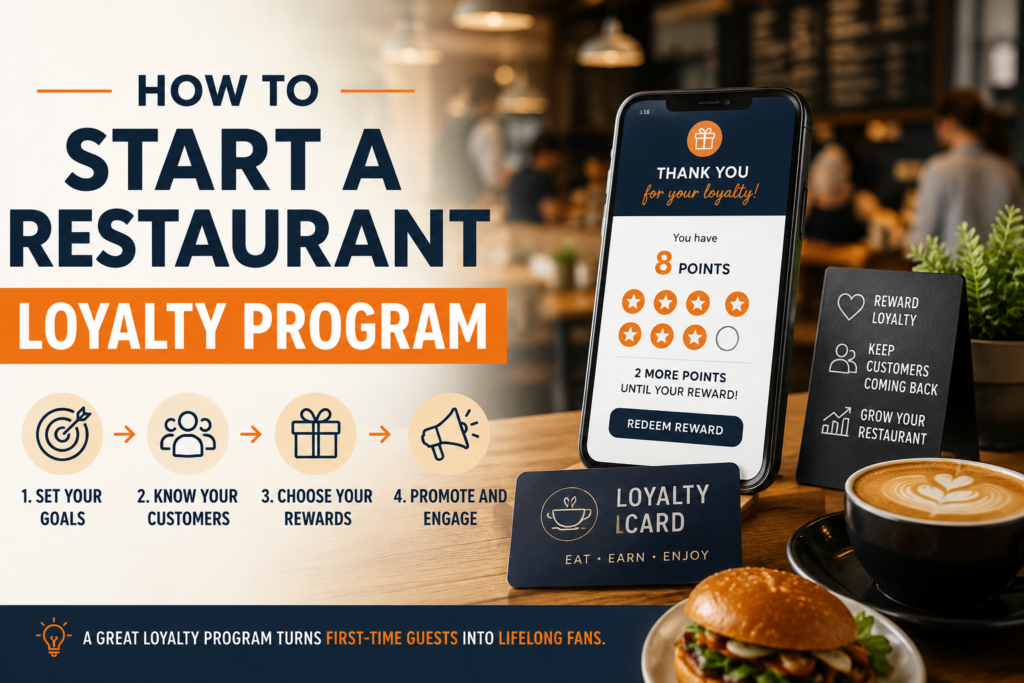
Then tell your members before they find out at the counter. A short SMS naming their new balance prevents the conversation your cashier would otherwise have thirty times. If you are rebuilding the program anyway, our guide on how to start a restaurant loyalty program covers the earn-and-burn decisions worth making now.
Single location. Usually the cheapest thing that gets guests enrolled. A digital stamp card on a wallet pass replaces the paper punch card, which for many neighbourhood restaurants is the entire job. If you are already replacing your POS, take the loyalty that comes with it.
Small group, two to ten locations. This is where a second tablet and a second bill per store becomes real money. For a multi-location loyalty program, run the comparison on total cost across all stores: a per-location loyalty fee multiplies by store count with no volume discount, while loyalty inside a platform quote does not multiply that way. Ask every vendor for the five-location number, not the one-location number.
Franchise and national chains. For a franchise loyalty program, an enterprise loyalty platform integrated at head office is the standard answer, priced by quote on multi-year terms. The questions that matter are franchisee data access and whether points work across every store.
The cross-cutting case. If online ordering, gift cards or the register itself are also on your fix list, buying each separately is how a stack becomes six invoices and four support numbers. Snappy runs loyalty in the same system as the point of sale, online ordering, kiosk, and gift cards and memberships. Points can be collected in store and online, guests check their balance through the app, a QR code or a rewards link, tiered earn rates and double points on chosen items are set by you, and the names, birthdays and email addresses you collect feed SMS and email campaigns from one place. Groups that want their own branded app can add one on the same rails through the custom app, with points shareable across participating restaurants. Freshslice’s results are in our case study on How Freshslice Upgraded Its Loyalty Program & Increased Growth.
Most standalone platforms quote by demo rather than publishing a price, and the base fee is only part of the bill: expect messaging overages, a platform account for any branded app, and hardware. POS-native loyalty is quoted inside the platform. Ask every vendor for the all-in year-one number per location.
Ask before you sign, because it is not automatic. Some agreements release member data only after an early-termination fee is paid. Get the export format and any release fee written into the agreement.
Usually, because the comparison is total cost rather than sticker price. A standalone tool adds a monthly fee on top of your POS bill, plus per-message charges and any branded-app add-on, while POS-native loyalty is quoted inside the platform. Watch for the exception: a POS add-on that is still billed per location per month.
Not just because time has passed. Ontario has banned time-based expiry since 2018, with exceptions for inactivity and low-value rewards, and Quebec allows expiry only after at least one year of inactivity and a notice sent 30 to 60 days beforehand.
Not if you convert balances rather than copying them. Export member records with current balances, agree a conversion ratio if the programs use different earn rates, test the import on a small batch, reconcile total points liability rather than member count, and message members their new balance before their next visit.
Standalone loyalty platforms are competent products, and if a white-label branded app is what you are buying, one of them earns a shortlist spot. Operators rarely leave because of the loyalty engine. They leave because of the second tablet, the annual term, the caps and add-ons stacked on the base fee, and the discovery that leaving costs money and might cost the customer list.
So run the comparison one step earlier than the listicles do. Decide whether you are buying a loyalty app or a POS that already includes one. If you are within a year of replacing your register, the second question answers the first.
Ready to see loyalty living in the same system as your register, your online ordering and your gift cards? Talk to the Snappy team and we will walk your current stack and your current bills, not a generic demo.
Book a walkthrough
Show us your second tablet and second bill
Book a walkthrough of your current loyalty setup and register. We will go clause by clause through the quote in front of you, on your own numbers.
By Wilson Wu. Published August 28, 2026.
Written by
Wilson Wu
Chief Revenue Officer, Snappy
Wilson Wu is Chief Revenue Officer at Snappy, the restaurant technology company, and is based in Boston. His first job was in a restaurant kitchen, and he has spent his career since at the intersection of hospitality and software, working with operators across Canada on the systems their service runs on. He also builds the technology he writes about. His engineering work includes a per-location customer service agent that answers guests with a restaurant's real hours, menu and prices, deployed with independent restaurants, and a document-extraction model that reads supplier invoices and matches invoice numbers against what is owed. He writes here about what changes on a busy service: ordering, payments, loyalty, the phone, and the Canadian rules behind them. He holds an MBA from Duke University and a Master of Science in Computer Science from Georgia Tech.
Connect on LinkedInNo-obligation walkthrough
Paying twice for the same loyal guest?
See what your loyalty tablet and bill actually cost against your own margin, not an industry average.
On this page
Get The Latest Restaurant Data, Trends & Tips