
Wilson Wu
Chief Revenue Officer, Snappy
September 10, 2026·14 min read
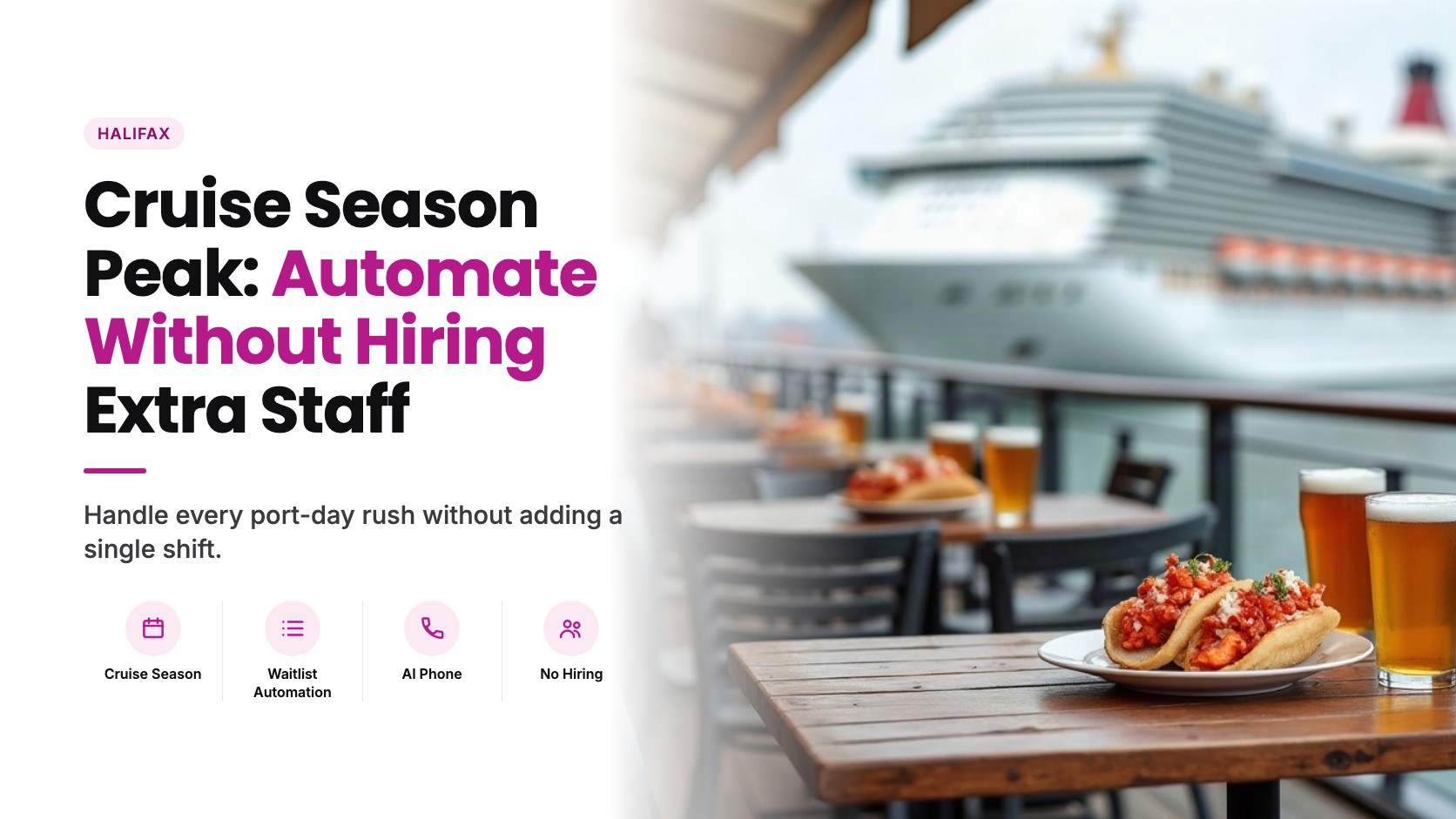
Halifax restaurants can handle the 2026 cruise season without hiring by moving three jobs off the floor team: quoting and paging the waitlist, answering the phone, and asking for the review. Each can run on software that adds no labour on a port day and no payroll once the last ship leaves in November. The three fixes: a digital waitlist for the door, an AI phone line for the phone, and QR ordering for the line, tackled in that order.
The season is not small. 189 calls from 28 cruise lines are expected through November (a “call” is one ship docking for a port day), and the Port of Halifax anticipates around 363,000 visitors. Those visitors walk off the gangway at the Seaport and straight up the boardwalk into the same restaurants that absorbed a minimum-wage increase in April and face a second one on October 1. With the 2026 season running to November, everything below is built to be set up before the next port day, not next spring.
Summary
On this page
Halifax expects 189 ship calls from 28 cruise lines and about 363,000 visitors through November 2026, per the season-opening outlook on the Chamber of Shipping of British Columbia’s Shipping Matters site. The same report describes the cruise sector as generating close to $200 million annually and supporting about 1,000 jobs in Nova Scotia.
For an independent on the waterfront or downtown, the number that matters is not the season total but the shape of a single day.
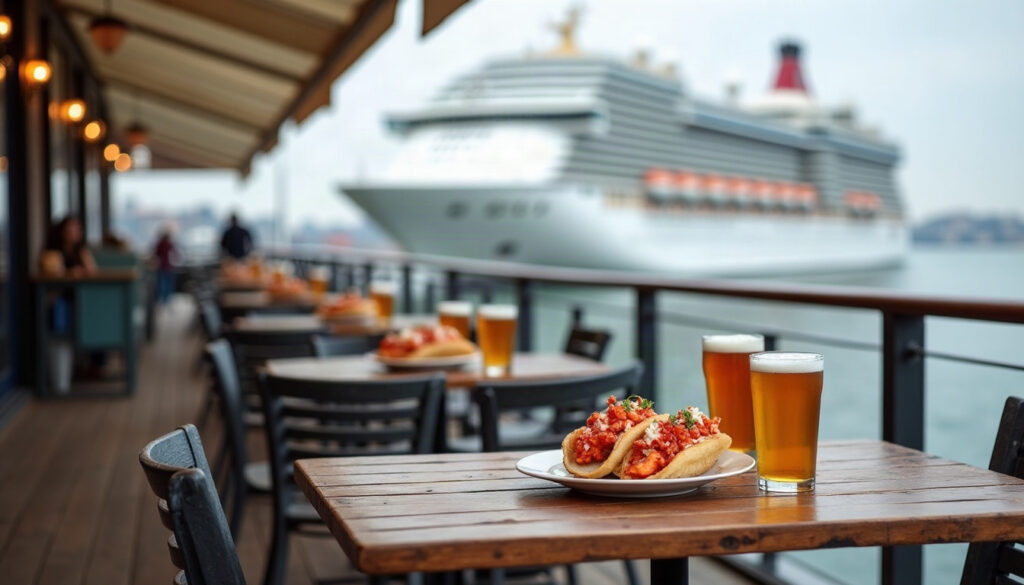
A port day is any day a cruise ship is berthed at the Seaport, and it behaves like a wave, not a tide: passengers clear the terminal in a block, walk into the downtown waterfront, and hit lunch inside a window the ship’s departure time dictates. That means your busiest stretch arrives at roughly the same hour every port day, then vanishes, and a full staff hired for that window is idle by mid-afternoon.
The pattern rhymes with the rest of Atlantic Canada’s seasonal economy. The Agri-Food Analytics Lab notes that smaller markets across Atlantic Canada and the Prairies depend more heavily on seasonal traffic and narrow customer bases, and PEI’s own tourism board opens its patio-season guide on the same seasonal note. Halifax has the same dependence with a harder edge: the traffic arrives by schedule, and the schedule is not yours.
Because the margin to pay for it is not there this year. Restaurants Canada reports that 71% of restaurant operators report lower profitability so far in 2026, and more than one-third are operating at a loss or merely breaking even. CBC Nova Scotia ran the local version of that story under the headline N.S. restaurants struggling to manage rising costs, slowdown in business.
Labour cost is the specific line that moved. Nova Scotia Labour Standards sets the minimum wage at $16.75 per hour as of April 1, 2026, rising to $17.00 per hour on October 1, 2026, which means the second increase lands while ships are still calling. We covered what the double increase does to a Halifax P&L in our post on the Nova Scotia minimum wage increase and what it means for restaurants in 2026.
The practical problem with a port-day hire is not the hourly rate alone. It is that a seasonal host or runner has to be scheduled, trained and kept somewhat busy on the non-port days between ships, and then let go in November when the harbour goes quiet. You are paying a full season of wages to solve a problem that lasts one lunch service. The same surge logic applies to any scheduled crowd, which is why our guide on how Canadian restaurants can prepare for the 2026 FIFA World Cup reaches the same conclusion about hiring for a peak.
All three fail in the same order, and the order tells you where to intervene: the door goes first, the phone second, the line last. Fix them in that order.
The door fails first: a group of six from the ship asks the host how long, hears “about 45 minutes”, and walks two doors down. The phone fails second, because the host who was answering it is now quoting waits, and a caller asking whether you have a patio or take large parties rings out to voicemail. The line fails last, when the servers who should be turning tables are stuck taking orders from a patio full of first-time guests reading the menu for the first time.
The phone failure is quiet and expensive, in line with what we found when we looked at the cost of missed phone calls for restaurants. A caller who rings out while the host is quoting waits rarely leaves a message and rarely tries again; the group on the sidewalk with a departure time simply calls the next door. Nobody on the floor hears that call fail, so it never shows up in the day’s numbers, only in the covers that went somewhere else. On a port day, a waterfront pub is a full-service room with a quick-service call pattern: short questions, high volume, and no patience for hold.
Rank the fixes by that order of failure. The door needs a way to hold a guest without holding a table. The phone needs to be answered by something that is not a person on the floor. The line needs the ordering step moved to the guest. None of those three requires a hire, and none of them touches the kitchen: moving people through the door, phone and patio faster only helps if the kitchen can already cook at the pace the floor is now selling.
See where your port-day rush breaks first
Bring your ship calendar and we'll walk through whether it's the door, the phone or the line costing you covers, and which fix to set up first.
Show me my port-day fixYou let them wait somewhere else. A Tasting Table survey reported by Chowhound found that over 80% of respondents would not wait more than 30 minutes for a table (US data), and the quote is only useful if the guest believes it.
A cruise passenger with a departure time is more sensitive than that, not less, because a 45-minute quote on a paper list means standing on the sidewalk outside with no way to know whether the quote is real.
A digital waitlist changes the offer. The guest gives a name and a mobile number, walks the boardwalk, and gets a text when the table is up, so the quote costs you nothing to honour and the guest has no reason to bail. The mechanism is simple: the group that would have walked is now seated 45 minutes later instead of never, and the host who would have spent that time re-quoting the sidewalk is seating tables instead.
Snappy’s Waitlist product runs the digital waitlist alongside reservations and syncs both into the same dashboard the floor already runs on. That sync matters on a port day for a reason that has nothing to do with the guest: bookings that never hit the dashboard distort the food and labour plan for the next ship. For a wider look at the category, see our comparison of the best digital waitlist systems for restaurants.
Take the phone off the floor entirely, the same fix we cover in what AI phone answering systems for restaurants actually do. On a port day the calls are overwhelmingly questions a first-time visitor asks before choosing a door: are you open, do you have a patio, can you take a party of ten, is there anything gluten-free, how far are you from the Seaport.
Every one of those is answerable from a written FAQ, and every one of them pulls a host away from the door if a person has to answer it.
Snappy’s AI Phone General Inquiries line does exactly that, with no prerequisite product: it forwards your line to a Snappy number and answers every call from your own FAQ, with no bandwidth cap and no hold. Because it works by forwarding the number you already have, it runs alongside whatever point-of-sale system is already on your counter. The product page states that Snappy Phone works during peak hours, after-hours, and holidays, which is a plain description of a port-day lunch and a Sunday ship call. If you also run Snappy Reservation, the AI Phone Reservations line answers concurrent booking calls and books straight into the same reservation dashboard, so a caller from the ship who wants a table at one o’clock gets one without a host touching the phone.
There is a lighter option if you are not ready to hand the line to a voice agent. The same page lists an automated SMS fallback for any unanswered calls, which texts back the caller who rang out with a link to order or book, so the caller who rang out at least has something in hand. It is the smallest possible first step, and on a port day it catches the calls the floor could not.
Six of the seven port-day tactics below add no staff hours at all; only the extra host costs a shift, and it fixes the least. Labour figures are deliberately qualitative, because the right number depends on your room, your ship calendar and whether the tactic runs on non-port days too.
| Tactic | Staff hours it adds | What it captures on a port day | What it costs in the off-season |
|---|---|---|---|
| Extra host on port days | One shift per port day, plus the non-port days you keep them on to justify hiring | Faster quoting at the door; nothing for the phone or the line | A full seasonal wage line at $17.00 an hour from October 1, then a layoff in November |
| Paper waitlist | None, but it holds the host at the stand | A name and a hope; the guest who leaves is never recorded | None, and nothing to show for the season |
| Digital waitlist with text notification | None once set up | Walk-ins who will not stand on the sidewalk 45 minutes; quote accuracy the host can see | A software subscription; the same waitlist runs the winter brunch line |
| QR ordering for patio tables | None; it removes order-taking from the servers | First-time guests ordering at their own pace; tables turning without a server round trip | A software subscription; useful on any full patio, not only ship days |
| AI phone line for questions and bookings | None; the host stays at the door | Every hours, patio and large-party call, plus bookings into the reservation dashboard | A software subscription; it keeps answering through the winter when nobody is at the stand |
| Automated SMS fallback on missed calls | None | A text back to every caller who rang out while the host was at the door | A software subscription; the smallest step in this list |
| QR review stand at the door | None; the guest does the work | A Google review from a visitor you will never see again | Nothing the floor has to do; reviews keep compounding into next season |
Two of these rows deserve a note. The extra host is the only tactic that solves nothing on the phone or the line, and it is the only one that costs a wage on days no ship is in. The digital waitlist is the only tactic that fixes the first thing that breaks, the door, and it is also the one that most operators still run on paper.
If your patio is the surge zone, the ordering row pairs with payment. Snappy’s Dine-in QR and Order-from-Table let guests order and pay from the table. Snappy also offers a payment terminal with a built-in cellular SIM for patios and pop-ups, so a waterfront deck with no reliable WiFi can still close a bill at the table.
A cruise cover is a one-time cover unless it leaves a review, because the next passenger off the next ship finds you the same way this one did. A visitor with one afternoon ashore is searching on the gangway, not scrolling a delivery app, and the first thing that search returns is a star rating and a review count. Your Google rating is the menu board those visitors read, which is why how you respond to Google reviews matters as much as how many you collect.
The problem is that a satisfied guest rarely volunteers a review, and a guest with a ship to catch volunteers even less. A satisfied group from the ship walks out, boards, and sails; the review never happens unless someone asks at the door, and on a port day nobody has time to ask.
A QR review stand does the asking. Snappy Feedback is a QR-driven review funnel with a branded stand, stickers and a mobile survey page; its smart routing sends happy guests to Google and unhappy ones to an internal feedback form with a real-time alert to the owner. The routing is the point on a cruise day, because the complaint from a guest who waited too long reaches you privately and the praise reaches Google, where the next ship reads it. The broader product sits under Reputation Management.
189 calls from 28 cruise lines are expected through November, and the Port of Halifax anticipates around 363,000 visitors, per the season-opening outlook published on the Chamber of Shipping of British Columbia’s Shipping Matters site. The same report values the sector at close to $200 million annually for Nova Scotia.
It is harder than last year. Nova Scotia’s minimum wage rose to $16.75 per hour on April 1, 2026 and rises to $17.00 per hour on October 1, 2026, and 71% of Canadian operators report lower profitability in 2026, which is why this guide focuses on tactics that add capacity without adding a shift.
They leave. A Tasting Table survey reported by Chowhound found that over 80% of respondents would not wait more than 30 minutes for a table (US data), and a passenger on a ship’s clock is less patient than that. A digital waitlist that texts the guest lets them wait on the boardwalk instead of walking to the next door.
Software can. An AI general inquiries line answers hours, patio, location and menu questions from your own FAQ, and a reservations line books directly into your booking screen; Snappy’s product page states that Snappy Phone works during peak hours, after-hours, and holidays. If you want a smaller step, an automated SMS fallback texts back the callers you missed.
Ask at the door with a QR review stand that routes happy guests to Google and unhappy ones to a private form. Without a prompt, most satisfied guests never think of it, and a cruise guest is gone by the evening sailing.
Halifax’s cruise season is 189 ship calls and around 363,000 visitors arriving in scheduled waves, on top of a year in which 71% of Canadian operators are less profitable and Nova Scotia’s minimum wage steps up twice. Hiring for a single lunch surge is the one tactic on the list that costs a shift on every day of the season, including the days no ship is in.
The three jobs that break on a port day, the door, the phone and the line, can each move to software that costs no labour: a digital waitlist that texts guests, an AI phone line that answers questions and takes bookings, and QR ordering that lets a patio order itself. Add a review stand at the door so the visitor you will never see again still leaves a rating for the next ship to read. The waitlist, the bookings and the table orders all land in the same dashboard, and Snappy support is available 10 AM to 10 PM ET, seven days a week, which covers every port-day lunch on the calendar.
Set up before the next port day. Talk to our team and tell us your ship calendar; we will tell you which of these fits your room and how fast it installs.
Book a walkthrough
Set up your port-day fix before the next ship arrives
Bring your ship calendar and we'll walk through your door, phone and line together, so the next port day runs on software instead of a shift you can't justify hiring for.
Written by
Wilson Wu
Chief Revenue Officer, Snappy
Wilson Wu is Chief Revenue Officer at Snappy, the restaurant technology company, and is based in Boston. His first job was in a restaurant kitchen, and he has spent his career since at the intersection of hospitality and software, working with operators across Canada on the systems their service runs on. He also builds the technology he writes about. His engineering work includes a per-location customer service agent that answers guests with a restaurant's real hours, menu and prices, deployed with independent restaurants, and a document-extraction model that reads supplier invoices and matches invoice numbers against what is owed. He writes here about what changes on a busy service: ordering, payments, loyalty, the phone, and the Canadian rules behind them. He holds an MBA from Duke University and a Master of Science in Computer Science from Georgia Tech.
Connect on LinkedInNo-obligation walkthrough
Fix your busiest port-day hour first
Bring your ship calendar and see which port-day problem, the door, the phone or the line, is costing you covers.
On this page
Get The Latest Restaurant Data, Trends & Tips