
October 2nd, 2026
Managing one restaurant is already a complex operation. Managing multiple locations introduces another layer of challenges: keeping menus consistent, monitoring performance, managing employees, coordinating online orders, maintaining customer relationships, and making sure each location follows the same operating standards.
As a restaurant group grows, relying on separate systems at each location can make it difficult for corporate teams and operators to see what is happening across the business.
A modern restaurant management system for multi-location restaurants should provide centralized visibility while still allowing individual locations to operate according to their local needs.
Operating multiple restaurants creates management problems that don’t necessarily exist at a single location.
At one restaurant, an owner or general manager may be able to see what is happening throughout the day.
With five, 10, 20, or more locations, that becomes much more difficult.
Corporate teams need to answer questions such as:
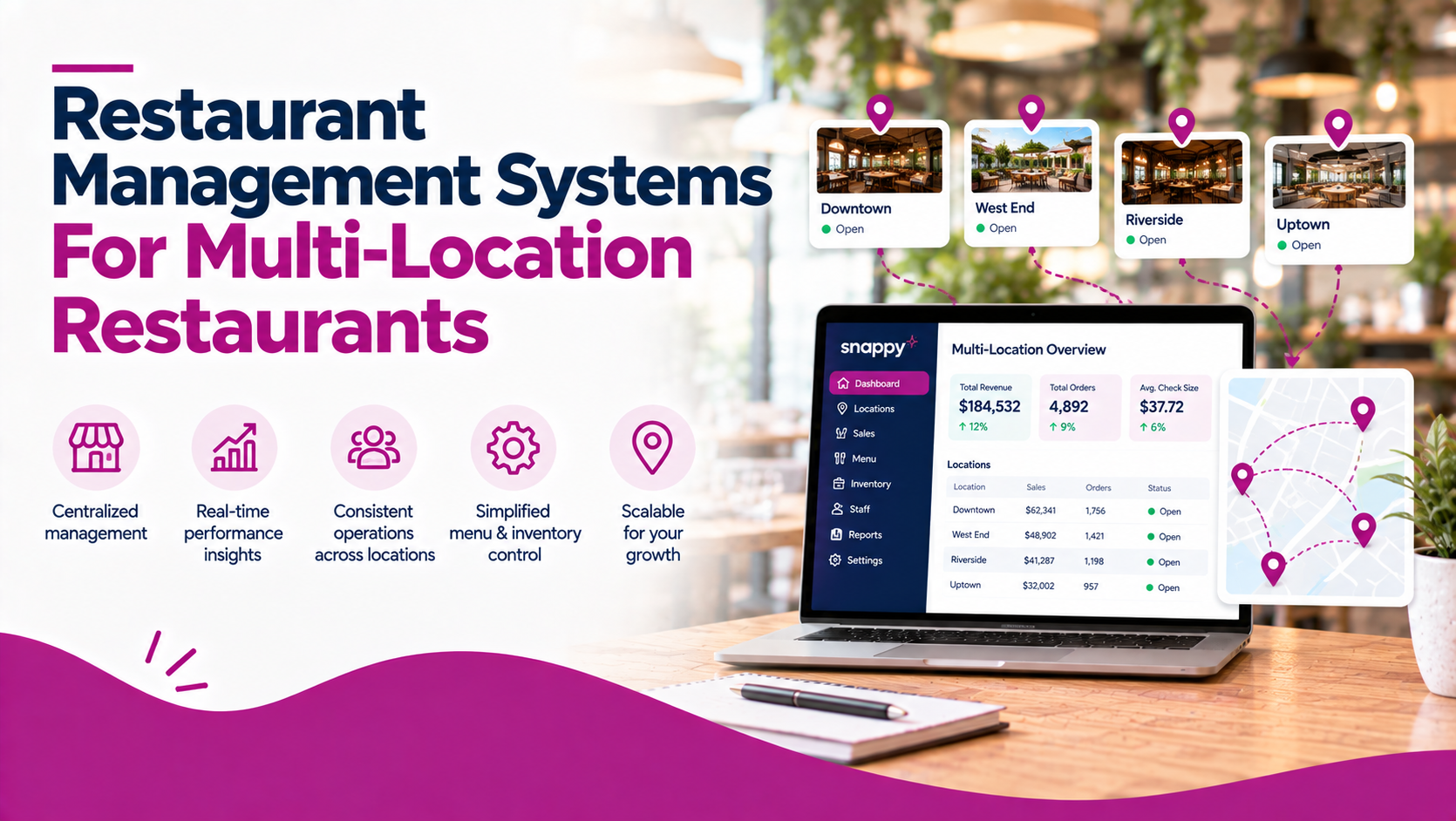
A multi-location restaurant management system can centralize much of this information.
For example, Toast’s multi-location management tools provide centralized reporting and allow operators to compare performance at the group or individual-location level.
Snappy similarly describes centralized sales data and a dashboard that provides a view of sales performance across restaurant locations.
The goal is to give corporate operators one operational picture of the business while retaining the ability to manage individual locations.
Choosing restaurant management software for a growing restaurant group requires looking beyond basic POS functionality.
Centralized Management
Corporate teams should be able to manage important settings without logging into every restaurant individually.
This can include:
Location-Level Flexibility
Centralization doesn’t mean every restaurant should operate identically.
A restaurant in one city may need different:
A good multi-location system should allow corporate standards while preserving location-specific control.
Centralized Reporting
Reporting becomes increasingly important as a restaurant group expands.
Corporate teams may want to compare:
Snappy’s Analytics & Reporting product is designed to centralize sales data into one dashboard and includes franchisee management, product mix, and sales summaries.
Online Ordering
Multi-location restaurants should also consider how online ordering is managed.
A system should ideally allow restaurants to maintain their direct ordering presence while managing menus and orders across locations.
Customer Management
Multi-location restaurants can accumulate large amounts of customer data.
A centralized system can make it easier to connect:
AI and Automation
AI is becoming another important consideration.
Instead of requiring corporate teams to manually review reports from every location, AI can help identify patterns and surface operational opportunities.
Snappy Intelligence is designed to apply AI across restaurant sales, labour, customer service, inventory, and decision-making. It can provide insights across sales, labour, products, and locations in one place.
| Feature | Snappy | Toast | Square | Lightspeed |
|---|---|---|---|---|
| Multi-location management | ✓✓✓ | ✓✓✓ | ✓✓ | ✓✓✓ |
| Centralized reporting | ✓✓✓ | ✓✓✓ | ✓✓ | ✓✓✓ |
| Location-specific menus | ✓✓✓ | ✓✓✓ | ✓✓ | ✓✓✓ |
| POS & payments | ✓✓✓ | ✓✓✓ | ✓✓✓ | ✓✓✓ |
| Online ordering | ✓✓✓ | ✓✓✓ | ✓✓✓ | ✓✓ |
| Delivery integrations | ✓✓✓ | ✓✓✓ | ✓✓✓ | ✓✓ |
| Reservations & waitlist | ✓✓✓ | ✓✓ | ✓ | ✓✓ |
| Loyalty & customer management | ✓✓✓ | ✓✓ | ✓✓✓ | ✓✓ |
| Marketing & CRM | ✓✓✓ | ✓✓ | ✓✓✓ | ✓✓ |
| AI & intelligent insights | ✓✓✓ | ✓✓✓ | ✓✓ | ✓✓ |
| Voice ordering / AI phone agent | ✓✓✓ | ✓ | ✓ | ✓ |
| Inventory & demand insights | ✓✓✓ | ✓✓ | ✓✓ | ✓✓✓ |
| Staff & shift management | ✓✓✓ | ✓✓✓ | ✓✓ | ✓✓✓ |
| All-in-one restaurant platform | ✓✓✓ | ✓✓✓ | ✓✓ | ✓✓✓ |
Rating key: ✓ = available/basic capability ✓✓ = broader capability ✓✓✓ = extensive capability or deeper integration. Ratings are editorial comparisons based on publicly described product capabilities and may vary by plan, configuration, location, and integrations.
Snappy is positioned as an all-in-one restaurant technology platform designed to help restaurants increase sales, streamline operations, and bring customers back. Its product suite is modular, allowing restaurants to start with individual products and add additional capabilities as their needs evolve.
For multi-location restaurants, this approach can be particularly relevant because operators may not want to replace every part of their technology stack at once.
Snappy platform includes:
Snappy is a platform that allows operators to manage and track orders in one system and get a broader view of sales performance across restaurant locations.
This is important for restaurant groups because the goal isn’t simply to install the same POS at every restaurant.
The goal is to create a connected operating environment.
Enterprise Menu Management
Snappy’online ordering product includes Enterprise Menu Management, allowing restaurant groups to manage their menus across their operations.
This can help reduce the administrative burden of maintaining menus across multiple locations.
Analytics and Reporting
Snappy Analytics & Reporting product is designed to centralize sales data and provide reports through one dashboard.
Its published capabilities include:
For multi-location operators, centralized reporting can make it easier to compare locations and identify differences in product and sales performance.
Customer Management Across Locations
Snappy also combines operational systems with customer-facing products.
Its platform includes loyalty, gift cards and memberships, marketing, customer profiles, and reputation management.
This creates the possibility of managing the customer relationship alongside restaurant operations instead of maintaining completely separate systems.
Snappy Intelligence
One of the biggest points of differentiation for Snappy is Snappy Intelligence.
Rather than treating AI as a standalone chatbot, Snappy describes its AI platform as being embedded into core restaurant functions.
The platform applies AI to:
Snappy Intelligence is designed to:
Increase sales through personalized recommendations, upselling, and targeted offers
Automate phone calls, reservations, customer questions, and repetitive tasks
Forecast demand and flag inventory issues
Provide insights across sales, labour, products, and locations
For a multi-location restaurant group, the ability to analyze information across locations can be particularly useful because corporate operators are dealing with substantially more data than a single-unit restaurant.
Voice Automation
Snappy’s Voice Agent can handle phone orders, reservations, and general inquiries, with the company describing the service as available 24/7 and in multiple languages.
Its broader Snappy Phone product is also designed to convert missed calls into reservations and online orders while reducing staff interruptions.
For restaurant groups with high call volumes across multiple locations, this type of automation can become an operational consideration rather than simply a customer-service feature.
Multi-Location Customer Experience
Snappy’s published customer examples include multi-location operators.
One testimonial on the company’s site describes Snappy being used across four locations, while another describes a group using Snappy across six locations and additional sister locations.
These are customer statements published by Snappy and should be viewed as testimonials rather than independent performance evidence.
Toast offers a broad restaurant technology ecosystem and dedicated multi-location management capabilities.
Toast’s multi-location management tools provide centralized controls for menus, reporting, operational settings, and other configurations.
Centralized Menu Management
Toast allows operators to build menus and publish them to selected locations.
Restaurants can maintain different menu versions and location-specific pricing while still managing those menus centrally.
This is useful for restaurant groups that want a common brand menu but need local flexibility.
Centralized Reporting
Toast provides reporting at both the group and location level.
Operators can compare sales categories and product performance across locations while also drilling down into individual restaurants.
Operational Controls
Toast also supports centralized configuration for operational settings.
Its multi-location management capabilities include workflow templates, discount and permission controls, and location-level tax configuration.
Toast Restaurant Management
Toast’s multi-location capabilities are part of its broader Restaurant Management offerings.
Toast states that Multilocation Management allows shared configurations to be managed across restaurants and is available within its Restaurant Management Pro and Enterprise suites.
For larger organizations, this makes Toast a platform to consider when centralized control and enterprise-level restaurant management are priorities.
Square provides multi-location functionality through its broader commerce and restaurant ecosystem.
Square allows businesses to create multiple locations under a single account and provides location-specific business profiles, reporting, devices, and other management capabilities.
Location-Level Reporting
Restaurants can manage reporting by location, allowing operators to see performance at an individual restaurant rather than only viewing consolidated business data.
Menu Management
Square’s multi-menu management allows operators to control how menus appear across:
It also supports location-specific offerings and time-based availability.
Online and Offline Commerce
Square’s broader platform can connect restaurant operations with other business functions.
For restaurants already using Square, the ability to manage multiple locations within the same ecosystem can reduce the need for completely separate technology environments.
Lightspeed Restaurant provides multi-location management for restaurant groups that need centralized control over products, menus, reporting, and other restaurant settings.
Lightspeed’s multi-location functionality allows operators to create products, modifiers, discounts, and service charges centrally and propagate them to other locations. It also supports combined reporting across locations.
Location Management
Lightspeed’s current Locations Manager allows multi-location businesses to create menus and items once and synchronize them across sites while allowing individual locations to maintain local variations.
Shared Customer Data
Lightspeed also describes shared customer data across locations as part of its multi-location restaurant capabilities.
For groups that want a centralized POS environment while maintaining location-specific operations, Lightspeed is another option to evaluate.
A multi-location restaurant management system is software that allows restaurant groups to manage multiple restaurants from a connected technology environment.
Depending on the platform, this can include POS, menus, reporting, online ordering, payments, labour, customer management, loyalty, marketing, and other restaurant functions.
Centralized management and reporting are among the most important capabilities.
Restaurant groups need to be able to see performance across locations while still maintaining appropriate location-level control.
Yes. As the number of locations increases, comparing sales and operational performance manually becomes increasingly difficult.
Centralized reporting allows corporate teams to compare locations while managers can focus on their individual restaurants.