

Wilson Wu
Chief Revenue Officer, Snappy
November 2, 2026·11 min read
A Surrey or Delta South Asian restaurant, dhaba or sweet shop does not have one busy season. It has a weekly peak every weekend, a festival peak a few times a year, and a catering peak that follows your customers’ family calendars. The ordering setup that works year-round is the same in every case: a published order page with set quantities, a deposit on anything big, a pickup time on every order, and a phone line that does not drop a call while the counter is full.
Diwali is on November 8 this year, so next week is the pressure test. The rest of this guide is the plan for the other fifty weeks.
Imagine your shop is a school bus with a fixed number of seats. On a normal day the bus is not full, so you can take anyone who walks up. Before a festival or a wedding, a hundred families all want a seat at the same moment, and the bus can only leave once. A pre-order is a ticket: it says how many seats, what time the bus leaves, and that the seat has been paid for. When tickets are sold ahead of time, the driver knows exactly how many people are coming and nobody is left standing at the door.
Because the expensive failure is not a slow day, it is a peak you could not absorb. When 212,680 South Asian residents live in one city (Daily Hive) and a single parade draws more than 450,000 people (Global News), demand arrives in waves your counter and your phone were not built for.
Most owners prepare for Diwali because it is loud and obvious. The quieter peaks cost more over a year: the Saturday when three large tray orders arrive in the same hour, the wedding enquiry that lands while you are plating, and the family order that never gets confirmed because nobody picked up. Our guide to Indian restaurant catering and large group orders covers the catering side. This one is about the system under all of it.
One honest limit: we could not find published data on how many weddings Punjabi families in Surrey hold in any given month, or what a typical guest count is. So we do not tell you which months are your wedding peak. Look at your own tickets, find the three or four months when large orders cluster, and mark them. That calendar is yours.
How many orders came in by phone last weekend?
Bring a busy weekend and we will look at which orders could have come in online, with the details already filled in.
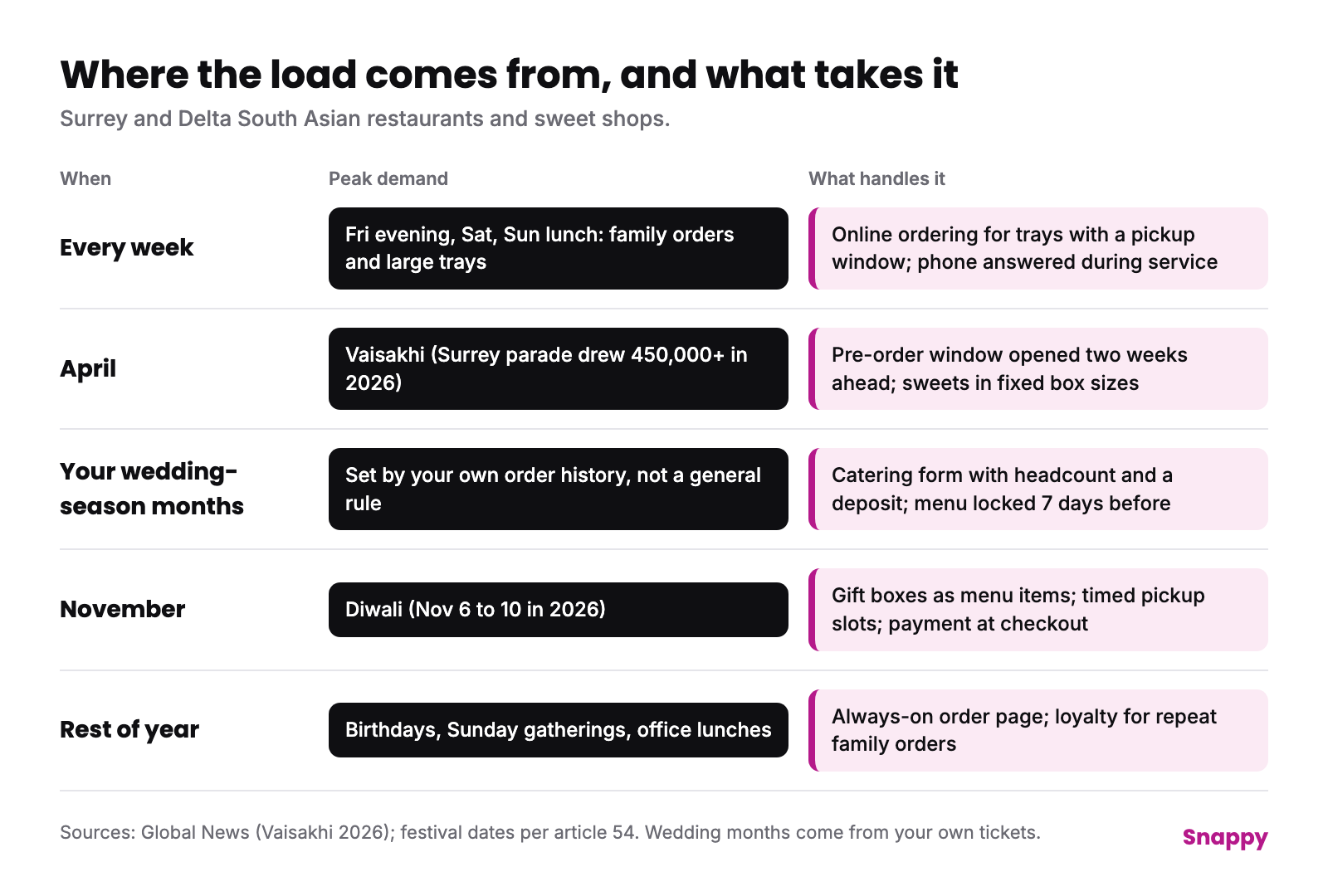
Review my weekendEach peak needs a different tool, which is why one fix does not cover all of them. The table maps the recurring ones.
| Peak | When | What breaks | What takes the load |
|---|---|---|---|
| Weekend family orders and trays | Every Friday to Sunday | The phone rings during dinner service; trays are promised with no pickup time | An order page with tray sizes as items and a pickup window |
| Vaisakhi | April; the 2026 Surrey parade drew over 450,000 (Global News) | A sudden spike in sweets and takeout around the parade route | A pre-order window opened a couple of weeks ahead |
| Wedding-season catering | Your own cluster of months | Headcounts change after the deposit; menus drift | A catering form with headcount, deposit and a menu-lock date |
| Diwali | November 6 to 10 in 2026 (HinduTone) | Gift boxes, corporate trays and dietary questions land on the same phone | Boxes as menu items, timed pickup, payment at checkout |
| Weekend tiffin and regular large family orders | Weekly, if you run them | Repeat customers re-explain the order every time | A saved order template and a repeat-order link, plus loyalty |
Sell fixed quantities, not open-ended weights. A customer asks for “a kilo of mixed barfi,” which means you have to decide the mix, the packing and the price on the phone. A published order page with a 250 g box, a 500 g box and a 1 kg box turns that into a menu item that prints on a ticket and can be packed ahead of time.
Where a product genuinely sells by weight, check whether your system can charge by weight before you rely on it. If it cannot, publish set box sizes online and keep the loose-weight sales for the counter. The goal is that nothing on the online page requires a conversation to price.
Three habits make this work:
On any order large enough that a no-show would hurt, take payment or a deposit before you start. The size is yours to set, not a rule. As an illustrative example only: a 100-guest catering tray order at $18 a head is $1,800, and a 25% deposit is $450, which covers most of the raw ingredients you commit on day one.
The principle is simple. A deposit separates a real order from an enquiry, and it protects the one who says yes. Put the refund terms in the same place as the price so nobody argues about them later.
On the phone side, Snappy AI Phone Ordering requires Snappy Online Ordering, takes the complete order, collects payment up front through a link and prints straight to the kitchen (Snappy). That is the mechanism that stops a verbal order from being a promise with no money behind it.
A pickup window turns a rush into a schedule. Without one, every customer arrives at 5:45 p.m. because that is when they finish work. With one, you can see that four trays are due between 5:30 and 6:00 and staff accordingly.
Set windows in blocks you can actually produce, such as 15 or 30 minutes, and cap the number of large orders per block. Print the window on the kitchen ticket and on the customer’s confirmation. When you run Snappy POS, online orders land in the same order flow the counter uses, and the kitchen display system routes tickets to kitchen stations (Snappy), so the person at the stove reads one ticket, not three channels. Whichever system you choose, Snappy included, test pickup windows, slot caps and deposits on your own menu before you commit.
Phone is how many of your customers order, and the person who calls often wants to speak in the language they use at home. That is a staffing question first. Make sure someone on every shift can take an order in the languages your customers use, and write the order down in the same format whoever takes it.
The phone also has to survive the rush. Snappy AI Phone General Inquiries has no prerequisite and answers every call from your own FAQ, with no bandwidth cap and nobody put on hold (Snappy). Hours, address, parking, tray sizes and how to place a big order are all answers a caller can get without tying up a person.
We do not state that Snappy’s AI phone line handles Punjabi or Hindi callers, and we do not state that our Vancouver team has a Punjabi-speaking representative. If language support is the deciding factor for you, ask our team directly what is available today and get it in writing. Our piece on what a restaurant loses when the phone rings during the rush shows the cost of the call that goes unanswered.
BC’s PST page for food and beverage service providers says sales of food for human consumption are exempt from PST, including meals and snack foods, and that catering services such as menu planning, preparing, plating and serving food are not subject to PST (Government of British Columbia). The same page says goods a client keeps after an event can be taxable, and it lists a 10% PST on liquor.
The practical point for a sweet shop is to set tax per item category in your system and confirm each category with the Ministry of Finance or your accountant, rather than assuming. A gift box that includes a non-food keepsake can be treated differently from the sweets inside it. GST is a separate question again, so check that too. We are not tax advisors, and this is a place to verify with a professional.
Usually not on the biggest orders, because the fee is a percentage of a large number. The Food Delivery Service Fee Act caps what a delivery company can charge a BC restaurant at no more than 20% of the order’s dollar value, effective January 1, 2023, and the province noted fees had reached as high as 30% during the pandemic. Delivery companies may still offer optional enhanced services you opt into (Government of British Columbia).
Run the numbers on your own order. On a $1,800 catering order, the 20% ceiling is $360. On your own ordering page, there is no per-order commission, because Snappy Online Ordering is commission-free (Snappy). Our OWA savings calculator guide shows the comparison for your volume.
Five pieces, in this order:
If you run Snappy POS, online orders flow to the same kitchen the counter uses. Ask our team for the full monthly cost in writing, as you would from any vendor.
The 2021 census counted 212,680 South Asian residents in Surrey, the city’s largest group, and 369,295 across Metro Vancouver, about 14% of the region (Daily Hive).
Sunday, November 8, with the five-day festival running November 6 to 10 in Canada (HinduTone).
BC’s guidance says food for human consumption, including snack foods, is exempt from PST (Government of British Columbia). Confirm how your specific products and gift packaging are treated with the Ministry of Finance or an accountant.
No more than 20% of the dollar value of an order, under the permanent cap in effect since January 1, 2023, with optional paid services on top (Government of British Columbia).
We do not state that it can. Snappy AI Phone General Inquiries answers calls from your own FAQ, and AI Phone Ordering takes full orders with payment up front, but ask our team which languages are supported today.
On any order where a no-show would cost you real money, yes. Set the threshold and the percentage yourself, and publish the refund terms with the price.
Your calendar has peaks every week, every season and every family milestone, and the setup for all of them is the same: fixed quantities, a deposit, a pickup window and a phone that is always answered. Build it once before the next peak and it carries every one after.
Call our team at 1-855-818-0058 and tell us which month hurts most. We will show you the lightest setup for it. Book a demo.
Book a walkthrough
Ready before the next festival week?
Book a walkthrough and we will look at your menu, your busiest weeks and how big family orders reach the kitchen.
Written by
Wilson Wu
Chief Revenue Officer, Snappy
Wilson Wu is Chief Revenue Officer at Snappy, the restaurant technology company, and is based in Boston. His first job was in a restaurant kitchen, and he has spent his career since at the intersection of hospitality and software, working with operators across Canada on the systems their service runs on. He also builds the technology he writes about. His engineering work includes a per-location customer service agent that answers guests with a restaurant's real hours, menu and prices, deployed with independent restaurants, and a document-extraction model that reads supplier invoices and matches invoice numbers against what is owed. He writes here about what changes on a busy service: ordering, payments, loyalty, the phone, and the Canadian rules behind them. He holds an MBA from Duke University and a Master of Science in Computer Science from Georgia Tech.
Connect on LinkedInNo-obligation walkthrough
Big orders still coming in by phone?
See how pre-orders and pickup times can arrive online, already written down.
On this page
Get The Latest Restaurant Data, Trends & Tips
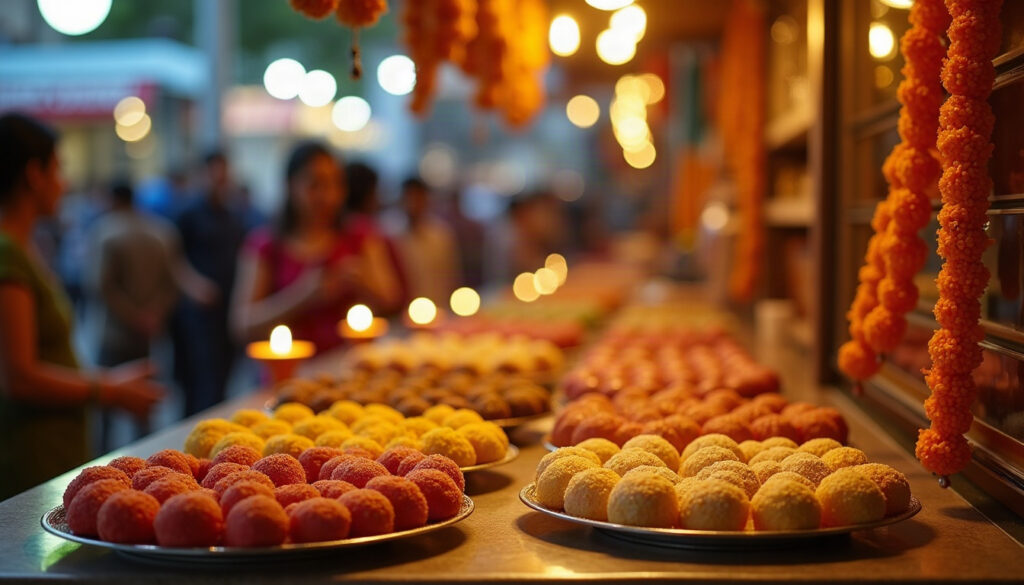 Diwali Pre-Orders: How Surrey Mithai Shops and South Asian Restaurants Handle the Seasonal Surge Without Extra Phone Lines
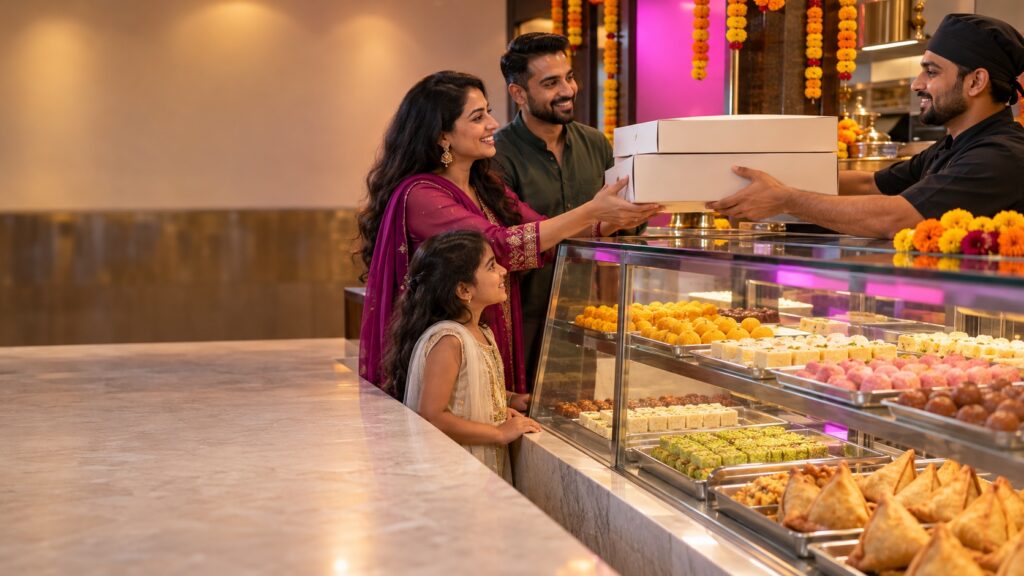 Restaurants et confiseries sud-asiatiques de Surrey et Delta : un guide de la commande toute l’année
Précommandes de Diwali : comment les boutiques de mithai et les restaurants sud-asiatiques de Surrey gèrent la pointe saisonnière sans ligne téléphonique supplémentaire


