
Wilson Wu
Chief Revenue Officer, Snappy
September 17, 2026·15 min read
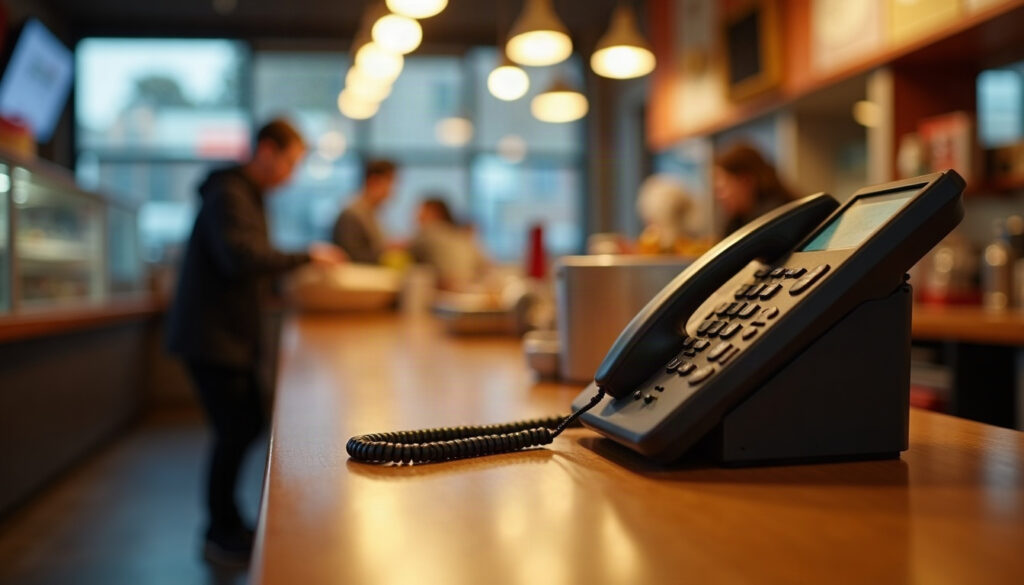
A phone call at 6:45 PM costs you twice. The call nobody answers is revenue that leaves quietly. The call somebody does answer pulls a server off the floor, parks a guest on hold, and lands as a scribbled note that gets re-keyed into the register later. Most operators only ever price the first one.
Summary
On this page
Watch one call end to end and you stop arguing about whether the phone matters. A server three tickets deep hears the ring, finishes pouring, walks to the host stand, and picks up on the fifth ring. That walk is the first cost, and nothing about it appears in any report.
The caller wants something small: are you open until ten, do you have parking, can you do the noodles without fish sauce. The server answers, comes back, and now has to remember where they were on table 14. The cost is not the ninety seconds. It is the reset.
Then there is the other version, the one that answers why phone orders go wrong more often than app orders. The caller wants to order, and the server does not have a terminal at the host stand, so the order goes onto a notepad. Later, somebody types it into the register. Every re-entry point is a place a modifier can quietly disappear, and modifiers are exactly what a phone caller is most likely to ask for.
Picture two counters. In a suburban plaza takeout shop, the phone rings at the same counter that is bagging pickup orders and running the register. In a downtown dining room, the same call lands on the host stand while two parties wait to be seated. Same phone, two different bottlenecks, and one shared symptom: the person answering was doing something else.
How many calls is your restaurant actually missing at peak? Nobody outside your building can give you that number, because the real answer is a short formula built from your own data: missed calls per week, times 52, times the share trying to order or book, times your own average phone ticket. Industry-wide averages are fine for arguing at a conference and useless for deciding whether to spend money this September.
Your own number takes about twenty minutes and one report, and it is the only version that will survive a conversation with your accountant.
Here is the whole calculation. Missed calls per week, times 52, times the share of those calls that were trying to order or book, times your own average phone ticket.
Work it once with real inputs. Say your phone system reports 15 missed calls in a week. That is 15 x 52 = 780 calls a year that never reached anyone.
If roughly a third of them were trying to order rather than ask a question, that is 780 x 0.33 = 257 orders nobody took, and you already know what a takeout ticket is worth in your store. Multiply those two and you have a defensible figure built entirely out of your own data.
Each input has a source, and each one has a way of going wrong.
| Input | Where you get it | What to watch for |
|---|---|---|
| Missed calls per week | Your phone system's inbound, answered and abandoned report | Pull a full week, not a busy day. Look at the hour band, not the total |
| Share trying to order or book | A three-day tally sheet at the counter or host stand | Owners overestimate this. Questions are usually the biggest bucket by volume and the smallest by revenue |
| Average phone ticket | Your own order history, phone orders only | Phone tickets and app tickets are rarely the same size. Do not borrow the app number |
| Staff minutes per call | Time ten calls during service, including the walk there and back | This is the number that changes minds, and it is the one nobody measures |
Your format decides which half of the problem to care about. A takeout counter where most tickets arrive by phone is losing revenue every time the line rings out during the rush. A dining room that answers nearly everything is not losing calls at all; it is losing floor time to holds. Pull your own report before you assume which restaurant you are running, because the fix is different in each case. Our blog post on the cost of missed phone calls for restaurants shows similar calculations worked through.
Because the cost moves from the caller to the floor, where it is harder to see. A missed call is invisible and free in the moment. An answered call spends your scarcest resource at the worst possible minute.
Hold time is the part operators never price. Time ten of your own holds during a Friday service and multiply. If the average comes back at a minute, twelve holds in one service is 12 x 60 = 720 seconds, roughly twelve minutes of guests sitting in silence on your line, in a single service. More calls make that number bigger, not smaller. Nothing about that figure is a benchmark. It is your restaurant, measured.
That is only the caller side. So what does the staff side actually cost you?
It is the walk to the phone, the call itself, the note, the re-entry into the register, and the return to a table that has moved on without you. The hold clock is a floor on the disruption, not the total.
The labour market makes this worse rather than better. 54% of operators cited a shrinking labour pool as their biggest concern in attracting and retaining talent in the year ahead, in a survey of 253 restaurant franchise leaders (Nation’s Restaurant News, US data).
The same survey found labour efficiency, training and scheduling were the top areas where AI could be of use (40%), ahead of customer data analysis and trend predictions (34%) and customer experience and personalization (28%) (Nation’s Restaurant News, US data). When you are already one person short on a Friday, the phone is not a small tax. It is the person you did not hire being asked to do a second job.
What Is the Rush-Hour Phone Call Actually Costing Your Floor?
Bring a week of your own call report and phone tickets, and we will walk through what the missed calls and the answered ones are each costing your floor, line by line.
Show Me My Rush-Call CostFour different callers hit the same handset, and they do not cost the same thing or need the same fix. Sorting one week of calls into these four buckets is the single most useful hour you can spend before you talk to any vendor.
| Caller wants | What it costs you today | What actually solves it | Where the result has to land |
|---|---|---|---|
| A question (hours, parking, allergens, halal, patio) | Pure interruption. No revenue attached, and the same five answers repeat all day | An assistant that answers from your own information, every time, with no hold | Nowhere. Nothing is written, which is why this is the lowest-risk place to start |
| An order | The highest-value interruption, and the one most likely to be re-keyed with a missing modifier | Full order capture with modifiers and payment handled before the ticket prints | Your online ordering system and the kitchen, with no retyping |
| A booking | Lands on the host stand at exactly the moment two parties are waiting to be seated | Concurrent booking capture, so five callers at 7 PM are five bookings, not one booking and four voicemails | The same reservation dashboard the host stand is already looking at |
| A wait time | Repeated twenty times on a Saturday, and every answer is a guess unless the floor is tracked | A digital waitlist that quotes and confirms without a human doing the arithmetic | The waitlist the floor runs on, so the quote matches reality |
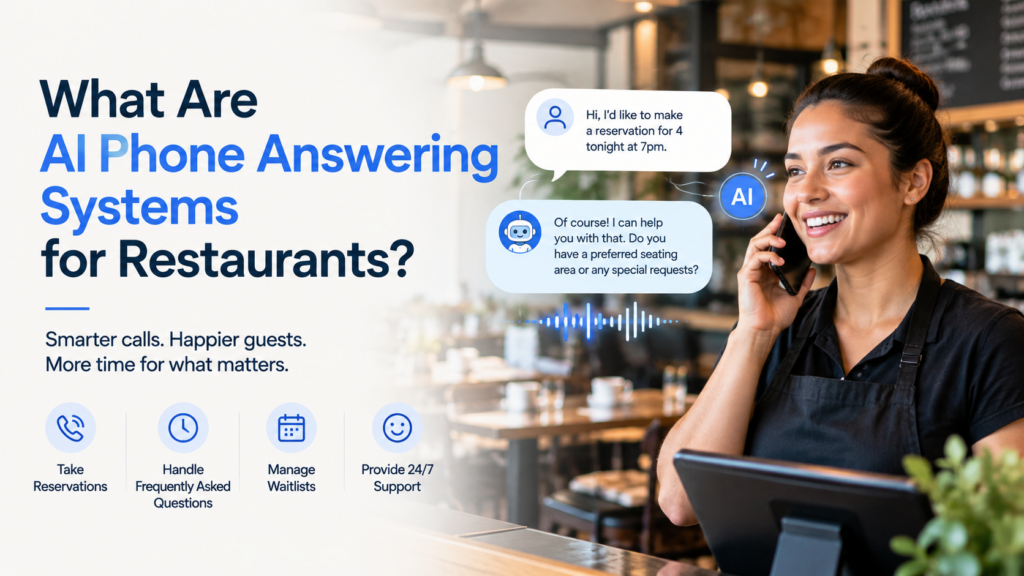
Snappy sells the phone side of this as three products, and the prerequisites matter when you are budgeting. AI Phone General Inquiries has no prerequisite: it answers every call from your own FAQ, never puts a caller on hold and requires no other Snappy product. AI Phone Ordering requires Snappy Online Ordering: it takes every call at once, captures the complete order, collects payment up front through a link, and prints straight to the kitchen. AI Phone Reservations requires Snappy Reservation and books into the same reservation dashboard the host stand runs on. Snappy also runs a digital waitlist alongside reservations, which is the answer to the fourth row.
The product page describes two modes rather than one. In AI voice mode, the assistant will “answer every call immediately with a natural AI voice” and route to staff when a human touch is needed. In missed-call mode there is “automated SMS fallback for any unanswered calls”, where the guest instantly receives an SMS that links to online ordering or reservations and completes the action with no staff involved (Snappy).
Do you actually need an AI phone line for your restaurant? Snappy’s rule of thumb: ten or more calls a day is enough to justify one at all, and thirty to fifty or more ordering calls a day, or fifty or more booking calls, makes you a heavy user who should be looking at the full set rather than the SMS fallback alone.
You do not have to take anyone’s word for how AI phone answering systems sound in a real restaurant. Snappy keeps four demo lines open, and they are the fastest due diligence in this category. Call them from your own phone, in a noisy room, the way your guests actually call you.
| What the caller wants | Demo line | Number | What to try | What to listen for |
|---|---|---|---|---|
| A question | General Support | +1 647 496 1372 | Ask about parking, then ask for a person | Does it answer from the restaurant's own facts, and does it hand off cleanly when you ask |
| A table | Reservation | +1 289 276 8745 | Book a party of six for Saturday | Does it confirm date, time, party size and name back to you |
| An order | Pizza AI Ordering | +1 289 301 4075 | Order a half and half, then change one topping halfway through | Does it capture every modifier and explain how payment works |
| A wait | Waitlist | +1 289 278 8978 | Add a party of four | Does it quote a wait and confirm you are on the list |
Try to break them. Talk over the assistant. Use an accent. Ask for something that is obviously not on a menu. Change your mind. Ten minutes of that tells you more about a phone product than an hour of slides, and it costs you nothing but the call.
Listen for three things, in this order, on every line: the handoff to a human when you ask for one, whether the result writes into the system your floor already runs, and how the assistant recovers when you talk over it or change your order.
First, the handoff. Ask for a human. A phone assistant that will not let go of a caller is worse than voicemail, because the guest now has a story to tell about it. Snappy’s product page states that calls route “to staff only when a human touch is needed” and that callers can request to speak to staff and be routed accordingly (Snappy). Test that claim on the demo line rather than reading it.
Second, the write-back. On the reservation and ordering lines, ask yourself where the result would land in your restaurant. If a booking taken by an assistant has to be retyped by a host, you have added a step instead of removing one. The whole point of putting the phone inside the system your floor already runs is that nobody retypes anything.
Third, the recovery. Deliberately confuse it. Talk over it, change your order halfway through, ask for something that is not on the menu. This is the part of the category that varies most, and it varies by setup rather than by category: the same underlying technology sounds either competent or useless depending on how carefully somebody built the flows for a specific restaurant, with a specific menu and specific hours. You cannot read that off a website. You can hear it in about ninety seconds on a live line, which is why the demo numbers above are worth more to you than any comparison chart.
Seven days of your own data beats any industry benchmark, and the exercise has four steps: pull your call report, tally the four call types for three days, time ten calls during service, and count how many phone orders got re-entered by hand.
Pull the call report. Most business phone systems will give you inbound, answered and abandoned calls by hour. Print one week. You are looking for the hour band where answered drops and abandoned climbs, which in most restaurants sits between 5:30 PM and 8 PM.
Tally the four buckets. For three of those seven days, keep a sheet at the host stand or the counter with four columns: question, order, booking, wait. One tick per call. The mix is what decides which product you need, and the mix is almost never what the owner guesses.
Time ten calls. Have whoever answers note the start and end of ten calls during service, and add the walk to the phone and the return to the floor. Multiply the average by your weekly call count. That is staff time, priced at your real labour rate, and it is usually the number that moves an owner more than the lost-revenue estimate.
Count the re-entries. How many phone orders were written on paper and typed into the register a second time this week. Every one of those is an error opportunity you are paying somebody to create.
Now you have four numbers of your own: calls lost at peak, the call mix, staff minutes on the phone during service, and manual re-entries per week. If your busiest problem is walk-ins and wait quotes rather than the phone, our comparison of restaurant waitlist management systems is the better next read, and pizza counters should start with the pizza POS breakdown instead.
There is no credible universal answer, and this is a figure to calculate rather than to quote. Take missed calls per week from your phone system’s report, multiply by 52, multiply by the share of those calls that were trying to order or book, and multiply by your own average phone ticket. Fifteen missed calls in a week works out to 15 x 52 = 780 unanswered calls a year before you apply your own ticket, and that is a number you can defend.
Not on its own. A restaurant that answers nearly every call can still be paying for the phone in floor time: the walk to the handset, the hold, the note, the re-entry into the register, and the return to a table that has moved on. Answer rate only measures whether the caller reached a person. It says nothing about what that person stopped doing to reach them.
Yes. Snappy runs four public demo lines: General Support +1 647 496 1372, Reservation +1 289 276 8745, Pizza AI Ordering +1 289 301 4075 and Waitlist +1 289 278 8978. Call them before you talk to anyone in sales.
That depends on how you set it up. Snappy’s product page describes both modes: the assistant can answer every call immediately with a natural AI voice, or sit behind your team as an automated SMS fallback for any unanswered calls (Snappy).
Inbound, answered and abandoned calls by hour for one full week from your phone system’s report, a three-day tally of the four call types, and the minutes your staff spent on the phone during service. Bring those to any vendor conversation and it stops being a sales pitch.
The phone costs a restaurant twice, and most operators only count once. The call nobody answers is measurable the moment you pull the report, and until you pull it you are guessing. The call somebody does answer is the one hiding in plain sight: a server off the floor, a guest on hold, a modifier lost between a notepad and the register.
Fix it in the order your own data suggests. Measure one week. Sort the calls into questions, orders, bookings and waits. Then decide whether you need an assistant that only answers, one that writes orders into the kitchen, or one that books into the same screen the host stand already uses. The mix chooses the product, not the demo.
Called all four demo lines? Bring your one-week call log and we will price the interruption against your own numbers. Talk to our team.
Book a walkthrough
You Called the Demo Lines. Price Your Own Rush-Hour Calls.
Bring the call report from your phone system and a tally of your own call types, and we will walk through what each type of call is doing to your floor.
Try it now: Pizza AI Ordering +1 289 301 4075 · Reservation +1 289 276 8745 · Waitlist +1 289 278 8978 · General Support +1 647 496 1372
Written by
Wilson Wu
Chief Revenue Officer, Snappy
Wilson Wu is Chief Revenue Officer at Snappy, the restaurant technology company, and is based in Boston. His first job was in a restaurant kitchen, and he has spent his career since at the intersection of hospitality and software, working with operators across Canada on the systems their service runs on. He also builds the technology he writes about. His engineering work includes a per-location customer service agent that answers guests with a restaurant's real hours, menu and prices, deployed with independent restaurants, and a document-extraction model that reads supplier invoices and matches invoice numbers against what is owed. He writes here about what changes on a busy service: ordering, payments, loyalty, the phone, and the Canadian rules behind them. He holds an MBA from Duke University and a Master of Science in Computer Science from Georgia Tech.
Connect on LinkedInNo-obligation walkthrough
Price What the Rush-Hour Phone Call Costs You
See what phone interruptions during your rush actually cost your floor, using your own call data.
On this page
Get The Latest Restaurant Data, Trends & Tips