
October 7th, 2026
Running a restaurant often means managing far more than food and service. Restaurants may rely on separate systems for point of sale, online ordering, payments, reservations, delivery, inventory, staff management, loyalty, marketing, and reporting.
An all-in-one restaurant management software platform brings many of these functions together into one connected technology ecosystem.
Instead of managing several disconnected systems, restaurant operators can use one platform to manage day-to-day operations, customer interactions, sales, and business performance.
The goal is simple: fewer disconnected tools, less manual work, better visibility, and a more consistent restaurant operation.
This guide explains what all-in-one restaurant management software is, what features restaurants should look for, and some of the leading platforms worth considering.
When evaluating all-in-one restaurant management software, restaurants should consider:
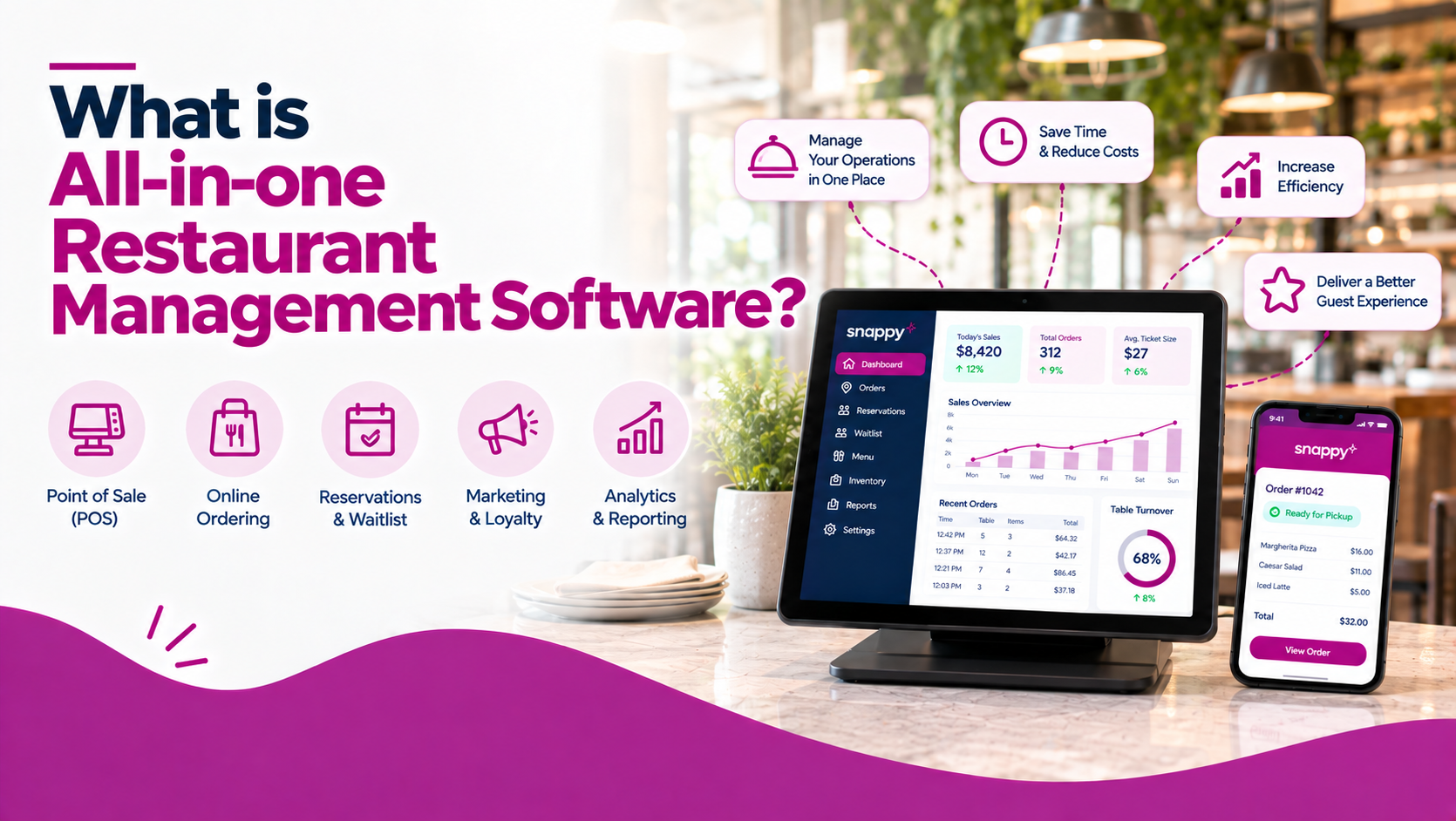
All-in-one restaurant management software is a technology platform that combines multiple restaurant systems into one connected solution.
A typical platform may include:
The exact combination varies between providers.
The biggest advantage is connectivity.
For example, when a customer places an online order, an integrated platform can send that order into the restaurant’s POS and kitchen workflow while also recording the transaction against the customer’s profile.
This can reduce duplicate data entry and give operators a more complete view of the business
Restaurant technology has traditionally been fragmented.
A restaurant might have one company handling its POS, another for reservations, another for online ordering, another for loyalty, and several delivery applications running alongside them.
Each system can provide useful functionality, but disconnected systems create additional work.
Restaurants may have to:
An all-in-one platform can reduce some of this complexity by connecting these functions.
The objective isn’t necessarily to replace every third-party application. Instead, it is to create a central operating system for the restaurant.
1. Point of Sale
The POS should be the operational foundation of the platform.
Restaurants should look for features such as:
The POS should also connect with the restaurant’s other technology rather than operate independently.
2. Online Ordering
Online ordering has become an important part of restaurant operations.
A strong all-in-one platform should allow restaurants to manage online orders alongside in-person orders.
Look for:
The key consideration is whether online orders flow directly into the restaurant’s existing operational workflow.
3. Payments
Payments should ideally be integrated directly with the POS and ordering system.
This can make it easier to manage:
Integrated payments can also reduce the need for employees to switch between separate systems.
4. Reservations and Waitlists
Full-service restaurants often need more than a POS.
Reservation and waitlist functionality can help restaurants manage:
Platforms such as TouchBistro position reservations, online ordering, payments, and POS as parts of their broader restaurant management ecosystem.
5. Inventory Management
Inventory can have a major impact on restaurant profitability.
All-in-one restaurant management software may connect sales data with inventory information to help operators understand:
Not every all-in-one platform provides the same depth of inventory functionality, so restaurants should evaluate this area carefully.
6. Staff and Labour Management
Labour is another major restaurant expense.
A restaurant management platform may include tools for:
Connecting labour information with sales data can give operators a better understanding of staffing requirements during different periods.
7. Customer Management, Loyalty and Marketing
An all-in-one platform can also connect restaurant operations with customer retention.
Useful features include:
This allows restaurants to use operational data to build longer-term customer relationships.
8. Analytics and Reporting
Restaurant operators need more than a sales total at the end of the day.
Good restaurant management software should help answer questions such as:
The more connected the underlying systems are, the more useful these reports can become.
9. AI and Automation
AI is becoming another important part of restaurant management software.
Instead of simply displaying historical information, AI can help identify trends and recommend actions.
Examples include:
This is particularly useful when AI is connected directly to restaurant workflows rather than existing only as a standalone chatbot.
There is no single platform that is perfect for every restaurant.
The right choice depends on restaurant type, location count, ordering channels, operational requirements, budget, and how much technology the restaurant wants to consolidate.
Some of the platforms worth considering include:
Best for: Restaurants looking for a broad all-in-one restaurant technology platform with POS, ordering, customer engagement, operations, analytics, and AI.
Snappy positions itself as an all-in-one restaurant technology platform designed to help restaurants increase sales, streamline operations, and bring customers back.
Its product ecosystem includes POS, online ordering, delivery, payment terminals, kiosks, dine-in QR ordering, reservations, waitlists, kitchen display systems, staff and shift management, loyalty, marketing, gift cards, analytics, reputation management, and more.
One of Snappy’s differentiators is Snappy Intelligence, which applies AI across restaurant sales, labour, customer service, inventory, and decision-making.
The company describes capabilities including:
Snappy says its AI is integrated into areas including POS, online ordering, reservations, waitlists, reputation management, analytics, and staff management.
For restaurants looking for an all-in-one platform that combines traditional restaurant management with AI-powered automation, Snappy is one of the options worth evaluating.
Toast
Best for: Restaurants looking for a broad restaurant-specific technology ecosystem.
Toast offers a restaurant technology platform covering areas such as POS, payments, online ordering, loyalty, gift cards, reservations and waitlists, scheduling, multi-location management, reporting, and Toast IQ.
Toast is particularly well suited to restaurants that want a restaurant-specific platform with a large ecosystem of hardware and software products.
Its platform can support both single-location and multi-unit restaurant operations.
The main consideration is how the restaurant wants to configure its Toast ecosystem and which products and integrations it needs.
Square for Restaurants
Best for: Restaurants looking for flexible restaurant POS and connected online ordering.
Square offers Square for Restaurants as an all-in-one restaurant POS solution with payments, online ordering, kitchen display, kiosks, reporting, and other restaurant tools.
Square also offers customer engagement features such as loyalty and marketing, while integrations can extend functionality into reservations, delivery, inventory, and labour management.
Square can be particularly attractive for restaurants that value flexibility and want to start with core POS functionality before adding additional tools.
Lightspeed Restaurant
Best for: Restaurants looking for cloud-based POS and operational flexibility.
Lightspeed provides restaurant POS and management technology designed to connect restaurant operations, reporting, inventory, customer information, and other workflows.
Lightspeed can be a strong option for restaurants that need configurable technology and integrations, particularly when restaurant operations extend beyond basic POS requirements.
Restaurants should evaluate which functions are native to their selected plan and which require integrations or additional products.
TouchBistro
Best for: Full-service restaurants looking for restaurant-focused POS and guest management tools.
TouchBistro describes its product as an all-in-one POS and restaurant management system built specifically for restaurants.
Its platform includes POS, payments, online ordering, reservations, staff management, reporting, menu management, and guest engagement solutions.
TouchBistro can be worth considering for restaurants where table service, reservations, guest engagement, and POS functionality are especially important.
| Platform | Best For | POS | Online Ordering | Reservations | Loyalty / Marketing | Analytics | AI / Automation |
|---|---|---|---|---|---|---|---|
| Snappy | All-in-one restaurant operations | ✓✓✓ | ✓✓✓ | ✓✓✓ | ✓✓✓ | ✓✓✓ | ✓✓✓ |
| Toast | Restaurant-focused ecosystem | ✓✓✓ | ✓✓✓ | ✓✓✓ | ✓✓✓ | ✓✓✓ | ✓✓ |
| Square | Flexible POS and ordering | ✓✓✓ | ✓✓✓ | ✓ | ✓✓✓ | ✓✓✓ | ✓✓ |
| Lightspeed | Flexible cloud restaurant management | ✓✓✓ | ✓✓ | ✓✓ | ✓✓ | ✓✓✓ | ✓✓ |
| TouchBistro | Full-service restaurants | ✓✓✓ | ✓✓ | ✓✓✓ | ✓✓✓ | ✓✓ | ✓✓ |
Rating guide: ✓ = basic capability, ✓✓ = broader capabilities, ✓✓✓ = advanced capabilities or deeper integration.
Note: Ratings are editorial comparisons based on publicly described capabilities. Actual functionality may vary by plan, configuration, location, and integrations.
1. Does it actually cover your most important workflows?
Don’t choose software because it has the longest feature list.
Identify the systems you currently use and determine which ones you actually want to consolidate.
2. How good are the integrations?
Even an all-in-one platform may rely on third-party integrations.
Check whether the integrations you need are available and how deeply they connect to the core system.
3. Does it work for your restaurant type?
A quick-service restaurant may prioritize kiosks, online ordering, speed, and delivery.
A full-service restaurant may care more about reservations, table management, handheld ordering, and guest profiles.
The best platform should fit the restaurant rather than force the restaurant into a particular workflow.
4. Can it support multiple locations?
If expansion is part of your plan, look at:
5. What is the total cost?
Look beyond the monthly software subscription.
Consider:
6. Can the platform grow with you?
A restaurant may start with one POS terminal and eventually need multiple locations, online ordering, loyalty, delivery, marketing, AI, and centralized reporting.
Choosing a platform that can grow with the business can prevent another technology migration later.
There is no single all-in-one restaurant management platform that is perfect for every restaurant.
Toast, Square, Lightspeed, TouchBistro, and Snappy all approach restaurant technology differently.
Ultimately, the right choice depends on your restaurant’s service model, number of locations, technology requirements, budget, and growth plans.
The best platform is the one that reduces operational complexity while giving your team better tools to sell more, operate efficiently, and build stronger customer relationships.
All-in-one restaurant management software combines multiple restaurant functions into one connected technology platform. These functions can include POS, payments, online ordering, reservations, inventory, labour management, loyalty, marketing, analytics, and AI.
The main benefits include fewer disconnected systems, centralized data, less manual work, easier reporting, simplified management, and more connected customer and operational workflows.