

Wilson Wu
Chief Revenue Officer, Snappy
October 10, 2026·15 min read
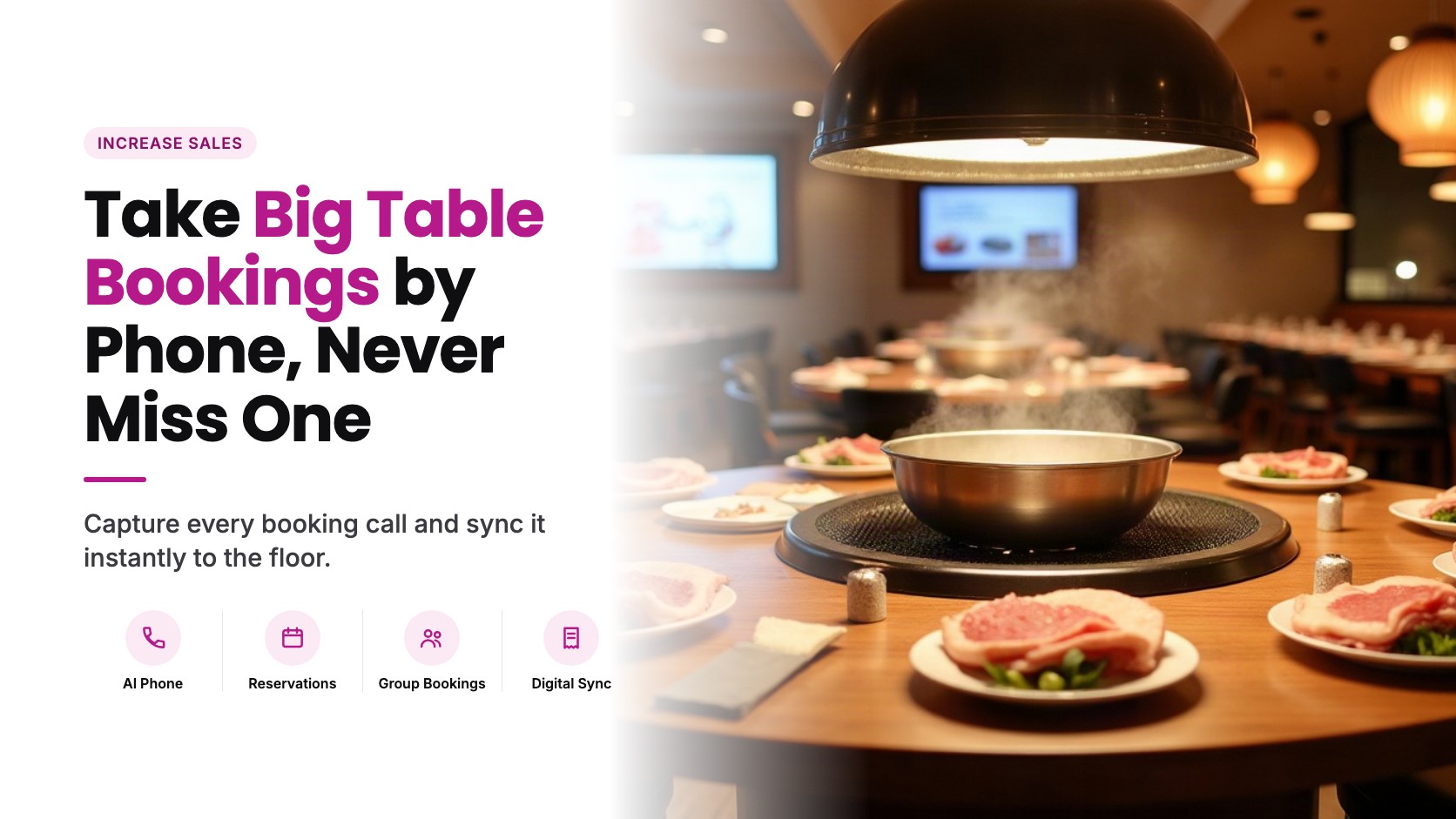
An AI phone reservations line is a voice service that answers every booking call at once, books the party into your live reservation book, and adds call-ahead walk-ins to the same waitlist your host stand runs. For a hot pot or Korean BBQ room built on twelve-tops and private rooms, that is the difference between a captured Saturday booking and a voicemail nobody returns.
Your highest-value call of the week is a party of 12 asking about a private room at 6:30 PM on a Saturday. It arrives at the exact minute your host is seating a queue, quoting a wait, and running two grills short. Here is what an AI phone line does with that call, and what to ask before you forward your number to one.
Summary
On this page
Because one call decides a whole room, not a table. A party of 12 for AYCE Korean BBQ commits a private room, a grill setup, a per-person price and a two-hour block of your busiest service. Losing that call is not losing a cover, it is losing a room.
These formats also carry more rules than a standard dining room, and the rules have to be explained on the phone before the guest commits. Look at what operators actually publish.
A downtown Vancouver Korean BBQ room states that “Dining time will be limited to 2 hours, commencing from the reservation time” and that “Reservations will be held for up to 15 minutes from the original reservation time” (Dae Bak Bon Ga). A California chain states “There is a 2 hour time limit from the time the first order is taken” and, in its waitlist rules, that “The whole party must be present in order to be seated” (Oz Korean BBQ, US data).
Those are two restaurants’ own posted policies, not an industry standard. One is a downtown Vancouver room, the other a California chain.
The point is the shape of the call, not the specific rule. A hot pot or AYCE booking call is a policy conversation: time limit, party size, deposit, whether every guest is doing the same AYCE tier. That takes minutes, and it happens at the worst possible minute.
Here is the illustration, with numbers you should replace with your own. A party of 12 at a $45 per-person AYCE price is 12 x 45 = $540 of covers riding on one phone call.
Before: the call goes to voicemail and the party books the room down the street, so the booking is worth $0 to you. After: the call is answered and written into your book, and the $540 is on the floor plan. One call, the entire difference.
Your format’s problem is probably not the ring. It is the hold.
A full-service room is not the classic missed-call story. Somebody almost always picks up, because the phone sits at the host stand and it is loud. That is exactly what makes the loss invisible: the call gets answered, so nothing in your phone log ever records it as missed.
So do not shop on somebody else’s average. Run your own hourly call log for one Saturday. Pull every call between 5:30 PM and 8:00 PM and sort it into three piles: answered and booked, answered and put on hold, and never picked up. The middle pile is the one nobody counts, and in a large-party room it is usually the expensive one. Read it in the right direction as you go: the busier the service, the bigger that middle pile gets, not smaller.
The hold is the more honest description of what a busy Korean BBQ host stand does. Nobody ignores the phone. Somebody picks it up, says “one moment”, puts the caller on a shelf, and goes back to seating the queue. The party of 12 hangs up and calls the next place, and you never see a missed-call log entry for it, because somebody did pick up. Our breakdown of the cost of missed phone calls for restaurants walks through pulling your own hourly call data before you shop.
It answers on the first ring, every time, no matter how many other lines are ringing, and it writes the result into your reservation book.
The mechanics are the same across the category. You forward your restaurant line to a number the vendor provides. A voice model answers using a knowledge base you supply: hours, private-room capacity, AYCE tiers, parking, time limits, deposit policy. Where products separate is what happens after the conversation ends.
Snappy’s AI Phone Reservations requires Snappy Reservation, and that prerequisite is the whole design: it answers every concurrent booking call and books into the same Reservation dashboard the host stand already runs on. Nothing is retyped, because there is no second system to retype it into. Snappy’s product page describes the same behaviour in guest terms: “Capture orders and reservations without staff involvement” and “Route calls to staff only when a human touch is needed” (Snappy).
Concurrency is the part operators underestimate. A host stand answers one call at a time by definition, and large venues solve that by putting two to six people on phones at peak. An AI line has no queue: five callers at 6:30 PM are five simultaneous conversations, and none of them hears a hold tone.
That also changes what “after hours” means for a booking-led room. Parties plan Saturday dinner on Wednesday at 11 PM. Those calls currently go to voicemail, which is why after hours is the safest place to pilot any phone AI: there is no downside case, because the alternative is already nothing.
The private-room call your host stand put on hold
Send us a Saturday of call logs and we'll sort them together into booked, held and lost, using your own numbers.
Sort my Saturday callsA large share of Friday hot pot parties never book at all. They call to ask how long the wait is and whether they can get on the list before they drive over.
That call is a waitlist transaction wearing a reservation costume, and it is high volume in AYCE formats where the room turns on a two-hour clock. Handled well, the caller is added to the same digital list as the guests standing at the door, and arrives when the table is close. Handled badly, the host guesses a number, the party arrives at the wrong time, and the door gets more crowded rather than less.
A phone waitlist line, as a category, lets the caller join that same list without a human at the host stand doing anything. Snappy runs a live Waitlist demo line at +1 289 278 8978. Call it, ask to add a party of four, and hear how a call-ahead party gets onto the list, including the question every real caller asks next, which is “how long is the wait right now”.
The reason to keep reservations and waitlist on one system is planning, not tidiness. Snappy syncs reservation and waitlist data into the same POS and dashboard the floor runs on, which means the bookings and the call-ahead parties land in the same place your food and labour planning already reads. If you are still comparing approaches, see our guides to restaurant waitlist management systems and digital waitlist systems for restaurants.
The AI’s real contribution to deposit policy is consistency, not collection. Ask about collection separately and in writing.
Consistency is worth more than it sounds. Deposit and no-show rules only work if every caller hears the same rule, which is exactly what breaks down when four different people answer the phone across a week and one of them waives the deposit for a regular. A line that states the policy identically on every call removes the variable that makes the policy unenforceable later.
Look at how specific published policies get. That same downtown Vancouver Korean BBQ room ties several consequences to the deposit at once: cancellation inside six hours, no-show, or showing up and leaving without dining can each result in a reservation penalty or no refund of the deposit (Dae Bak Bon Ga). That is a lot of policy to deliver accurately at 6:30 PM on a Saturday, and it is precisely the kind of script an AI line delivers the same way at 6:30 PM and at 11 PM.
Now the question to put in writing to every vendor, Snappy included: can the phone line take a deposit during the call, or does it book the table and leave the deposit to a follow-up. Do not assume either answer from a feature list, and do not let a demo of a two-top booking stand in for a 20-person room with a deposit attached.
In the territories where hot pot and Korean BBQ concentrate, this is not a nice-to-have. It is the buying criterion.
The 2021 census numbers are blunt. Chinese populations make up “nearly half (47.9%) of the population in the CSD of Markham and just under one-third (31.9%) of the population in the CSD of Richmond Hill”, against “just over one-tenth of the population of the CMA of Toronto (11.1%)” and 4.7% of Canada (Statistics Canada). Richmond Hill’s own census summary lists its most common mother tongues as “English (36.2%), Mandarin (13.7%), Cantonese (12.1%) and Persian/ Farsi (10.3%)” (City of Richmond Hill).
British Columbia is the same story with different numbers. Chinese populations make up “nearly one-fifth of the population of the CMA of Vancouver (19.6%)”, “the majority (54.3%) of the population in the census subdivision (CSD) (municipality) of Richmond” and “one-third (33.3%) of the population in the CSD of Burnaby” (Statistics Canada).
One data point in the same direction: local food press reported in February 2025 that signs had gone up for an AYCE Chinese BBQ skewer and hot pot brand’s first Burnaby location “along Kingsway”, at 5137 Kingsway, with “all-you-can-eat Beijing BBQ skewers and Malatang hot pot” and “three different AYCE tiers”, joining what the coverage calls “a stacked street of hot pot and skewer spots” (Noms Magazine).
So ask the language question properly. Some vendors publish supported languages on a marketing page; a published list is a claim, not evidence. Make every vendor, Snappy included, demonstrate a live call in Cantonese and in Mandarin, with a real caller who speaks it natively, switching languages mid-call the way your guests do. If you run a Korean BBQ room, put Korean on that same list and require the identical live demonstration before you assume the answer. Then ask what happens when the model does not understand: does it route to staff, or does it guess.
Three ways to handle the booking line, compared on the calls that actually decide your Saturday.
| Booking situation | Voicemail | Host stand at peak | Snappy AI Phone Reservations |
|---|---|---|---|
| 12-person private room request, 6:30 PM Saturday | Recorded. Returned later, if anyone plays it back before the party books elsewhere | Answered, then held while the host seats the queue, or answered fast and rushed | Answered on the spot, alongside every other booking call ringing at the same minute |
| Party of 4 calling to join the waitlist | Not handled. The caller drives over blind or does not come | Handled if someone is free, guessed at if not | Call the Waitlist demo line at +1 289 278 8978 and hear a call-ahead party get onto the list |
| Deposit or no-show policy explained to the caller | Not explained. The caller hears a greeting | Explained as well as whoever picked up remembers it that night | Delivered from one script every time. Ask the vendor whether the deposit itself can be taken on the call |
| Booking written into the floor's system | Nothing is written. Someone retypes it later, or does not | Written by hand or typed between seatings, with the usual peak-hour errors | Books into the same Reservation dashboard, and reservation and waitlist data syncs into the POS and dashboard the floor runs on |
| Caller asks for a human | There is no human to ask for | Already a human | Routes calls to staff when a human touch is needed. Ask the vendor whether a caller can request the transfer themselves |
| Call arrives in Cantonese or Mandarin | Whatever language your greeting is recorded in. The caller still gets no answer | Depends entirely on who is on shift that night | Ask the vendor, and require a live demonstration before signing |
Read the table by row, not by column. If your lost calls are concentrated in row one and row two, the phone is your constraint. If they are concentrated in row four, your problem is a booking system that nothing writes into, and a phone agent bolted onto it will not fix that. Our guide to restaurant management systems with POS and reservations covers that second case.
Ten minutes on the phone tells you more than an hour of slides. Call the lines yourself, from the parking lot, before you book anything.
Snappy runs live demo numbers you can call right now: Reservation +1 289 276 8745 and Waitlist +1 289 278 8978.
Do not run the easy test. On the Reservation line, book a table for 12 on a Saturday, then change your mind about the time, then ask whether there is a private room and what the deposit is. On the Waitlist line, add a party of four and ask how long the wait is.
Ask for a human halfway through. Speak with an accent. Interrupt it.
Then pilot in stages. Week one, forward after-hours calls only, where the current outcome is voicemail and there is nothing to lose. Week two, forward overflow only, so the AI catches the calls that ring out while your team keeps everything it can answer.
Week three, listen to twenty real recordings, including five where the caller sounded frustrated. The dashboard will tell you every call was answered. Only the recordings tell you whether they were answered well.
Yes, if the line writes into a live reservation book rather than taking a message. Snappy’s AI Phone Reservations answers every concurrent booking call and books into the same Reservation dashboard your floor already runs on, which is why it requires Snappy Reservation.
Ask every vendor that question in writing, and do not infer the answer from a feature list. What an AI line reliably does is state your deposit and no-show policy the same way on every call and put every booking on one screen, so the policy is applied consistently instead of depending on who picked up.
A phone waitlist line lets a caller be added to the same digital waitlist as your walk-ins. Vendors in this category typically send position and wait updates by text; confirm it with each one, Snappy included. Call Snappy’s Waitlist demo line at +1 289 278 8978 and hear the flow before you decide.
Some vendors publish language support on their marketing pages, but a published list is not proof. Require a live demonstration in both languages, with a native speaker as the caller, from every vendor you shortlist, Snappy included.
Snappy’s product page states that it will “Route calls to staff only when a human touch is needed” (Snappy). Confirm with the vendor whether a caller can also ask for a human directly, what the caller hears during that handoff, and what happens to the call when your team is already on the other line.
The booking call for a 12-person hot pot or Korean BBQ room is the most valuable call your phone takes, and it arrives at the one minute your host stand cannot take it. Full-service rooms do not miss many booking calls, they hold them. A held caller with a party of 12 is a booked room somewhere else.
Judge the category on three things: whether the line answers every concurrent call, whether the booking is written into the reservation and waitlist system your floor already uses instead of being retyped, and whether the vendor will demonstrate Cantonese and Mandarin on a live call. In Markham, Richmond Hill, Richmond and Burnaby, that third one is not optional.
Call the Reservation demo line at +1 289 276 8745 and book a table for 12. Then call the Waitlist line at +1 289 278 8978 and add a party of four. If the calls sound like something you would put your own name on at 6:30 PM on a Saturday, talk to our team and we will look at your call volume with you.
Book a walkthrough
Walk through a private-room booking call with us
Book a walkthrough and we'll run your own private-room, call-ahead and deposit scenarios on the phone line together, so you can hear exactly what a caller hears.
Try it now: Pizza AI Ordering +1 289 301 4075 · Reservation +1 289 276 8745 · Waitlist +1 289 278 8978 · General Support +1 647 496 1372
Written by
Wilson Wu
Chief Revenue Officer, Snappy
Wilson Wu is Chief Revenue Officer at Snappy, the restaurant technology company, and is based in Boston. His first job was in a restaurant kitchen, and he has spent his career since at the intersection of hospitality and software, working with operators across Canada on the systems their service runs on. He also builds the technology he writes about. His engineering work includes a per-location customer service agent that answers guests with a restaurant's real hours, menu and prices, deployed with independent restaurants, and a document-extraction model that reads supplier invoices and matches invoice numbers against what is owed. He writes here about what changes on a busy service: ordering, payments, loyalty, the phone, and the Canadian rules behind them. He holds an MBA from Duke University and a Master of Science in Computer Science from Georgia Tech.
Connect on LinkedInNo-obligation walkthrough
The private-room call you put on hold
We'll look at your own Saturday call log and show where booking calls get held instead of booked.
On this page
Get The Latest Restaurant Data, Trends & Tips
 Réservations et liste d’attente par IA téléphonique pour la fondue chinoise et le BBQ coréen : réserver la grande table sans bloquer l’accueil
 How To Take Reservations Without OpenTable
 Diwali Pre-Orders: How Surrey Mithai Shops and South Asian Restaurants Handle the Seasonal Surge Without Extra Phone Lines


