
Wilson Wu
Chief Revenue Officer, Snappy
October 6, 2026·16 min read
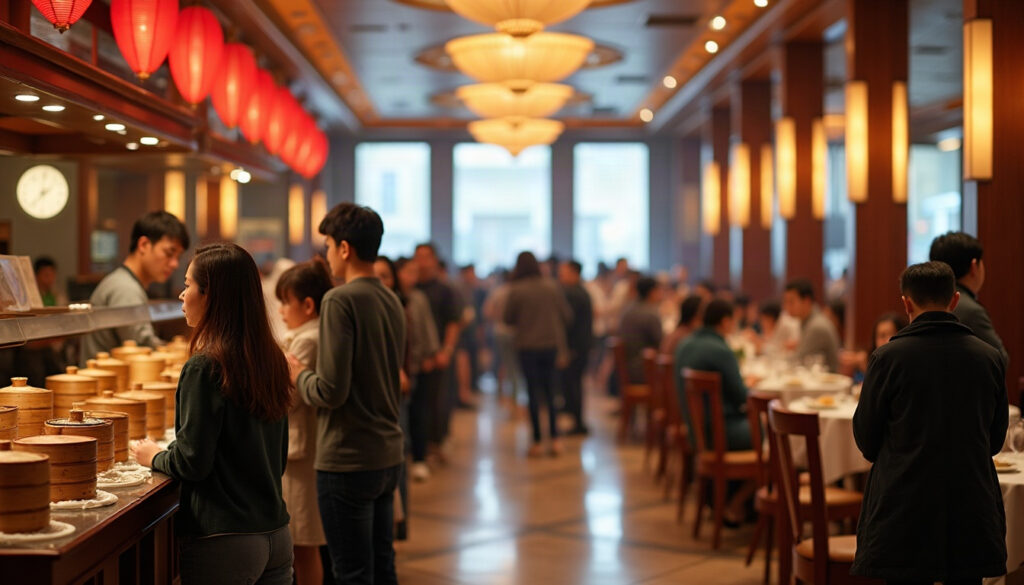
Richmond dim sum houses lose weekend guests at the door because the front door runs out of capacity before the kitchen does. At peak times, Metro Vancouver’s tourism bureau warns visitors, lineups of more than an hour are not unusual. One screen for the waitlist, the book and the floor keeps the family that would otherwise leave.
This is not a marketing problem. Your room is full, your name is known, and the line proves it. It is a capacity-and-queue problem, and the guest who gives up at 11 am is revenue that walks to the house next door.
At one of the Richmond dim sum guide’s top picks, phone reservations go to groups of six or more and not typically to smaller parties, so for most families there the lobby is the booking system. This article is about the front door: the waitlist, the booking call nobody can pick up at 11:30, and why dim sum reservations in Richmond, BC so often still run on paper. The carts, order slips and steamer timing are a separate conversation.
Summary
On this page
Because the demand is structural, not seasonal. Richmond counted 209,937 residents in the 2021 Census, and 54.3% of the population in private households identified as Chinese, and a Richmond dim sum travel guide describes the result as one of the most extraordinary Chinese food concentrations outside mainland China and Hong Kong. On a Saturday morning a large share of that population wants the same meal at the same hour, and yum cha with three generations at the table does not move to a Tuesday.
The peak is narrow and it is predictable. The guide puts the longest waits between 10 am and 1 pm on Saturday and Sunday, tells first-timers heading to its top two picks to arrive before 11 am on weekends or expect waits of 45 to 90 minutes, and at its top-ranked house calls weekend waits of 60 to 90 minutes normal without a reservation.
Metro Vancouver’s tourism bureau gives the same advice in fewer words: go early, because at peak times lineups of more than an hour are not unusual. Three hours of demand pressed against a room that can only turn its tables so many times in that window is arithmetic, not bad management.
Many of these rooms sit inside malls that pull their own weekend crowds. Aberdeen Centre alone lists 380,000 square feet with more than 160 stores, including eight full-service restaurants and an 800-seat food court, so a family that gives up on your lobby has somewhere else to spend the next hour without leaving the building.
You cannot add a second floor by Sunday. What you can change is how the queue is managed, how bookings get into the room, and whether the host stand can see both at once.
The mechanics are identical for a dim sum room in Vancouver or Burnaby. The figures above are Richmond’s, and yours will be your own, but the shape of the problem does not change: a hard weekend peak, a lobby full of families, and a phone that rings during the one hour nobody can answer it. If you want the wider context on the market, we keep a running count of how many restaurants are in Vancouver.
The Richmond guide notes that Sea Harbour takes phone reservations for groups of 6+, not typically for smaller parties, and that smaller parties should just arrive early on weekends. The rule is rational. A host stand with one phone and one paper book cannot promise a four-top at 11:15 without knowing how the room will look at 11:15, and taking a booking it cannot honour is worse than taking none.
The six-plus rule also protects the table mix. The large rounds are the scarce asset, so committing them to confirmed large parties is worth the phone time, while the smaller tables fill faster off the walk-in line. A paper book can carry a dozen large bookings a day. It cannot carry a hundred small ones, and it cannot tell the host at 11 am which of the noon bookings are still coming.
The cost of the rule is that at a house running it, every party under six becomes a walk-in by policy. The lobby is the booking system for most of those guests, and the lobby has no memory, no quote, and no way to tell a family of four that their table will be ready in 35 minutes and mean it. The policy is fine. The tooling behind it is the constraint, and that is the part that can change.
A family that leaves your line costs more than one table, because most guests will not wait past 30 minutes for a table. In a survey run by the food site Tasting Table (US data), over 80% of respondents wouldn’t wait more than 30 minutes for a table. A quoted wait of more than an hour is not a filter for patient guests. It is a filter that removes most of your demand before the host ever writes a name down.
The phone has its own arithmetic, and it is yours to run. Take one Saturday, count the booking calls that rang out between 10 am and 1 pm, and multiply by what a large-party table brings in at your house. A dim sum table for eight on a Sunday, with tea, a whole steamed fish and three generations on the bill, is not a small cheque, and the caller who could not get through has usually booked the next house by the time anyone at the stand is free to call back.
The guest who walks does not vanish. They walk to the next house, and in a city the guide describes as a Chinese food concentration on that scale, substitution is immediate. The family that gives up on your line at 11 am is pouring tea somewhere else by 11:30, and the house that seated them now has a shot at their next Sunday too.
The territory is not forgiving in 2026. Noms Magazine reports that at least 10 food spots across Richmond closed in early 2026. Rent in the malls dim sum houses share is real, and a Saturday peak has to carry the week. In 2023, in Vancouver’s Chinatown, Daisy Garden’s owner named a labour shortage across front-of-house, kitchen, chef and barbecue chef roles, with the dishwasher retiring too as the main reason for closing. The host stand is the one position on that list you can give to software.
See what Saturday's line is really costing you
Bring your busiest weekend: the paper list, the walk-aways, and the calls that rang out during the rush. We'll map it against your own host stand.
Show me my Saturday mathA digital waitlist is a queue that runs on a screen instead of paper: it gives each guest a quoted wait, notifies them when their table is ready, and shows the host each party’s position on one screen. Paired with a reservation book on the same screen, it changes what the host stand knows and what the guest believes.
Today most houses run three sources of truth on a Saturday: a paper reservation book for the big parties, a paper walk-in list for everyone else, and the floor itself. A digital waitlist and a reservation book on the same screen collapse those into one.
The table below walks through the six situations every Richmond dim sum host faces between 10 am and 1 pm. The right-hand column describes what a digital waitlist and reservations system does in general. Ask any vendor, Snappy included, to show you the guest notification and the live wait quote on a real Saturday before you sign.
| Weekend situation | How most houses handle it today | Digital waitlist plus reservations |
|---|---|---|
| Party of 4 arrives at 10:45 am | Name on a paper list, "about an hour", and the family waits in the lobby or gives up | The party joins a digital waitlist with a quoted wait and is notified when the table is ready; the host sees their position on the same screen as the floor |
| Party of 8 calls Thursday for Sunday | Booked into the paper book if someone picks up, then a note left for the weekend host | Booked into Snappy Reservation, which runs on the dashboard the floor already uses, so the Sunday host stand sees it with no handoff |
| Party of 6 calls at 11:30 am Saturday | Rings out or sits on hold while the host seats walk-ins; often never booked | Snappy AI Phone Reservations answers the call during the peak and books it into the same Reservation dashboard (requires Snappy Reservation) |
| Guest asks "how long?" at the door | A guess, repeated dozens of times an hour, that guests learn not to trust | A quoted wait from the waitlist that updates as tables turn, so the number at the door and the number on the screen are the same number |
| No-show on a 10-top booking | The round is held empty while the lobby is full; nobody notices until the booking time has passed | The booking and the walk-in list live on one screen, so the host can release the round to the next large party waiting |
| Host writes names on paper and shouts them | The lobby is the paging system; the family that stepped out to the mall misses its turn | Guests are notified when the table is ready and can wait anywhere in the mall or the parking lot instead of the lobby |
Two things in that table matter more than the rest. The first is the quote. Wait-time trust is a variance problem: the gap between the number the host says and the minute the family actually sits. A host reading from a live list can keep that gap small, where a host guessing from a paper sheet is repeating the same “about an hour” at 10:45 and at 12:15, and guests learn fast which houses’ quotes are worth believing. The second is the no-show row: on a Sunday, a ten-top held empty for 20 minutes is the most expensive piece of furniture in Richmond.
For a broader look at the category, see our comparisons of digital waitlist systems for restaurants and restaurant waitlist management systems.
Yes, and for a large-format house that is the whole point. Snappy lists Reservation & Waitlist as booking management on the dashboard the floor already runs on, with the digital waitlist alongside it, and reservation and waitlist data syncing into the same POS and dashboard. The problem Snappy names for that sync is bookings that never hit the dashboard and distort food and labour planning. Any dim sum operator who has prepped steamer baskets off a guess at Sunday’s covers knows exactly what that means.
Think about how a Sunday 12-top actually enters most rooms today. A weekday manager takes the call on Thursday, writes it in the book, and the Sunday host finds it, or does not. The kitchen never sees it at all, so the prep list is built from last week’s memory. When the book, the walk-in list and the floor are on the same screen, the booking exists for everyone who needs it the moment it is taken.
For a multi-room house this is also a control question. Two rooms, two host stands and one paper book means one stand is always working blind. One dashboard means the second room’s host can see the first room’s bookings and the shared waitlist, and can pull a waiting party into whichever room turns first. That is not more seats. It is more sittings out of the seats you already pay rent on.
We cover the wider stack in our guide to restaurant management systems with POS and reservations and, for the specific needs of a Chinese full-service room, our Chinese restaurant POS system guide.
They go somewhere else. At a dim sum house at 11:30 on a Saturday, the person who would answer the phone is seating a party of twelve, so the practical hold is however long it takes them to get back to the stand, if the caller is still there. Nobody measures that hold, because nobody is at the stand to measure it, and the caller does not leave a note saying where they booked instead.
Snappy’s own framing of the problem is that booking calls swamp the host stand exactly at peak, and that big venues respond by putting two to six people on phones. That is a labour answer to a bandwidth problem, in one of the roles Daisy Garden’s owner told Global News in 2023 she could not fill. Snappy’s alternative is Snappy Phone (AI), whose AI Phone Reservations brief lists Snappy Reservation as a prerequisite. Per that brief, it answers every concurrent booking call and books each one into the same Reservation dashboard the host stand is already looking at.
The prerequisite is the point, not a catch. The reservation platforms most full-service rooms already use manage bookings; as Snappy puts it, none of them answer the phone. An AI line that books into a separate system just moves the retyping to the host stand. One that books into the dashboard the floor runs on removes the step entirely. Snappy qualifies the product on call volume, with 10 or more calls a day qualifying and 50 or more calls a day on the reservations line described as a power user.
One practical question for this territory. Ask which languages the line answers in before you forward the phone, and ask to hear a recorded call.
It has to, because the host stand is only half the weekend. Dim sum’s labour problem is structural: many dim sum chefs working in New York City are in their 50s or 60s (US data), and the pipeline behind them is thin. One Toronto food writer traces how the city’s dim sum houses replaced cart service with paper order slips decades ago. That is Toronto’s history, not Richmond’s, and Richmond houses have made their own choices about carts, but the point stands: the paper slip is already a guest self-ordering system.
The QR order slip is the digital descendant of that paper slip. Snappy lists Order-from-Table as guests ordering from the table. Dine-in QR is tableside QR self-ordering and payment, on the same POS that the reservation and waitlist data syncs into. A family seated off the digital waitlist at 11:20 can be ordering har gow by 11:22 without a server walking the slip to the station, and paying without flagging anyone down when the room is at its loudest.
That matters for the front door because the turn is what sets the wait. Every minute a table waits to order, waits for a slip to be collected, or waits for a bill is a minute added to the quote the host gives the next family. The waitlist manages the queue. The order slip and the payment step shorten it. The rest of the kitchen-side story, from steamer timing to station labour, is its own article, and this one stops at the pass.
Richmond counted 209,937 residents in the 2021 Census, and 54.3% of the population in private households identified as Chinese, and Metro Vancouver’s tourism bureau warns that at peak times lineups of more than an hour are not unusual, with the guide putting the longest waits at the Saturday and Sunday 10 am to 1 pm peak. Demand is concentrated into three hours and the rooms cannot grow, so the queue is the release valve.
It depends on the house. One of the guide’s top Richmond picks takes phone reservations for groups of 6+, not typically for smaller parties. At a house running that rule, every smaller party goes to the walk-in line, which is why the waitlist matters as much as the reservation book.
A digital waitlist gives guests a quoted wait and can notify them when the table is ready, instead of holding them in the lobby. In a Tasting Table survey (US data), over 80% of respondents wouldn’t wait more than 30 minutes for a table, so a quote the guest trusts is what keeps them in your queue rather than someone else’s.
An AI reservations line answers every concurrent booking call and writes into the same reservation dashboard the host stand uses. The AI Phone Reservations brief for Snappy Phone (AI) lists Snappy Reservation as a prerequisite for exactly that reason, so the 11:30 am call gets booked without a human leaving the floor.
Yes. Snappy lists Reservation & Waitlist as a digital waitlist alongside reservations, with both syncing into the same POS and dashboard the floor runs on.
Richmond dim sum houses lose weekend guests because demand outruns the front door, not because anyone is doing a bad job. The Saturday and Sunday peak is 10 am to 1 pm, Metro Vancouver’s tourism bureau warns that at peak times lineups of more than an hour are not unusual, and at a house that books by phone mainly for six or more, the lobby is the booking system for most guests. A paper list cannot quote, cannot page, and cannot answer the phone.
The fix is not more seats. It is a digital waitlist that gives guests a quote they trust, a reservation book that lives on the same dashboard as the floor, and a phone line that gets answered at 11:30 without pulling the host off the stand. Every one of those keeps a family in your queue instead of sending them to the house next door, and in a year when at least 10 Richmond food spots have already closed, the house that seats its demand is the one that carries the week.
Snappy puts the waitlist, reservations and the floor on one screen, with an AI reservations line that books into the same dashboard, and has an office in Vancouver and a support team available seven days a week. If you run a dim sum room in Richmond, Vancouver or Burnaby and your Saturday still runs on a paper list, see reservations, waitlist and the floor on one screen. Bring your busiest Sunday’s numbers and we will walk through what the front door is costing you.
Book a walkthrough
Put your waitlist, bookings and phone on one screen
Walk through a Saturday peak at your host stand: the paper list, the booking calls, and the moment guests give up, mapped against your own numbers and your own phone line.
Written by
Wilson Wu
Chief Revenue Officer, Snappy
Wilson Wu is Chief Revenue Officer at Snappy, the restaurant technology company, and is based in Boston. His first job was in a restaurant kitchen, and he has spent his career since at the intersection of hospitality and software, working with operators across Canada on the systems their service runs on. He also builds the technology he writes about. His engineering work includes a per-location customer service agent that answers guests with a restaurant's real hours, menu and prices, deployed with independent restaurants, and a document-extraction model that reads supplier invoices and matches invoice numbers against what is owed. He writes here about what changes on a busy service: ordering, payments, loyalty, the phone, and the Canadian rules behind them. He holds an MBA from Duke University and a Master of Science in Computer Science from Georgia Tech.
Connect on LinkedInNo-obligation walkthrough
Stop losing guests at the door
See how a shared waitlist and reservation screen keeps your host stand from guessing wait times on a Saturday.
On this page
Get The Latest Restaurant Data, Trends & Tips