
Wilson Wu
Chief Revenue Officer, Snappy
September 19, 2026·15 min read
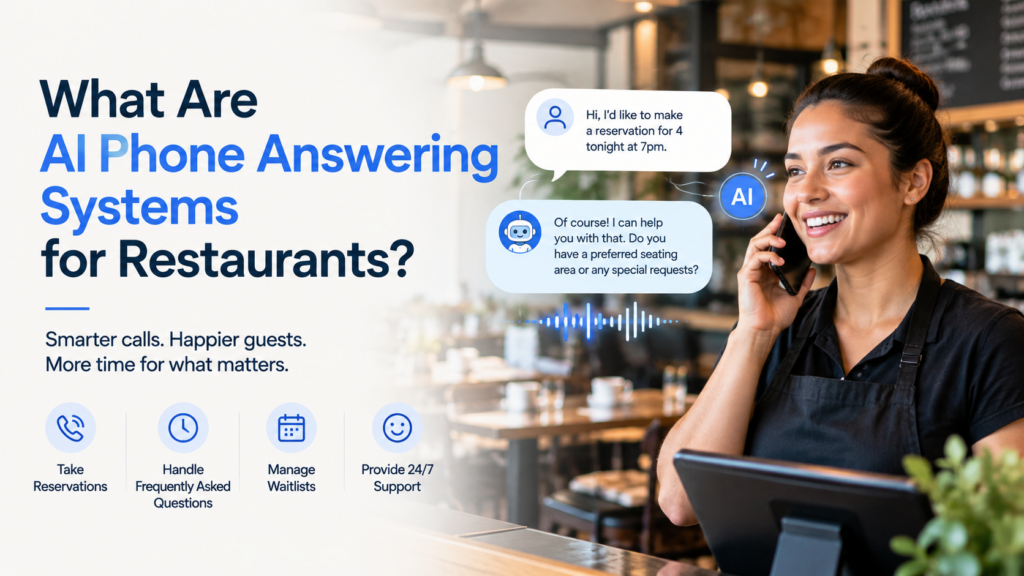
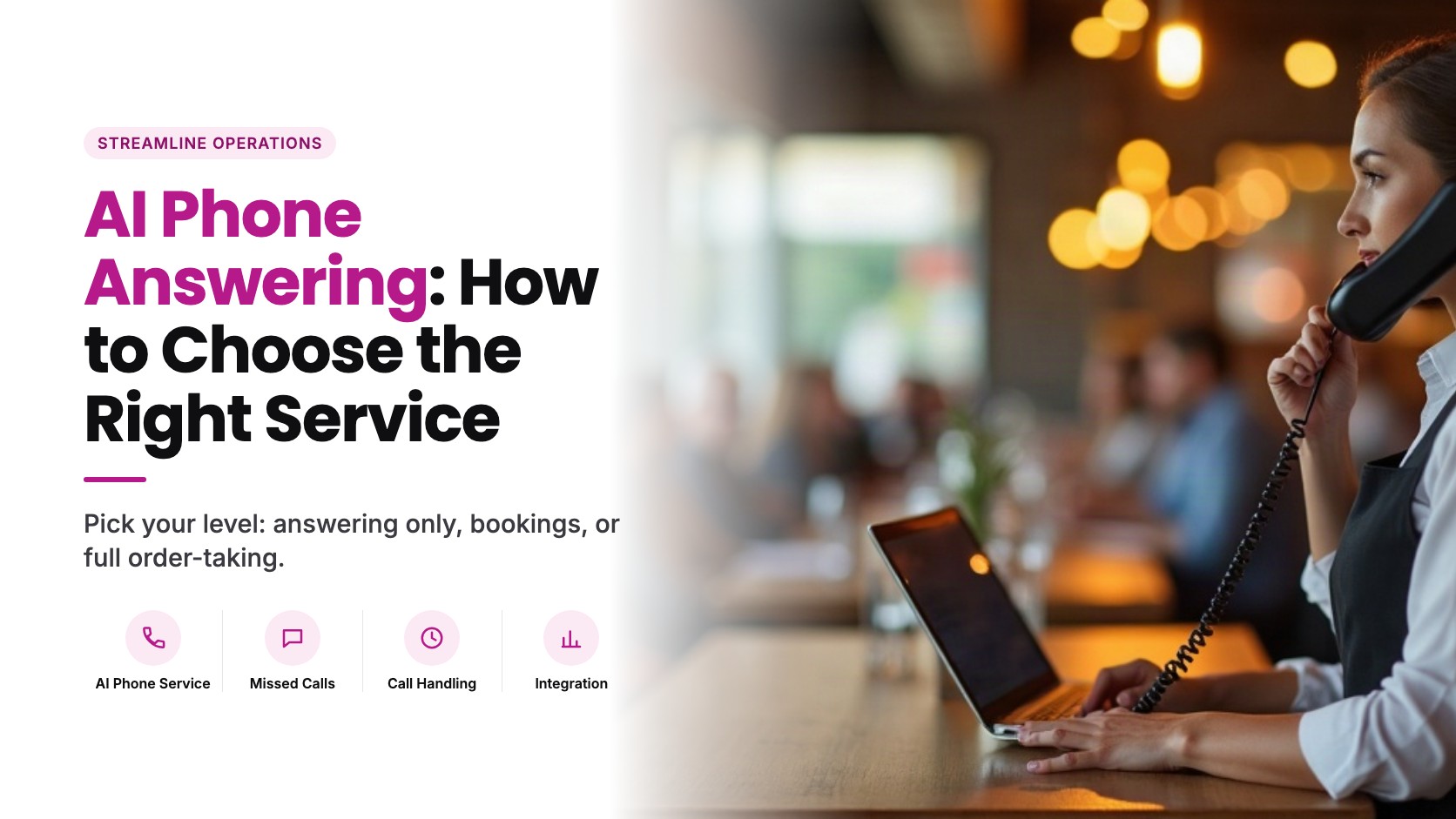
An AI phone answering service picks up every call your restaurant cannot, answers questions from your own information, and depending on the product, books the table or takes the order. Services differ on three things: what the AI may do on the call, whether it writes into your reservation book or POS, and whether the vendor shows a price before a sales call.
This is a real product category now, not a pilot. A 2026 report published by a voice-AI vendor and covered by US trade press, built from 12,091 restaurant call recordings, found that quick-service restaurants miss 40.1% of their calls (QSR Web, US data). Below is what these systems actually do, how the main types differ, and how to test one before it touches your busiest service.
Summary
On this page
Mechanically these products all work the same way, a mechanism our overview of what AI phone answering systems for restaurants actually are covers in full. You forward your restaurant line to a number the vendor provides, and a voice model answers on the first ring using a knowledge base you supply: hours, parking, menu, allergen policy, dress code, private dining rules. From there they diverge into three levels of authority.
Level one is answering. The AI responds to questions, then takes a message or routes to a human. Nothing is written anywhere, which makes it the lowest-risk starting point. Snappy’s AI Phone General Inquiries works this way: it answers every call from your own FAQ, with no other Snappy product required.
Level two is booking. The AI checks live availability and writes a reservation into your existing system. Some vendors do this through an integration with a third-party reservation platform; Snappy’s AI Phone Reservations books straight into the same Snappy Reservation dashboard the host stand runs on.
Level three is ordering. The AI takes a complete takeout order with modifiers, collects payment, and pushes the ticket into the POS. Snappy’s AI Phone Ordering takes the full order, collects payment up front through a link, and prints the ticket straight to the kitchen.
The level you need is not the level the demo shows you. It is the level your actual call mix demands.
A 2026 report estimates missed calls cost a quick-service restaurant about $73,000 USD a year, and a 50-location chain about $3.65 million USD; miss rates vary sharply by format, so start with your own segment rather than an industry average.
The most detailed public dataset we found is a 2026 report that analyzed 12,091 restaurant call recordings across quick service, fast casual, full service and pizza, published by a voice-AI vendor and covered by US trade press on August 24, 2026 (QSR Web, US data). Miss rates split sharply by segment.
QSR answered 59.9% of calls, a 40.1% miss rate. Fast casual missed 24.8% of its calls. Pizza restaurants answered 93.1%, the best answer rate in the industry per the report, which works out to a miss rate of 100 minus 93.1, or 6.9%.
The report estimates the QSR miss rate costs about $73,000 USD per location per year, or $3.65 million USD across a 50-unit chain (QSR Web, US data). The chain figure is the location figure times 50: 73,000 x 50 = 3,650,000. Treat both as the report’s estimate, not a forecast for your store. The study reached the market through US trade press; your call volume, your average ticket and your labour cost are the inputs that matter.
If your room takes reservations rather than takeout orders, do not quote the 40% number at yourself. The segment splits are the point, and the best answer rate in the report did not mean the best phone. Pizza restaurants picked up more calls than anyone and still made an upsell attempt on only 28.6% of them (QSR Web, US data). Your version of the phone problem may be what happens after somebody picks up, not whether anybody does.
Fast casual has yet another version of the problem: it falls apart at dinner. The report found wait times rose 31% from lunch to dinner in that segment, with performance across every metric deteriorating at the same time (QSR Web, US data). If your phone is fine at 2 PM and a disaster at 6:30 PM, that is the pattern an AI agent is best at fixing, because it never gets busy.
Before you shop, pull your own numbers: inbound, answered and abandoned calls by hour for one full week. Most business phone systems report this. Our breakdown of the cost of missed phone calls for restaurants walks through the same exercise.
There are four ways to buy a restaurant phone answering service, and they are not interchangeable. The differences show up in what gets written where, and in how many systems can break on a Saturday night.
| Approach | What it does on the call | Where the result lands | Failure points | Best fit |
|---|---|---|---|---|
| Missed-call text responder | Does not answer. When a call goes unanswered, the caller instantly gets an SMS with a link to order or book | Your online ordering page or reservation page, completed by the guest | One: the SMS has to arrive | Counter-service and takeout spots that already have online ordering and want the cheapest safety net |
| Answering-only voice agent | Answers on the first ring, handles questions from your FAQ, takes a message or routes to staff | Nowhere. No booking, no order | Knowledge-base gaps and accent handling | Any restaurant whose calls are mostly hours, parking, allergens and walk-in questions |
| Bolt-on booking or ordering agent | Answers, then books or orders through an integration with a third-party reservation platform or POS | Your existing reservation book or POS, via the vendor's integration | Two or three: the agent, the integration, the receiving system, each of which can fail independently | Restaurants committed to a reservation platform or POS they will not change |
| Snappy AI Phone Suite | Three SKUs: General Inquiries (no prerequisite), Ordering (requires Snappy Online Ordering), Reservations (requires Snappy Reservation). Missed-call SMS or full AI voice | The Snappy POS, Online Ordering and Reservation dashboard the floor already runs on | One: the Snappy system itself | Operators who want the phone, the register, the ordering site and the booking book from one Canadian vendor, with one support line |
Snappy’s product page describes both modes. In missed-call mode, an unanswered call triggers an automated SMS that links to online ordering or reservations, and the guest completes the action with no staff involved. In AI voice mode, the assistant answers immediately, guides the guest to the right next step, and the call is completed or routed to staff on request (Snappy).
The right row for you depends on volume as much as format. A useful threshold: from about ten calls a day an AI agent is worth pricing out, and from thirty to fifty or more ordering calls a day, or fifty or more booking calls, you are into full-suite territory rather than the text responder.
How Many Calls Is Your Phone Dropping?
Bring your call log and we'll go through it with you, hour by hour: which calls you're catching, and which ones are slipping through.
Show Me My Missed CallsBuy against your call mix: calls that are mostly questions need answering only, calls that are mostly bookings need write-back into your reservation system, and calls that are mostly orders need POS write-back with payment capture on the call. Sort one week of calls into these three buckets and the right capability declares itself.
If most calls are questions about hours, parking, allergens or walk-ins, you need answering only, the same walk-in territory our guide to the best restaurant waitlist management systems covers. It is the cheapest tier everywhere and the least risky, because the AI is never authorized to change anything. Snappy sells this as AI Phone General Inquiries with no other product required, which makes it the natural first step.
If most calls are bookings, you need write-back into whatever holds your covers. This is the fine-dining case, and where the highest-value calls live: large parties, private dining, anniversaries, allergy notes. Those are exactly the callers a voicemail box loses, and they are the calls a host stand with two people on the phones at 7 PM cannot take.
If most calls are orders, you need POS write-back and payment capture on the call. Every phone order that arrives unpaid carries no-show risk: the kitchen makes it, the driver is dispatched, and the guest never shows. Snappy’s AI Phone Ordering collects payment through a link before the ticket prints, which removes that risk by design.
One more filter. If the AI takes an order but cannot collect payment, you have automated the order and kept the no-show risk. Ask specifically how payment is handled before the ticket reaches the kitchen.
If your AI receptionist only books or orders and a human retypes it, you have added a step, not removed one. Write-back is the whole product.
The practical question is how many systems sit between the caller and the ticket. A bolt-on agent that books into a third-party reservation platform, which syncs to your table management, which does not talk to your POS, is three integrations that can each fail independently on a Saturday night. Vendors that publish a list of supported POS and reservation systems are being more honest than vendors who say “integrates with everything”, but a list is still a list of integrations.
The alternative is a phone agent already inside the system it writes to. Snappy’s AI Phone Reservations books into the same Reservation and Waitlist dashboard the host stand runs on, and AI Phone Ordering routes through Snappy Online Ordering into the kitchen. That is why those two SKUs carry a prerequisite: they are not integrations, they are the same product.
Ask every vendor three questions in writing. Which exact version of my POS is supported. What happens to a call when the integration is down. Who owns the call recordings and the guest data. For how this fits the rest of the stack, see our guide to restaurant POS systems with AI integrations and features.
Never point 100% of your line at a new AI phone service on day one. Stage it.
Day zero, call the demo lines. Before you forward anything, phone the vendor’s own agent and try to break it. Snappy runs four live demo numbers you can call right now: General Support +1 647 496 1372, Reservation +1 289 276 8745, Pizza AI Ordering +1 289 301 4075, and Waitlist +1 289 278 8978. Ask about a nut allergy. Change your mind halfway through an order. Speak with an accent. Ten minutes on the phone tells you more than an hour of slides.
Week one, after-hours only. Forward calls that arrive when you are closed. There is no downside case: those calls currently go to voicemail. You get a clean read on comprehension, accent handling and how the AI behaves when a caller asks something the knowledge base does not cover.
Week two, overflow only. Route calls that ring more than four times or arrive while the line is busy. Your team still answers everything it can; the AI only catches what would have been lost.
Week three, listen to the recordings. Not the dashboard, the recordings. Pull twenty calls: five bookings, five orders, five questions and, most importantly, five where the caller got frustrated or hung up. The 2026 study is a useful warning here. Its AI-versus-human benchmark covered only 224 AI-answered calls against 9,187 human-answered ones, and it found that poorly configured AI agents underperformed humans on caller sentiment, 3.30 against 3.90, while properly configured ones beat them with 4.2 or higher (QSR Web, US data). Configuration is the product. Verify, do not assume.
Two questions then settle it: did the AI handle the calls your staff would have handled, and did it capture calls your staff would have lost. Ask every vendor for a pilot window and a month-to-month term during it.
Expect a custom quote, not a published price: nearly every vendor in this category, Snappy included, prices per call, per minute, or per location, and the metering model, billing currency and any prerequisite subscription decide whether that quote is a good one.
First, the metering model. Some vendors charge per call, some per minute, some per location with an included usage allowance and an overage rate above it. A per-minute plan is the wrong shape for a restaurant whose callers ask long questions about the menu. A per-call plan punishes a busy pizza night. Ask for the model in writing and ask what a month at double your current volume would cost.
Second, the billing currency. If you are in Canada, confirm whether the quote is in Canadian or US dollars and whether the rate is fixed. If the vendor is US-based, get that in writing rather than assuming it. Snappy supports restaurants from offices in Toronto, Vancouver and Montréal.
Third, the prerequisite. A bolt-on agent needs your reservation platform or POS to be on its supported list, which may mean a second subscription. Snappy’s Ordering and Reservations SKUs require Snappy Online Ordering and Snappy Reservation respectively; General Inquiries requires nothing.
Payback is one division problem, and you should run it with your own numbers rather than an industry average. Take the monthly fee from the quote and divide it by your average phone order or the value you place on a booked table. As an illustration only, and not a Snappy price: take a hypothetical $300 CAD monthly fee divided by a $40 CAD average phone order, which is 300 / 40 = 7.5, so the service breaks even on the eighth recovered order in a month. Substitute your own ticket and your own quote.
Then instrument the pilot so the number is real: recovered calls, reservations booked by the AI, orders completed by the AI, and average ticket on AI-taken orders versus staff-taken ones. If your restaurant misses even a fraction of what the 2026 study measured for its segment, eight orders a month is a low bar. It is only low if you measure it.
Most vendors, Snappy among them, do not publish a list price. The number that matters is the metering model: per call, per minute, or per location with an included usage allowance and an overage rate. Get that in writing, along with the billing currency, before you compare two quotes.
Yes, but only on the tiers built for it, and only when the agent writes into your POS. Snappy’s AI Phone Ordering requires Snappy Online Ordering, takes the complete order, collects payment up front through a link, and prints the ticket straight to the kitchen. Whatever vendor you consider, ask how payment is captured before the ticket reaches the kitchen.
It depends on what you authorize it to do and how well it is configured. The 2026 study’s warning is about configuration, not category: poorly configured AI agents scored 3.30 on caller sentiment against 3.90 for human staff, while properly configured ones scored 4.2 or higher (QSR Web, US data). Configure the AI for overflow and after-hours first, keep human handoff on request, and listen to real recordings before widening its scope.
Not for basic answering. An inquiries-only agent works from your own FAQ and needs nothing else, which is why Snappy sells AI Phone General Inquiries with no prerequisite. Booking and ordering are different: the AI has to write into something. Snappy’s AI Phone Reservations requires Snappy Reservation and books into that same dashboard.
Yes. Call the vendor’s demo line and try to confuse it before you sign anything. Snappy’s four demo numbers are General Support +1 647 496 1372, Reservation +1 289 276 8745, Pizza AI Ordering +1 289 301 4075 and Waitlist +1 289 278 8978. Then pilot after hours, where a missed call already goes to voicemail and there is nothing to lose.
AI phone answering stopped being experimental in 2026. A 2026 report built from 12,091 restaurant call recordings found quick-service restaurants missing four calls in ten in the US study, and it found that a well-configured AI agent beats human staff on caller sentiment while a badly configured one loses to them. Configuration, not the category, decides the result.
Pick on three criteria: what the AI is allowed to do, whether it writes into the system your floor already uses, and whether the vendor shows you a price and a metering model before a sales call. If you would rather not stitch a phone agent to a POS to a booking tool across three vendors, Snappy puts all three on one system, with one vendor and one support line, and offices in Toronto, Vancouver and Montréal.
Whatever you choose, pilot after hours first and read the transcripts. The dashboard will tell you the AI answered every call. Only the recordings tell you whether it answered them well.
Want to see what your phone is actually costing you, and what an AI phone agent would recover on your call volume? Talk to our team.
Book a walkthrough
Hear What an AI Phone Agent Would Say to Your Callers
Book a walkthrough of your own call mix: the questions, the bookings, the orders, and where you'd want an AI agent to stop and hand off to your team.
Try it now: Pizza AI Ordering +1 289 301 4075 · Reservation +1 289 276 8745 · Waitlist +1 289 278 8978 · General Support +1 647 496 1372
Written by
Wilson Wu
Chief Revenue Officer, Snappy
Wilson Wu is Chief Revenue Officer at Snappy, the restaurant technology company, and is based in Boston. His first job was in a restaurant kitchen, and he has spent his career since at the intersection of hospitality and software, working with operators across Canada on the systems their service runs on. He also builds the technology he writes about. His engineering work includes a per-location customer service agent that answers guests with a restaurant's real hours, menu and prices, deployed with independent restaurants, and a document-extraction model that reads supplier invoices and matches invoice numbers against what is owed. He writes here about what changes on a busy service: ordering, payments, loyalty, the phone, and the Canadian rules behind them. He holds an MBA from Duke University and a Master of Science in Computer Science from Georgia Tech.
Connect on LinkedInNo-obligation walkthrough
What Are Your Missed Calls Costing You?
Bring your call log and we'll show you which calls you're missing during the rush.
On this page
Get The Latest Restaurant Data, Trends & Tips